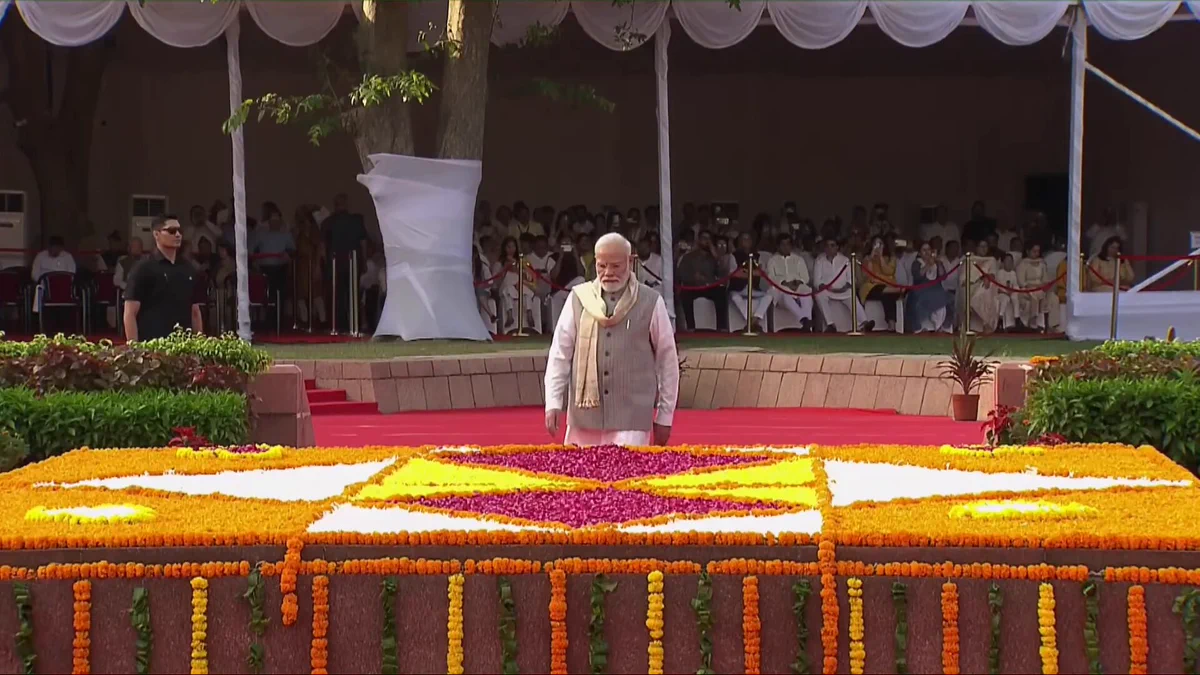
NEW DELHI — Prime Minister Narendra Modi paid floral homage to former Prime Minister Shri Lal Bahadur Shastri at Vijay Ghat on Friday, October 2, 2026, marking the late leader’s 122nd birth anniversary. Commemorating Shastri’s legacy of rock-firm resolve and utter simplicity, PM Modi highlighted his enduring inspiration for 1.4 billion Indians.
“Homage to Lal Bahadur Shastri Ji, whose simplicity and dedication to the nation remain deeply inspiring.”
In an official communication issued through the Prime Minister’s Office (PMO) and his personal social media handle on X, PM Modi emphasized that Shastri Ji’s gentle personality fills every citizen with pride, while his determination in times of national defense and food scarcity served as a bedrock for modern India.
Prime Minister’s Morning Visit to Vijay Ghat Memorial
Early on Friday morning, Prime Minister Modi arrived at Vijay Ghat, the official memorial dedicated to Lal Bahadur Shastri situated along the banks of the Yamuna River in the national capital. The Prime Minister offered fresh flowers, bowed in solemn silence, and joined national dignitaries to honor the former leader.
The ceremony took place concurrently with nationwide commemorations marking October 2, a date shared with the birth anniversary of Mahatma Gandhi. Union Cabinet Ministers, senior officials from the Ministry of Culture, and leaders across political parties gathered at Vijay Ghat and Rajghat to reflect on the dual legacies of peace, self-reliance, and integrity.
The Immortal Slogan: “Jai Jawan, Jai Kisan” and Its Modern Relevance
Born on October 2, 1904, in Mughalsarai, Uttar Pradesh, Lal Bahadur Shastri became India’s second Prime Minister in June 1964 during a critical epoch defined by severe grain shortages and national security threats. His iconic call—“Jai Jawan, Jai Kisan” (Hail the Soldier, Hail the Farmer)—brought together the military defending India’s borders during the 1965 India-Pakistan War and the agricultural workers securing national food reserves.
| LEGACY OF LAL BAHADUR SHASTRI (1904–1966) |
|---|
|
Shastri’s strategic directions laid the groundwork for both the Green Revolution and the White Revolution (Amul cooperative movement via the National Dairy Development Board – NDDB), transforming India from a food-aid dependent state to a major exporter. Modern policy frameworks, such as Atmanirbhar Bharat (Self-Reliant India) and enhanced defense manufacturing corridors, draw direct inspiration from Shastri’s early self-reliance mandates.
Highlighting Shastri Ji’s “Firm Resolve” Amid Global Crises
In his tribute, PM Modi underscored that while Shastri Ji possessed a quiet and humble demeanor, his leadership in crisis was “firm like a rock”. During the 1965 war, Shastri’s swift decision-making reaffirmed India’s sovereignty despite international economic pressures and severe domestic grain rationing.
The tribute comes at a time when global supply chain disruptions and geopolitics have pushed nations toward localized food security and strong border readiness. Government bodies, including the Indian Council of Agricultural Research (ICAR) and the Ministry of Defence, routinely cite Shastri’s vision as an operational benchmark for contemporary food and border management strategies.
Frequently Asked Questions (FAQs)
What is the significance of Lal Bahadur Shastri Jayanti 2026?
Lal Bahadur Shastri Jayanti 2026 marks the 122nd birth anniversary of India’s second Prime Minister, who was born on October 2, 1904. It is celebrated across India to honor his leadership during the 1965 war and his push for self-reliance in agriculture and national defense.
Where did PM Modi pay tribute to Lal Bahadur Shastri on October 2?
Prime Minister Narendra Modi paid homage to Lal Bahadur Shastri at Vijay Ghat in New Delhi. He offered floral tributes at the official memorial before sharing a message on X highlighting Shastri Ji’s simplicity and firm resolve.
Who coined the famous slogan “Jai Jawan, Jai Kisan”?
Lal Bahadur Shastri coined the immortal slogan “Jai Jawan, Jai Kisan” in 1965 during a public gathering at Ramlila Maidan in Delhi. The slogan aimed to boost the morale of Indian soldiers defending the nation and farmers overcoming severe food grain shortages.
How did Lal Bahadur Shastri contribute to India’s food security?
Lal Bahadur Shastri initiated national policies that directly led to the Green Revolution and the White Revolution. He promoted the National Dairy Development Board (NDDB) and encouraged modern farming technologies to reduce India’s reliance on foreign grain imports.
What message did PM Modi share about Lal Bahadur Shastri on X?
PM Modi posted on X: “Homage to Lal Bahadur Shastri Ji, whose simplicity and dedication to the nation remain deeply inspiring.” He further noted that Shastri Ji’s gentle personality fills every Indian with pride, while his determination was rock-firm.
Analytical Summary & Long-Term Implications
The annual commemoration of Lal Bahadur Shastri by Prime Minister Narendra Modi at Vijay Ghat reinforces the central tenets of modern Indian governance—self-sufficiency, ethical leadership, and national defense. By aligning current national initiatives like PM-KISAN, defense indigenization, and agricultural technology integration with Shastri’s foundational ethos, the administration highlights a continuity of policy focused on resilience.
As India progresses toward its development goals for 2047, the lessons of Shastri’s brief yet powerful tenure (1964–1966) serve as an enduring framework. His life demonstrates that modesty and unwavering resolve can coexist to steer a nation through complex military and economic crises, ensuring his place as one of independent India’s most revered statesmen.

Manish Kumar began his professional journey in digital marketing and performance marketing, and currently works as a Digital Marketing Excutive and SEO expert. With over 3 years of professional experience, he handles both strategy and execution. Currently, he manages digital marketing and performance marketing at ‘Shabd Sanchi’ (shabdsanchi.com).