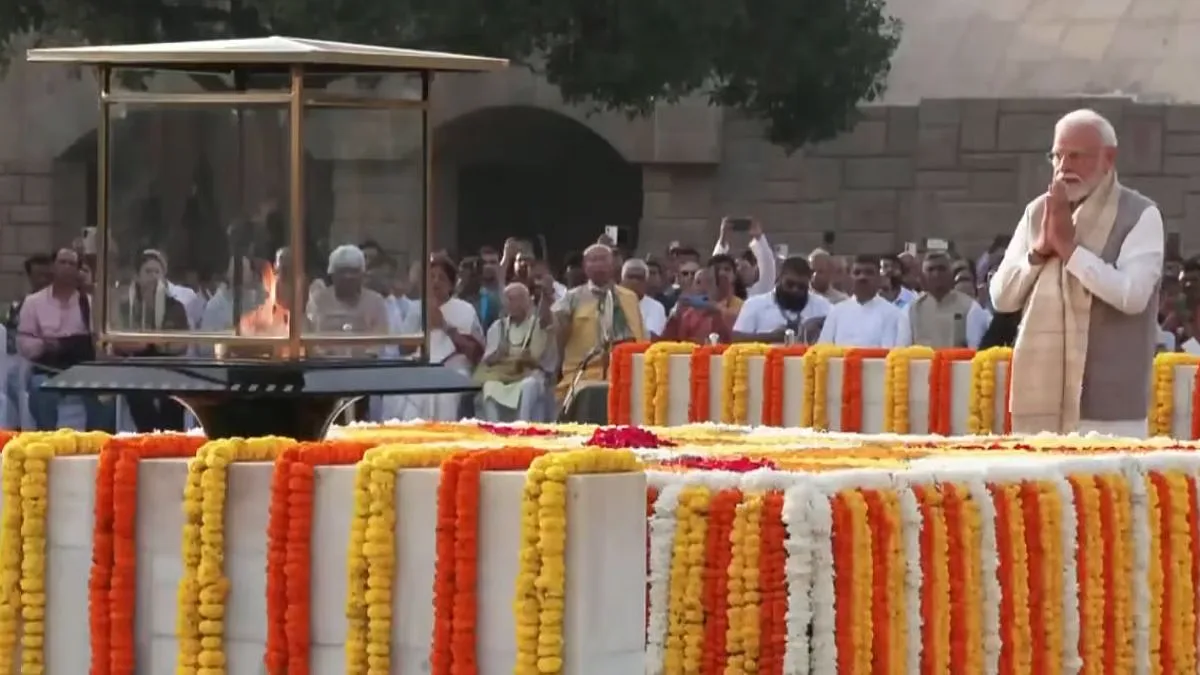
Prime Minister Narendra Modi paid homage to Mahatma Gandhi on October 2 on his birth anniversary, reiterating the enduring relevance of Bapu’s philosophy for global humanity. Highlighting the imperative of self-reliance, the Prime Minister made a direct appeal to citizens nationwide to purchase at least one Khadi product today to strengthen the Swadeshi movement.
The Swadeshi Imperative: Aligning Bapu’s Vision with Viksit Bharat
In an official statement issued on October 2, 2026, Prime Minister Narendra Modi stressed that Mahatma Gandhi’s core principles continue to inspire societies globally as long as human values remain interconnected. He noted that adopting local products—specifically hand-spun textiles—serves as a foundation for economic independence and sustainable development.
“May Bapu’s timeless message keep guiding us towards a better society and a Viksit Bharat,” Prime Minister Narendra Modi stated.
The Prime Minister emphasized that among all native industries, Khadi stands as the foremost symbol of self-reliance and national pride. By urging every citizen to incorporate indigenous manufacturing into their daily consumption, the government aims to bridge traditional heritage with modern economic self-sufficiency.
SWADESHI TO VIKSIT BHARAT FRAMEWORK
▼
▼
▼
Economic Impact of the Khadi and Village Industries Push
The call to prioritize Swadeshi products aligns with national economic priorities overseen by the Khadi and Village Industries Commission (KVIC) and the Ministry of Micro, Small and Medium Enterprises (MSME). Over the last decade, official government records indicate a unprecedented expansion in indigenous craft sales, empowering rural artisans, women entrepreneurs, and handloom weavers across tier-2 and tier-3 regions.
| ECONOMIC BENEFITS OF SWADESHI ADOPTION | |
|---|---|
| Key Focus Area | Direct Impact |
| Rural Artisan Support | Direct income generation for millions of weavers and spinners |
| Micro-Enterprise Growth | Boosts cottage industries and localized supply chains |
| Environmental Sustainability | Low-carbon footprint through hand-spun, organic textiles |
| Foreign Exchange Savings | Reduced dependency on imported fast-fashion commodities |
By encouraging citizens to actively select Swadeshi alternatives, the government seeks to convert festive seasonal demand into sustained market opportunities for domestic producers. The symbolic gesture of buying a single Khadi garment or artifact on October 2 acts as an entry point for deeper consumer participation in national industrial growth.
Global Relevance of Gandhi’s Ideals in Contemporary Policy
Addressing the international significance of Mahatma Gandhi’s legacy, the Prime Minister asserted that Bapu’s ideas offer solutions to modern global challenges, ranging from environmental degradation to economic inequality.
“Mahatma Gandhi’s thoughts have inspired the entire world and continue to remain relevant as long as their flow remains connected with humanity,” Shri Modi highlighted.
Policy analysts view this statement as a reinforcement of India’s stance on sustainable living and decentralized economic development. Integrating Swadeshi habits directly supports the international agenda on sustainable consumption while anchoring national development in local production capabilities.
Frequently Asked Questions (FAQs)
What was PM Narendra Modi’s main message on Gandhi Jayanti?
Prime Minister Narendra Modi paid rich tributes to Mahatma Gandhi on his birth anniversary, calling upon the nation to embrace Swadeshi values and buy at least one Khadi product to help realize a Viksit Bharat.
Why is Khadi given special emphasis on October 2?
Khadi was central to Mahatma Gandhi’s Swadeshi movement for economic freedom. Buying Khadi on October 2 honors his memory while providing immediate livelihood support to rural weavers and small artisans across India.
How does promoting Swadeshi contribute to Viksit Bharat?
Promoting Swadeshi strengthens domestic manufacturing, reduces import reliance, generates rural employment, and fosters self-reliance, forming the economic backbone required to transform India into a developed nation (Viksit Bharat).
What agency oversees the development of Khadi in India?
The Khadi and Village Industries Commission (KVIC), operating under the Ministry of Micro, Small and Medium Enterprises (MSME), is the statutory body responsible for planning, promoting, and implementing Khadi and rural industry development programs.
Where can citizens purchase authentic Khadi products?
Citizens can purchase certified Khadi items at official Khadi India outlets, recognized state handloom emporiums, or through the official digital portal managed by the Khadi and Village Industries Commission (KVIC).
Analytical Conclusion & Future Outlook
Prime Minister Narendra Modi’s renewed call for Swadeshi on Gandhi Jayanti marks a strategic blending of historical symbolism with modern industrial policy. By linking consumer habit changes directly to the macro vision of Viksit Bharat, the administration aims to turn individual purchases into driver metrics for national economic resilience.
Moving forward, the success of this initiative will rely on sustained policy support for small-scale manufacturers, digital integration of traditional weaver networks through KVIC, and competitive positioning of local textiles against global brands. As India advances its long-term development strategy, integrating grassroots Swadeshi production into global supply chains remains pivotal for enduring, self-reliant growth.

Manish Kumar began his professional journey in digital marketing and performance marketing, and currently works as a Digital Marketing Excutive and SEO expert. With over 3 years of professional experience, he handles both strategy and execution. Currently, he manages digital marketing and performance marketing at ‘Shabd Sanchi’ (shabdsanchi.com).