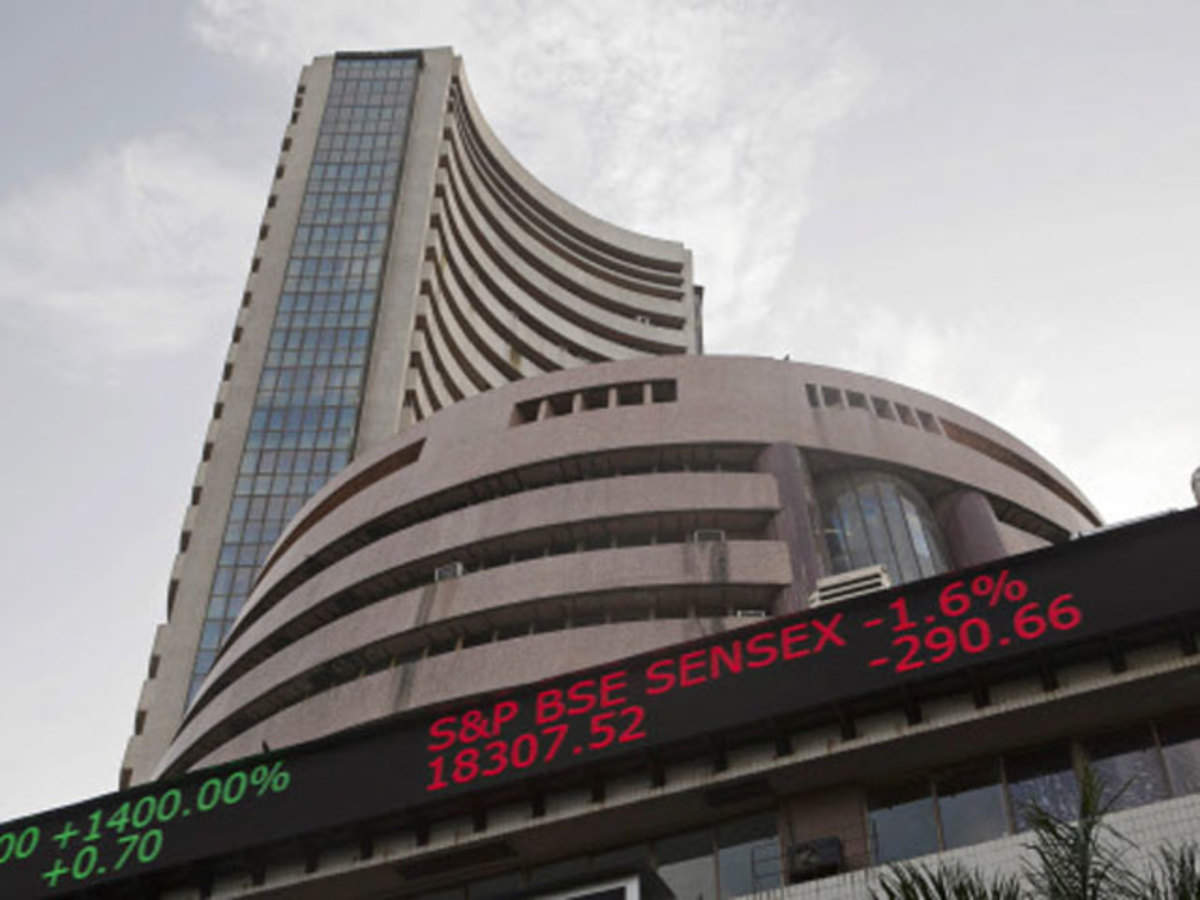
The record-breaking five-day rally in the Indian stock market finally ground to a halt on Friday, June 19, 2026. Following a full-year revenue growth guidance cut by global IT consulting giant Accenture, widespread selling erupted across domestic bourses. The IT sector bore the brunt of the onslaught, single-handedly dragging Dalal Street’s overall market sentiment into the red.
This heavy wave of profit booking caused the benchmark Sensex to lose over 600 points, while the Nifty 50 closed below the crucial 24,050 mark.
The Market Breakdown: Key Numbers from Friday’s Crash
Signs of weakness were visible right from the opening bell in Friday’s trading session. The 30-share BSE Sensex tumbled 607.08 points, or 0.78%, to close at 76,802.90. However, fueled by panic selling during intraday trade, the index had cratered by up to 940.26 points (1.21%) to hit a low of 76,469.72.
Simultaneously, the National Stock Exchange (NSE) benchmark Nifty 50 shed 154.90 points, or 0.64%, ending the day at the 24,013.10 mark.
Key Takeaway: While large-cap equities and prominent IT heavyweights experienced sharp declines, broader market confidence remained resilient. The Nifty Smallcap 100 edged up 0.4%, and the Nifty Midcap 100 rose 0.2%, indicating that the correction was sector-specific rather than structural across the entire economy.
The Core Trigger: Accenture’s Guidance Cut and Its Domino Effect
The primary catalyst for this crash was the earnings report of global IT consulting heavyweight Accenture. Accenture’s stock slumped up to 18% in the US markets on Thursday night, setting off immediate alarm bells for Indian tech firms on Friday morning.
Accenture lowered its fiscal year 2026 revenue growth forecast from 3%–5% down to 3%–4% in local currency terms. The company cited a slowdown in its US federal government business and a tightening of IT budgets by corporate clients worldwide.
Given that Indian tech bellwethers like Tata Consultancy Services (TCS), Infosys, and Wipro derive a massive chunk of their revenue from North American and European enterprise clients, Accenture’s muted outlook served as a direct warning signal for the domestic outsourcing sector.
Read Also: From Rented Sets to Owning a Mega Studio: Bharti Singh’s Emotional Journey
4 Key Reasons Behind the Stock Market Crash Today
The sudden downtrend in Indian markets on Friday can be traced back to four prominent market pressures:
1. Discretionary Tech Spend Squeeze
Global corporations are strictly prioritizing essential operational maintenance over transformation. Clients are putting discretionary projects—such as massive cloud migrations and digital overhauls—on the back burner. According to Morgan Stanley analysts, while companies are expanding investments in Artificial Intelligence (AI), this capital is being carved out of traditional IT allocations, shrinking the core pipeline for Indian vendors.
2. Profit Booking After 5-Day Winning Streak
Prior to Friday, the Sensex and Nifty 50 had put together a stellar five-session winning streak, pushing both indices near historic peaks. The negative macro cue from Accenture gave short-term traders and institutional funds a clear excuse to lock in gains and trim large-cap equity exposure.
3. Geopolitical Friction and Global Risk-Off
Uncertainties on the diplomatic front further strained investor risk appetite. Sudden roadblocks in international diplomatic dialogues and escalating geopolitical frictions in the Middle East fueled a macro “risk-off” mood. Accenture CEO Julie Sweet also highlighted in her commentary that regional conflicts had roughly a $100 million impact on their quarterly revenue considerations.
4. Persistent FII Selling Pressure
Foreign Institutional Investors (FIIs) have maintained a steady net-selling stance in the domestic equity market. Even on June 18, FIIs pulled out over ₹1,025 crore from cash equities. While Domestic Institutional Investors (DIIs) attempted to counter the trend with a robust net purchase of ₹3,516 crore, the global IT sell-off amplified supply pressure beyond domestic absorbency.
Technical Analysis: Crucial Support and Resistance Levels for Nifty 50
Market technicians point out that the Nifty 50 closing just above the psychological floor of 24,000 will dictate the directional trend for the coming sessions.
| Index / Parameter | Immediate Support | Immediate Resistance | Next Crucial Zone |
| Nifty 50 | 23,900 | 24,050 | 23,800 (Breakdown Warning) |
| Nifty Bank | 57,500 | 57,800 | 57,200 (Consolidation Support) |
| Nifty IT Index | 26,000 | 28,000 | 25,500 (Multi-Month Low) |
The 23,800 to 23,900 range represents a formidable consolidation base for the Nifty. If the index breaks and closes below 23,800, technical structures could sustain deeper damage. Conversely, unless the Nifty convincingly crosses and holds above 24,200, overhead supply will likely trigger selling on every bounce.
Read Also: SSC Delhi Police Constable Result 2026 Out: Check Category-Wise Cut Off & Direct PDF Link
Investor Strategy: Should You Buy the Dip in Indian IT?
The Nifty IT index plunged over 3.7% to settle at 26,886 on June 19, touching a fresh 52-week intraday low of 26,634. The sector index has corrected approximately 32% from its previous multi-year peak of 39,530 reached in late 2025.
Global brokerage operations at Citi and Nomura suggest that growth headwinds for Indian IT vendors could linger through the first half of fiscal year 2027 (April–September 2026). Retail investors should deploy a measured strategy:
- Avoid Aggressive Bottom-Fishing: Do not rush to buy the dip blindly in hopes of a swift V-shaped recovery. Q1FY27 corporate earnings reports from TCS and Infosys are due in July; watching their management commentary on pipeline conversion is critical.
- Utilize the SIP Route: For long-term portfolios (3–5 year horizon), staggering investments via systematic investment plans (SIPs) in cash-rich, large-cap balance sheets like TCS, Infosys, or HCL Tech remains a sound accumulation approach.
- Pivot to Defensive Elements: During periods of software export cyclicality, defensive allocations in pharmaceuticals, healthcare, and defense manufacturing can offer much-needed portfolio stability.
Conclusion
The market correction on June 19, 2026, is an isolated macro-driven reaction to a global sector warning rather than a structural failure within the domestic economic framework. Accenture’s guidance revision proves that the road to recovery for global technology spending will take longer than initially modeled. Investors should approach this volatility with discipline, prioritizing quality assets and robust cash flows over speculative trades.
Frequently Asked Questions (FAQs)
Q1: How much did the Sensex and Nifty decline on June 19, 2026?
The BSE Sensex dropped 607.08 points (0.78%) to end at 76,802.90, while the NSE Nifty 50 fell 154.90 points (0.64%) to close at 24,013.10.
Q2: What triggered the sudden sell-off in Indian IT stocks?
Global IT leader Accenture reduced its full-year revenue growth guidance from 3%–5% down to 3%–4%. This renewed worries regarding a protracted enterprise spending slowdown, depressing sentiment across the Indian IT outsourcing ecosystem.
Q3: Which major IT stocks lost the most ground during the crash?
Infosys emerged as the top loser, sliding 6.50% in the session. Other prominent tech majors also suffered, with TCS shedding 3.06%, Tech Mahindra down 2.33%, and HCL Tech falling 2.23%.
Q4: Did any sector manage to close in the green during this market drop?
Yes. Despite pressure on large-cap components, the mid-cap and small-cap indices closed higher. Defensives like pharmaceuticals, healthcare, and select defense enterprise counters also showed relative strength.
Q5: What are the key technical support levels to watch for the Nifty 50?
The immediate technical cushion is located at the 23,900 mark, while the defining structural support level rests around the 23,800 zone.
For more information, follow Shabdsanchi‘s social media pages today and stay updated.
- Facebook: shabdsanchi
- Instagram: shabdsanchiofficial
- YouTube: @shabd_sanchi
- Twitter: shabdsanchi