New Delhi has fiercely condemned the recent Pakistan airstrike on Kabul hospital, categorically rejecting Islamabad’s military justification. The Ministry of External Affairs termed the devastating attack, which reportedly killed hundreds at a rehabilitation facility, a “massacre dressed as a military operation.” The incident highlights severe violations of Afghan sovereignty and escalating regional instability.
India’s Strong Diplomatic Response
The Ministry of External Affairs (MEA) issued a strongly worded statement on Tuesday regarding the escalating violence in the region. Indian diplomats did not mince words, describing the targeting of a medical facility as a cowardly and unconscionable act of violence. The official communication made it unequivocally clear that a civilian hospital can never be justified as a legitimate military target under any operational pretext.
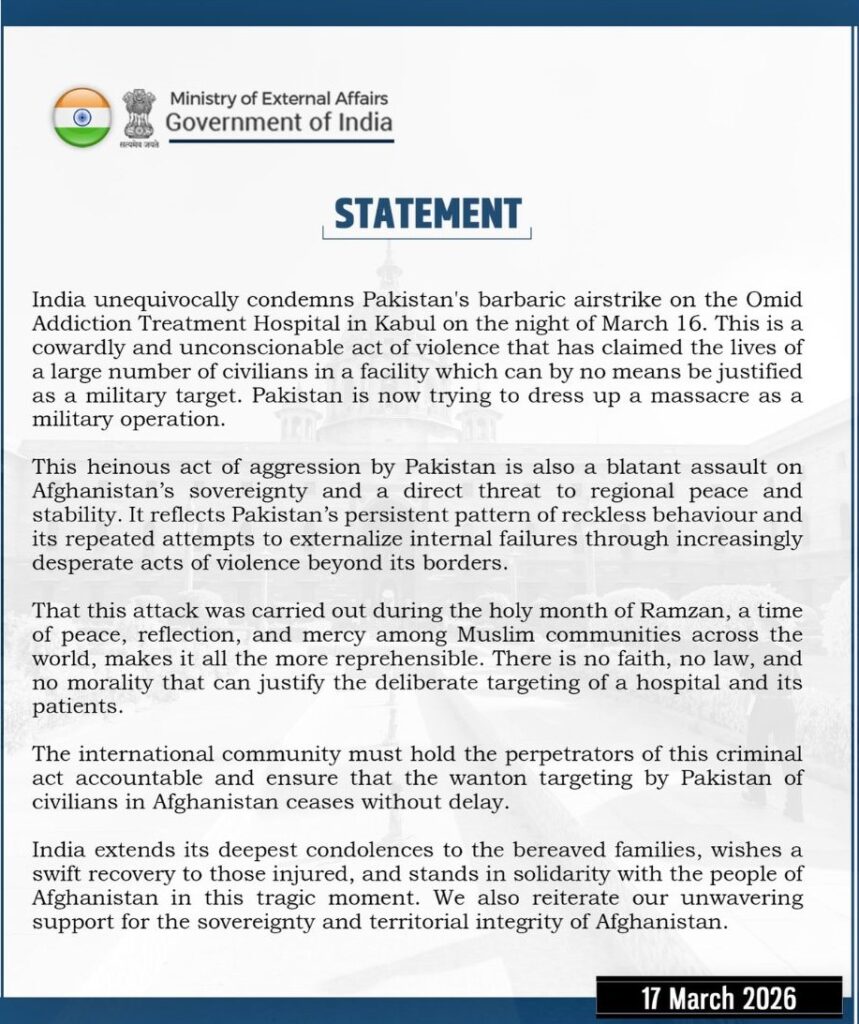
Furthermore, the MEA interpreted this aggression not as an isolated incident, but as a symptom of a deeper systemic issue within Islamabad. The Indian government noted a persistent pattern of reckless behaviour from its neighbour. By launching missiles across the border, Pakistan is allegedly attempting to externalise its own internal political and security failures through increasingly desperate acts of violence. This approach, New Delhi warned, poses a direct and immediate threat to broader regional peace and stability.
Details of the Pakistan Airstrike on Kabul Hospital
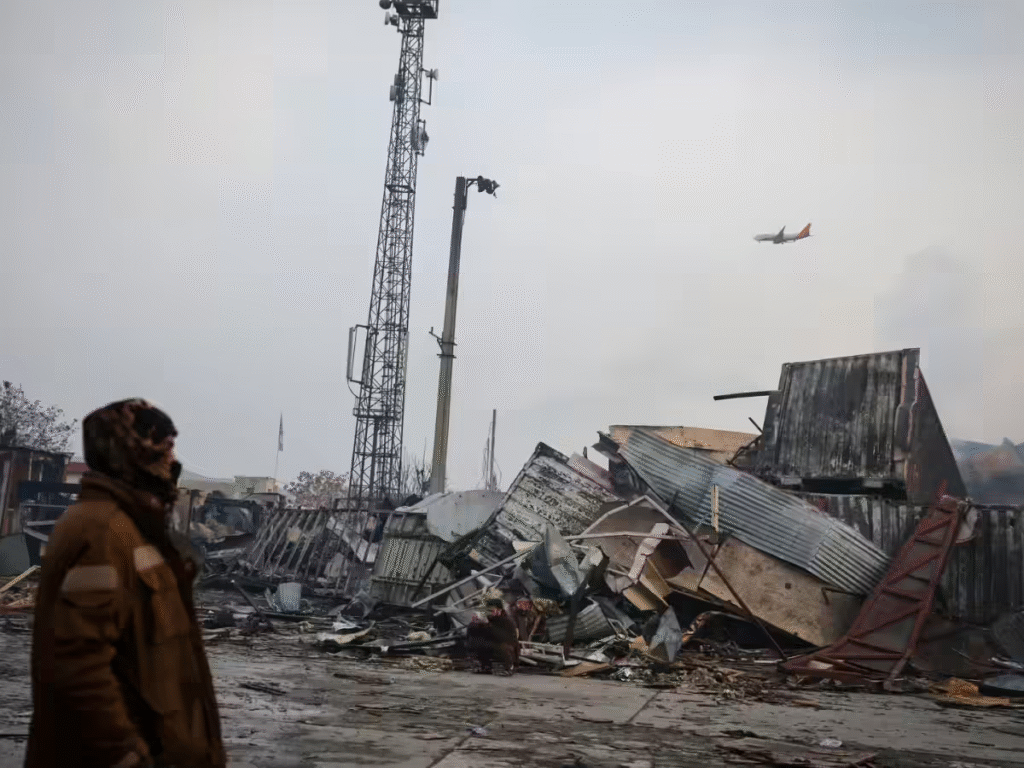
The sheer scale of the devastation has shocked the international community. According to Hamdullah Fitrat, the deputy spokesperson for the Taliban regime in Kabul, the civilian toll is staggering. Fitrat confirmed via social media that the death toll from the bombardment has already risen to 400, with an additional 250 individuals sustaining severe injuries.
The primary target of the attack was the Omid Addiction Treatment Hospital. This was not a small-scale clinic or a suspected militant hideout. It was a massive 2,000-bed facility exclusively dedicated to treating drug addiction—a critical public health crisis in Afghanistan. The nighttime raid, which occurred at approximately 9:00 PM, completely leveled large sections of the medical infrastructure, burying patients and medical staff under the rubble.
The Humanitarian Crisis at Omid Treatment Centre
Afghanistan is currently battling a severe narcotics addiction epidemic, making facilities like the Omid Treatment Centre vital to public health recovery. The destruction of this infrastructure represents a catastrophic blow to the country’s fragile healthcare system. Patients seeking rehabilitation were stripped of their sanctuary and subjected to lethal military force.
Rising Civilian Casualties During Ramzan
The timing of the bombardment has drawn additional international outrage. The MEA statement explicitly noted that these strikes were carried out during the holy month of Ramzan. Targeting a civilian healthcare facility during a period of religious fasting and reflection makes the unprovoked attack even more reprehensible. It demonstrates a severe disregard for both humanitarian principles and regional cultural sensitivities.
Background of Pakistan-Afghanistan Border Tensions
To understand the catalyst for this strike, one must examine the rapidly deteriorating relationship between Islamabad and Kabul. The Pakistani military has initiated multiple cross-border strikes in recent weeks. This aggressive posture is part of an ongoing conflict triggered by Islamabad’s persistent claims that the Taliban regime is actively harbouring extremists. Pakistan alleges these militants are responsible for a surge in deadly cross-border attacks targeting Pakistani security forces.
Clashes along the Durand Line—the disputed and highly volatile border separating the two nations—have been intensifying for months. Skirmishes escalated significantly in October of last year, resulting in dozens of fatalities on both sides. After a brief lull, hostilities resumed with unprecedented intensity last month.
The TTP Factor and Cross-Border Militancy
The core of the friction revolves around the Tehrik-i-Taliban Pakistan (TTP). Islamabad accuses the Afghan Taliban of providing safe havens and operational support to the TTP, an umbrella organization of militant groups operating against the Pakistani state. Pakistan’s Defence Minister Khawaja Asif recently escalated the rhetoric, describing the current border situation as an “open war.” However, Kabul consistently denies these allegations, asserting that Pakistan’s security failures are domestic issues that cannot be blamed on Afghanistan.
Violation of International Humanitarian Law
The bombing of the Omid Addiction Treatment Hospital transcends bilateral border skirmishes; it enters the territory of severe international law violations. Under the Geneva Conventions, hospitals and medical personnel are granted absolute protection during armed conflicts. Medical units cannot be attacked unless they are being used to commit acts harmful to the enemy, and even then, protection ceases only after a due warning has remained unheeded.
By defining the strike as a massacre, India is drawing global attention to the illegality of the operation. There is no publicly available evidence suggesting the 2,000-bed addiction centre was utilized as a military fortress. Consequently, the strike represents a grave breach of international humanitarian law, demanding immediate scrutiny from global human rights organizations.
India’s Geopolitical Stance and Support for Kabul
India’s response is deeply rooted in its long-standing strategic approach toward Afghanistan. Unlike Pakistan’s militaristic engagements, India has historically relied on soft power, developmental aid, and infrastructure building in the war-torn nation. From constructing the Afghan Parliament to investing in the Salma Dam and various healthcare projects, New Delhi has positioned itself as a partner in Afghanistan’s civilian development.
The MEA statement reaffirmed this historical stance. India extended its deepest condolences to the bereaved families and wished a swift recovery to the injured. More importantly, the diplomatic release reiterated India’s unwavering support for the sovereignty and territorial integrity of Afghanistan. This serves as a clear diplomatic signal to Islamabad that India will vocalize opposition to unwarranted cross-border military incursions.
Global Community Urged to Take Action
The Indian government concluded its statement with a direct appeal to global powers. New Delhi called upon the international community to abandon its passive stance and hold the perpetrators of this hospital bombing accountable. Merely issuing condemnations is no longer sufficient.
There is an urgent need for international pressure to ensure that Pakistan’s targeting of civilians and civilian infrastructure in Afghanistan ceases without delay. As the death toll climbs and rescue operations continue in the ruins of the Omid hospital, the region teeters on the edge of a broader, more destructive conflict.
To learn more, follow Shabdsanchi’s social media pages today and stay updated.
- Facebook: shabdsanchi
- Instagram: shabdsanchiofficial
- YouTube: @shabd_sanchi
- Twitter: shabdsanchi