NEW DELHI — The Delhi Police on Friday, October 9, 2026, officially denied permission for the Cockroach Janta Party (CJP) to hold a demonstration at Jantar Mantar on Saturday, October 10, citing procedural non-compliance, short notice, and security threats. Simultaneously, law enforcement took an unprecedented communication approach by issuing an emotional open letter addressed to citizens, emphasizing shared humanity and public safety ahead of potential law and order disruptions.
‘Uniform Ke Peeche Bhi Insaan Hai’: Delhi Police’s Public Appeal
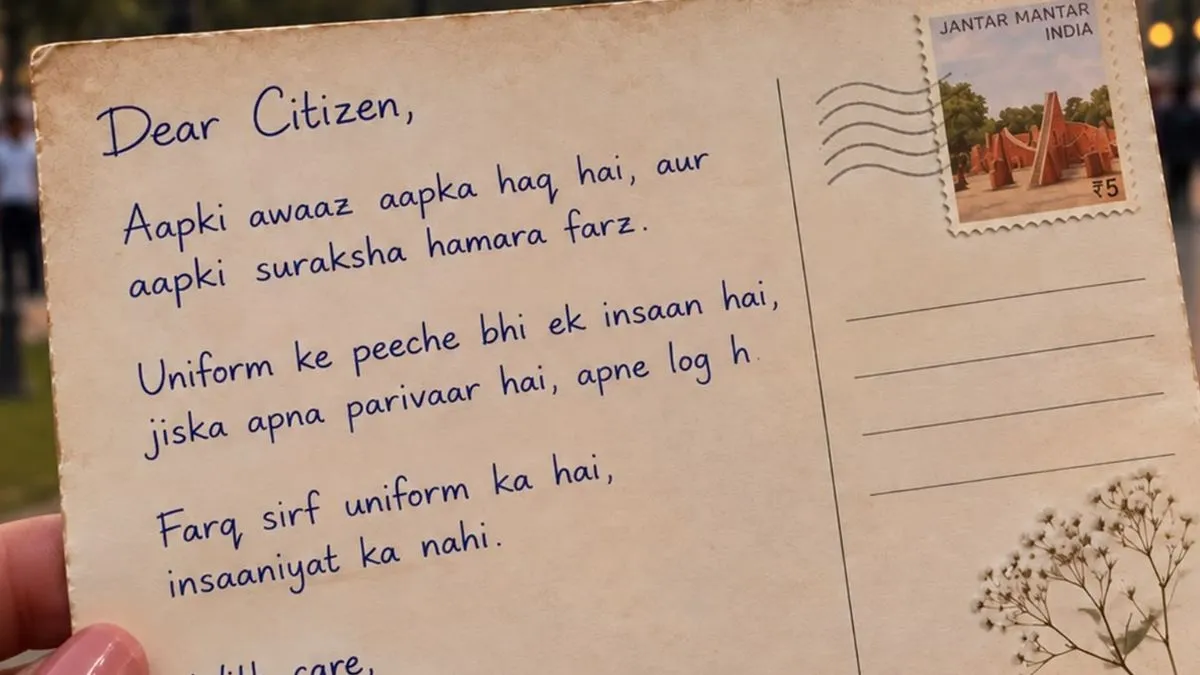
In a widely shared postcard-style message released across official channels on October 9, Delhi Police appealed directly to the public. The letter balances firm administrative stance with an empathetic human tone amid escalating political tension in the national capital.
“Dear Citizen, Aapki awaaz aapka haq hai, aur aapki suraksha hamara farz. Uniform ke peeche bhi ek insaan hai, jiska apna parivaar hai, apne log h. Farq sirf uniform ka hai, insaaniyat ka nahi. With care, Delhi Police.”
The message—translating to “Your voice is your right, and your safety is our duty. Behind the uniform is a human with a family and loved ones”—aims to de-escalate tensions as public mobilization attempts continue despite the formal protest ban.
Why Permission Was Denied: Procedural Violations & Short Notice
Addressing a press conference on Friday afternoon, Joint Commissioner of Police (New Delhi Range) Nupur Prasad confirmed that the application submitted by CJP co-convener Saurav Das on October 7 was rejected.
According to mandatory administrative guidelines, protest organizers must notify authorities at least 10 days in advance. CJP submitted its intimation just 3 days prior to the proposed event.
“Because of not following the conditions as part of undertaking during the past protest, and due to short notice, this time the permission has been denied,” stated Joint CP Nupur Prasad.
Police authorities noted that previous demonstrations led by the group resulted in breach of undertakings and traffic chaos, making fresh clearance unviable given public safety risks.
Legal Restrictions Enforced: Section 163 BNSS in New Delhi
To prevent unauthorized gatherings and civil disruption, the Delhi Administration has strictly enforced Section 163 of the Bharatiya Nagarik Suraksha Sanhita (BNSS) across the New Delhi district.
Under BNSS Section 163 (formerly Section 144 CrPC), assembly of five or more persons, carrying of weapons, or unauthorized demonstrations are prohibited. Delhi Police warned that anyone violating the order or attempting to forcibly assemble at Jantar Mantar on October 10 will face immediate legal prosecution.
Security deployment has been intensified around critical transit nodes and government buildings. Authorities have also requested precautionary crowd-management measures across major Delhi Metro stations serving central Delhi to prevent unannounced public swarms.
Analytical Angle: The Shift from Pure Force to Behavioral Communication
The release of the open letter marks a notable tactical evolution in Delhi Police‘s public relations strategy. Historically reliant on formal advisories and barricades, law enforcement is increasingly deploying humanized messaging to counter digital mass mobilization.
By validating the citizen’s democratic right to speak while reminding the public of the physical safety of officers on duty, the department seeks to reduce polarization between demonstrators and on-ground personnel. However, with organizers challenging the necessity of police permission, central Delhi remains on high security alert ahead of Saturday.
FAQs (People Also Ask)
Q1: Why did Delhi Police deny permission for the CJP protest on October 10?
Delhi Police denied permission because the organizers submitted their application only 3 days in advance instead of the mandatory 10-day notice, along with violations during previous demonstrations.
Q2: What is Section 163 BNSS currently enforced in New Delhi?
Section 163 BNSS is a legal restriction that prohibits unlawful assemblies, protest gatherings, and disruptions to public order within specified municipal boundaries.
Q3: Can citizens still gather at Jantar Mantar on October 10?
No, public assemblies without prior police authorization are strictly prohibited at Jantar Mantar under current BNSS Section 163 orders, and violators face legal action.
Q4: What was the main message in Delhi Police’s open letter?
The open letter emphasized that while voicing opinions is a right, protecting citizens is police duty, urging the public to recognize the shared humanity of personnel in uniform.
Conclusion: Long-Term Implications for Urban Agitations
The denial of permission for the October 10 CJP rally highlights tightening administrative oversight on public agitations within New Delhi’s high-security zones. As law enforcement combines strict statutory tools like BNSS Section 163 with empathetic direct-to-citizen messaging, civil groups will face growing pressure to adhere strictly to statutory timelines and undertaking compliance. The outcome on Saturday will set a crucial precedent for how unapproved urban demonstrations are managed in the national capital moving forward.

Manish Kumar began his professional journey in digital marketing and performance marketing, and currently works as a Digital Marketing Excutive and SEO expert. With over 3 years of professional experience, he handles both strategy and execution. Currently, he manages digital marketing and performance marketing at ‘Shabd Sanchi’ (shabdsanchi.com).