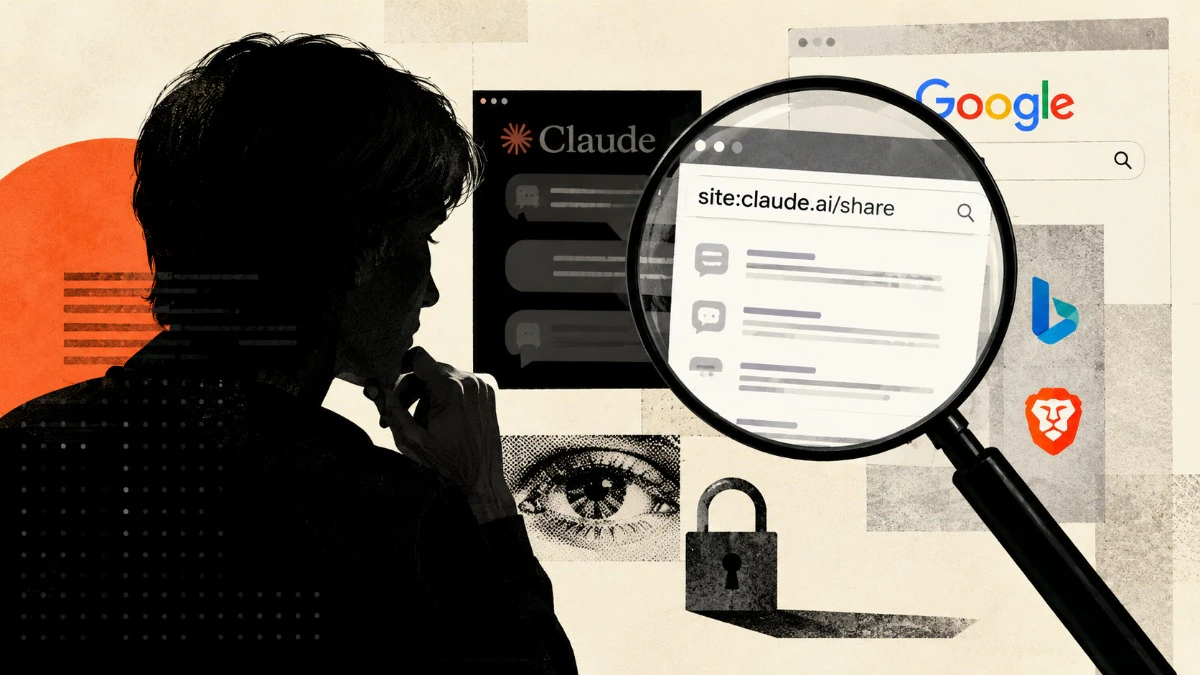
Hundreds of user conversations with Anthropic’s popular AI assistant, Claude AI, were recently discovered to be publicly accessible via simple Google searches. The exposed content ranged from everyday queries to sensitive workplace documents, personal details, and code snippets.
While Anthropic has taken action to remove these links from search indexes, the incident highlights a growing privacy challenge in generative AI: how simple sharing options can unintentionally broadcast private data to the entire internet.
How Claude AI Links Ended Up in Google Search
The exposure was initially flagged by users on community forums like Reddit. By using site-specific search operators—such as searching site:claude.ai/share on Google—anyone could view indexed pages containing real user prompts and AI responses.
User Action: Clicks "Share" in Claude UI
        │
        ▼
Generates Public URL (claude.ai/share/...)
        │
        ▼
Link gets posted on a public site/forum
        │
        ▼
Search engine crawlers index the link
        │
        ▼
Chat appears in public Google Search results
The issue stems from the web’s foundational architecture. When a user clicks the “Share” button inside Claude, the platform generates a standalone, accessible web address. If that URL is subsequently posted on a public blog, social platform, or developer forum, search engine bots (like Googlebot) crawl the link. Because the link itself functions as a public webpage, search engines archive and list it in search results.
Anthropic’s Response to the Search Indexing Issue
Anthropic clarified that its internal directories and private database logs were not breached or deliberately handed over to search engines. A company spokesperson stated:
“We give people control over sharing their Claude conversations publicly, and in keeping with our privacy principles, we do not share chat directories or sitemaps with search engines like Google. These shareable links are not guessable or discoverable unless people choose to share them themselves.”
Anthropic added that when a user generates and distributes a share link, they choose to make that specific snapshot publicly accessible. However, tech ethicists note that users rarely realize that “anyone with the link” also includes automated search engine crawlers.
How to Audit and Secure Your Claude AI Account
If you have used Claude AI‘s share feature in the past, take these steps to review and revoke public access:
- Access Settings: Log in to your Claude AI dashboard and click your profile icon in the bottom-left corner.
- Open Privacy Settings: Select Settings, then navigate to the Privacy or Account tab.
- Review Shared Links: Look for the Shared Chats directory to view all active public URLs generated under your account.
- Delete Active Links: Click Delete or Unshare next to any conversation containing personal, financial, or proprietary workplace data.
Frequently Asked Questions (FAQs)
Were private Claude AI chats leaked in a data breach?
No, this was not a hack or data breach. Default, private Claude AI chats remain unindexed and secure. Only conversations where a user manually clicked the “Share” button and distributed the link became discoverable by search engine crawlers online.
Why did Google index my shared Claude AI conversation?
When you generate a share link, it becomes a public URL. If that link is posted anywhere on the open web—or picked up by third-party tracking services—search engine bots index it like any standard webpage, making it searchable by the public.
Does deleting a shared chat link remove it from Google immediately?
Deleting or revoking the shared link in Claude immediately disables access to the content. However, Google Search may still show a cached version or link snippet until search engine crawlers re-index the page and remove the stale result from their database.
Are other AI chatbots like ChatGPT subject to the same issue?
Yes, this is an industry-wide challenge. Similar search indexing occurrences have previously affected shared links on OpenAI’s ChatGPT and xAI’s Grok. Any platform offering public URL generation runs the risk of web crawlers indexing those shared endpoints.
Conclusion
The discovery of indexed Claude AI chats on Google serves as a critical reminder for anyone using artificial intelligence tools. While AI assistants are invaluable for brainstorming, coding, and writing, public share links turn private prompts into open web pages. Always audit your shared links, avoid inputting sensitive confidential data into shared sessions, and regularly manage your account privacy settings to keep your data secure.
For more information, follow Shabdsanchi‘s social media pages today and stay updated.
- Facebook: shabdsanchi
- Instagram: shabdsanchiofficial
- YouTube: @shabd_sanchi
- Twitter: shabdsanchi