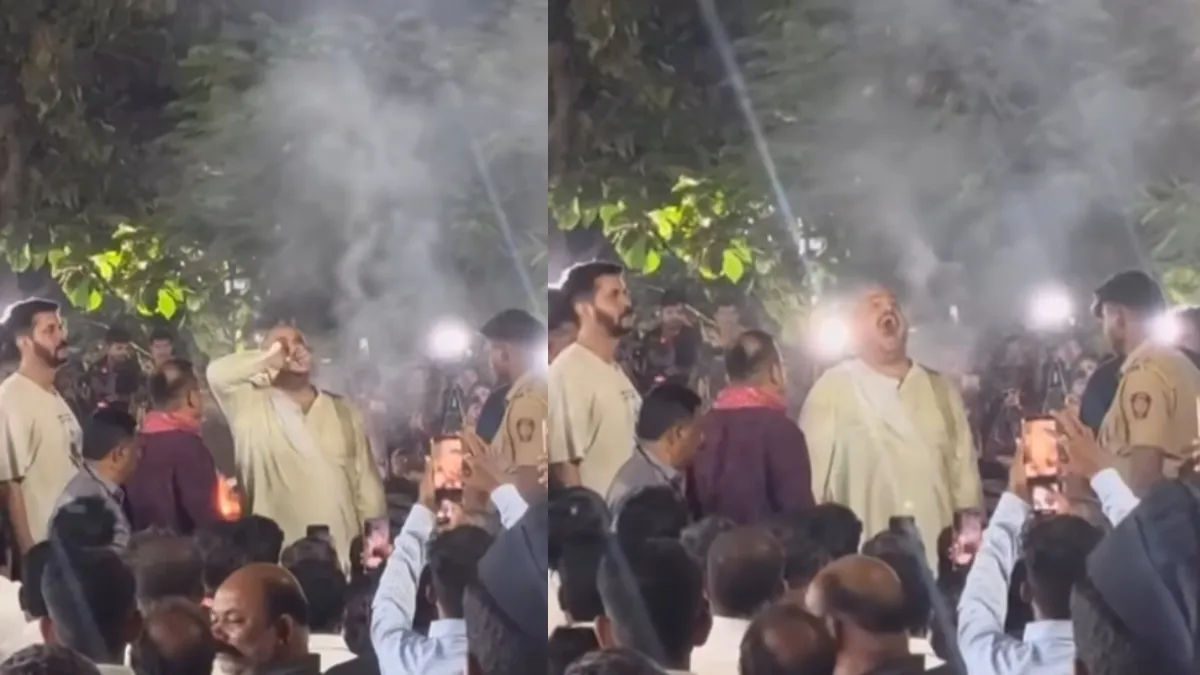
Veteran actor Nana Patekar was cremated with full state honors at his native farmhouse in Donje village, Pune, following his sudden demise on October 8, 2026, at the age of 75. While thousands of mourners, political leaders, and film fraternity members gathered to bid a tearful adieu to the Krantiveer star, it was his son, Malhar Patekar, whose actions during the final pyre ritual captured nationwide attention. Just before performing the mukhagni, Malhar shouted “Pa” aloud and placed his hand backward over his mouth—sparking widespread curiosity regarding regional funeral customs and ancestral traditions.
The Anatomy of a Solemn Farewell: Understanding the Gesture
The late actor’s final journey concluded late into the night at his scenic Pune farmhouse, a location Nana Patekar had explicitly chosen for his final resting place. Amidst glowing tributes and chants of “Nana Amar Rahe,” Malhar Patekar stepped up to fulfill his filial duties.
However, the specific sequence where Malhar called out “Pa” with his hand inverted over his mouth prompted immediate discussions. While mainstream media and onlookers scrutinized the moment, cultural experts note that such acts do not stem from a single, pan-Indian scriptural mandate. Instead, they belong to a diverse tapestry of local folklore and community-specific practices observed across rural Maharashtra.
“In various localized traditions across western India, distinct vocal cues or physical reversals during the final separation are practiced by specific clans to signal the soul’s detachment from the physical realm, though they remain personal or regional expressions rather than universal Hindu obligations.”
Anthropologists studying Maharashtrian rural sociology suggest that unorthodox vocalizations during cremation can symbolize an ancient primal method of breaking worldly attachments, channeling grief, or urging the departed spirit to transition peacefully without lingering earthly bonds. Because the family maintained a dignified silence regarding an official explanation, these actions remain deeply rooted in personal grief intertwined with ancestral customs.
Why the Late-Night Cremation? Malhar Patekar Clarifies
The timing of the last rites—conducted deep into the night—also raised questions among followers accustomed to daytime cremations. Addressing the media, Malhar Patekar explained the logistical and emotional constraints that led to the midnight ceremony.
- Tragedy in Goa: The actor suffered a fatal cardiac arrest in the early hours of Thursday at his residence in Goa and was declared dead at Manipal Hospital.
- Transit Delays: Transporting the mortal remains from Goa through medical clearances, airport formalities, and transit to Pune’s rural outskirts took considerable time.
- Fulfilling Wishes: Given that a significant portion of the day had already passed since his passing, the family proceeded with the rites to honor his pre-stated wish of resting at his farmhouse without stretching the mourning period unnecessarily into the next day.
A Giant of Indian Cinema and Social Service
The passing of Nana Patekar closes a defining chapter in Indian parallel and mainstream cinema. Over a career spanning nearly five decades, the three-time National Award winner redefined intensity on screen through masterpieces like Krantiveer, Khamoshi: The Musical, and Parinda.
Beyond celluloid, his grassroots humanitarian work through the Naam Foundation—co-founded alongside Makarand Anaspure to support drought-stricken farmers in Maharashtra—cemented his legacy as a real-life hero. Dignitaries including Maharashtra Chief Minister Devendra Fadnavis, Deputy Chief Minister Sunetra Pawar, and industry icons like Jackie Shroff and Shah Rukh Khan converged to acknowledge a towering cultural footprint.
Frequently Asked Questions (FAQs)
1. Where were Nana Patekar’s last rites performed?
Nana Patekar’s last rites were conducted with full state honors at his farmhouse located in Donje village, near Pune, Maharashtra.
2. Why did Malhar Patekar shout ‘Pa’ during the cremation?
Malhar Patekar’s shout and inverted hand gesture reflected localized regional customs and emotional farewell traditions rather than a standardized scriptural mandate.
3. What was the cause of Nana Patekar’s death?
The veteran actor passed away following a severe cardiac arrest at his residence in Goa on October 8, 2026.
4. Why was the funeral held late at night?
His son Malhar explained that due to the time taken for transit from Goa to Pune and the completion of necessary legal protocols, the family proceeded with the rites on Thursday night.
5. Which notable leaders attended the state funeral?
Maharashtra Chief Minister Devendra Fadnavis, Deputy CM Sunetra Pawar, Union Minister Ramdas Athawale, and several cabinet ministers attended alongside film personalities.
Conclusion
The final farewell given to Nana Patekar mirrored his life on and off the screen: raw, unfiltered, deeply grounded in soil, and profoundly resonant. While the viral moments of Malhar Patekar’s ritualistic gestures highlight the survival of diverse indigenous customs in modern times, the broader narrative remains the irreplaceable void left by an artistic titan. As the film industry and society move forward, Nana Patekar’s institutionalized commitment to art, agricultural relief, and fierce authenticity will continue to guide future generations of storytellers and public figures.
What are your thoughts on how regional traditions preserve our cultural heritage during times of personal loss?

Manish Kumar began his professional journey in digital marketing and performance marketing, and currently works as a Digital Marketing Excutive and SEO expert. With over 3 years of professional experience, he handles both strategy and execution. Currently, he manages digital marketing and performance marketing at ‘Shabd Sanchi’ (shabdsanchi.com).