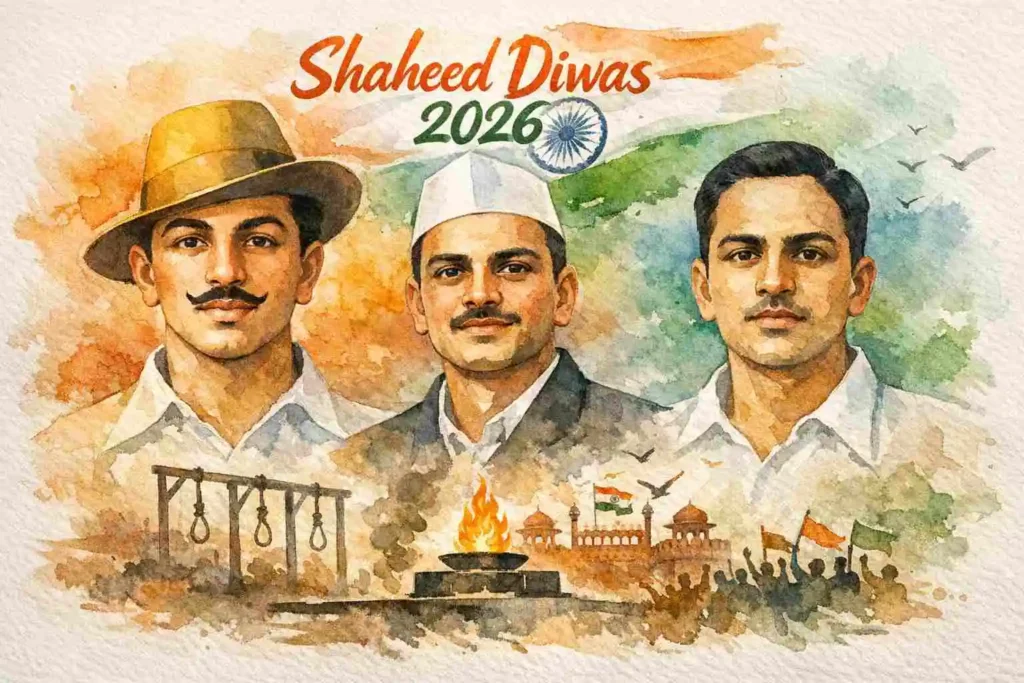
India will observe Shaheed Diwas 2026 on March 23 to honour the supreme sacrifice of Bhagat Singh, Shivaram Rajguru, and Sukhdev Thapar. This day commemorates their execution by the British colonial government in 1931. Their martyrdom remains a defining chapter in India’s struggle for independence, inspiring millions even today.
The Historical Context Behind Shaheed Diwas
To understand the significance of this day, one must look back at the political climate of the late 1920s. In 1928, the British government dispatched the Simon Commission to review political reforms in India. However, the commission did not include a single Indian member. This exclusion triggered massive, nationwide protests across the subcontinent.
Lala Lajpat Rai and the Lahore Protest
Veteran freedom fighter Lala Lajpat Rai led a massive demonstration against the Simon Commission in Lahore on October 30, 1928. The peaceful protest was met with severe police brutality. Police Superintendent James A. Scott ordered a ruthless lathi charge against the unarmed demonstrators. Lala Lajpat Rai sustained critical injuries during this assault. He succumbed to his wounds a few weeks later, on November 17, 1928.
A Turning Point in the Freedom Struggle
The tragic death of Lala Lajpat Rai sent shockwaves across the nation. It deeply outraged young revolutionaries, including Bhagat Singh, Sukhdev Thapar, and Shivaram Rajguru. They belonged to the Hindustan Socialist Republican Association (HSRA) and collectively vowed to avenge the death of their revered leader.
The Assassination of John Saunders
The revolutionaries planned to target James A. Scott, the officer directly responsible for the violent lathi charge. However, a critical case of mistaken identity occurred. On December 17, 1928, they assassinated another British police officer, John P. Saunders, instead. Following the incident, Bhagat Singh and his associates managed to escape Lahore, evading a massive British manhunt.
Also Read: Check RBSE 10th Result on DigiLocker: Step-by-Step Guide
The Assembly Bombing and Subsequent Trial
Months later, in April 1929, Bhagat Singh and Batukeshwar Dutt threw non-lethal bombs inside the Central Legislative Assembly in Delhi. Their intention was not to kill, but “to make the deaf hear.” They voluntarily courted arrest, using the subsequent court trials as a platform to publicize their anti-imperialist cause.
The British authorities eventually connected Bhagat Singh, Rajguru, and Sukhdev to the assassination of John Saunders. The resulting Lahore Conspiracy Case trial drew intense nationwide attention. The British legal system bypassed standard protocols, establishing a special tribunal to expedite the convictions of the three young men.
Execution at Lahore Central Jail
Despite widespread public outcry and numerous appeals for clemency from prominent national leaders, the British government remained unyielding. The execution was originally scheduled for March 24, 1931. However, fearing massive public unrest, authorities secretly advanced the hanging by several hours.
Bhagat Singh, Rajguru, and Sukhdev were hanged at the Lahore Central Jail on the evening of March 23, 1931. Their bodies were secretly cremated along the banks of the Sutlej River. This ultimate sacrifice immortalized them as national heroes overnight.
The Enduring Legacy of the Martyrs
The execution did not suppress the freedom movement; rather, it fueled it further. The bravery of these three young men galvanized public sentiment against colonial exploitation. They represented a shift from traditional moderate politics to a more assertive, revolutionary demand for complete independence.
Ideological Depth and Famous Quotes
Bhagat Singh was not just a revolutionary of action but also a profound thinker. His writings from prison reveal a deep understanding of political philosophy, equality, and human rights. His famous assertion, “They may kill me, but they cannot kill my ideas,” perfectly encapsulates his vision. He firmly believed that bombs and pistols alone do not make a revolution; instead, the sword of revolution is sharpened on the whetting stone of ideas.
Observing Shaheed Diwas Today
As we approach Shaheed Diwas 2026, the nation prepares to pay homage to these brave souls. Schools, colleges, and civic organizations across India organize educational events, debates, and tribute ceremonies. These observances ensure that the younger generation understands the heavy price paid for the liberties they enjoy today.
Also Read: RBSE Class 10th Result 2026 Out Today: Check Scores Here
To learn more, follow Shabdsanchi’s social media pages today and stay updated.
- Facebook: shabdsanchi
- Instagram: shabdsanchiofficial
- YouTube: @shabd_sanchi
- Twitter: shabdsanchi