New Delhi has accelerated India oil import deals to secure domestic energy supplies amid escalating tensions in the Middle East. With the Strait of Hormuz facing severe disruptions, the government is finalizing new crude and LPG contracts to shield the economy from global supply shocks.
Strait of Hormuz Closure Triggers Supply Fears
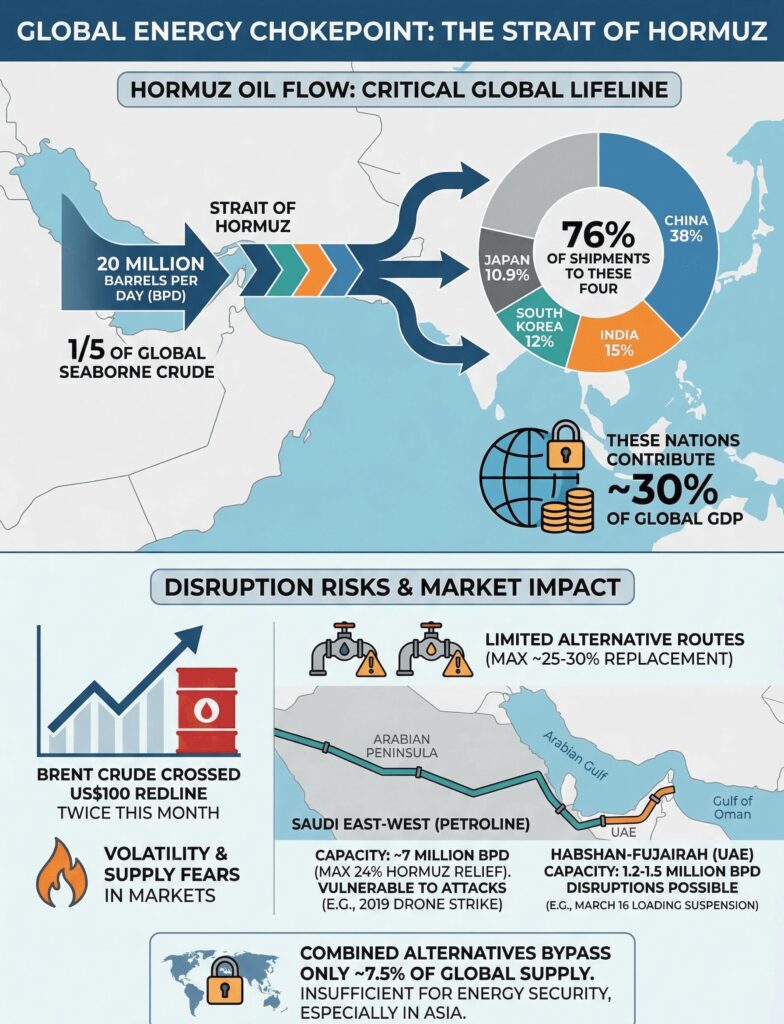
The global energy market is facing unprecedented volatility following the outbreak of the US-Israel conflict with Iran in late February. Tehran’s decision to shut down tanker traffic through the Strait of Hormuz has severely constrained international supply lines. This critical maritime chokepoint normally handles 20 to 25 per cent of the world’s seaborne crude trade.
For India, the blockade presents a direct logistical challenge. The Hormuz channel is a vital supply route, historically facilitating roughly 40 per cent of the country’s massive oil requirements. India consumes between 5.5 and 6 million barrels of crude oil per day, making immediate alternative arrangements essential.
Advancing India Oil Import Deals for Stability
To counter these disruptions, industry sources confirm that New Delhi is proactively diversifying its supplier base. Officials are currently finalizing multiple India oil import deals after conducting detailed negotiations. The primary objective is to lock in rates that protect India’s broader economic interests during this volatile period.
The list of potential suppliers actively features Russia. India had previously purchased substantial volumes of discounted Russian crude immediately after the Ukraine conflict began. These purchases were later scaled back to comply with conditions set by the United States for a February interim tariff agreement.
However, the current geopolitical crisis has forced a rapid policy shift in Washington.
US Grants Temporary Waivers for Crude Oil
Recognizing the severity of the Middle East supply shock, the US government adjusted its stance on sanctioned oil. On March 6, Washington granted Delhi a 30-day waiver permitting the purchase of Russian oil already loaded on vessels. This move specifically aims to offset the immediate loss of Middle Eastern supply.
Read Also: Free Gas Up to Rs 500 as Govt Pushes PNG Shift for Homes
Financial markets data from Bloomberg indicates that under these new India oil import deals, the country has already secured an estimated 60 million barrels from Russia. Suppliers will deliver this cargo in April 2026.
Furthermore, Washington issued a parallel 30-day waiver for purchasing sanctioned Iranian oil. This exemption applies strictly to crude stored on ships on or before March 20, with a mandatory discharge deadline of April 19.
Strategic Reserves Assure Domestic Fuel Availability
Despite the turbulent international environment, the central government has stressed that citizens face no immediate shortage of fuel or natural gas. India’s energy buffer remains well-stocked. Junior Petroleum Minister Suresh Gopi recently informed Parliament that the nation’s three strategic petroleum reserves (SPRs) currently hold approximately 3.372 million tons of crude.
This volume represents two-thirds of India’s maximum SPR capacity. When combined with ready-to-use fuel stored by oil marketing companies, the country holds sufficient reserves to sustain operations for 74 days.
Prime Minister Narendra Modi also addressed energy security concerns in Parliament. “In the last 11 years, we have diversified energy imports,” he stated. “Earlier we used to import from 27 nations. Now we import from 41.”
Boosting Domestic LPG Production
Alongside crude oil management, the government is actively addressing the supply of Liquified Petroleum Gas (LPG). Over 33 crore Indian households depend on LPG for cooking. Recent unverified reports suggested that some hotels and restaurants faced closures due to commercial LPG shortages.
Also Read: West Asia Crisis: Is a Lockdown in India 2026 Imminent?
To prevent market panic, authorities intervened in early March by ordering a 25 per cent increase in domestic LPG production. Officials have assured the public that supply chains are functioning smoothly and urged citizens to avoid panic buying.
Global Market Outlook and Escalating Outages
While India manages its internal supply, international energy analysts warn of prolonged global instability. Kpler, a prominent commodities analytics firm, stated that the recent US waivers will release approximately five million barrels per day within a month. However, this temporary influx will not offset sustained supply disruptions from the Middle East.
Cumulative oil losses have already reached 133 million barrels since the conflict escalated. Kpler warns this deficit could surge to 600 million barrels by the end of April if regular shipping flows do not resume. Current global outages stand at 10.7 million barrels per day and could increase further as military strikes damage regional refineries and depots.
To learn more, follow Shabdsanchi’s social media pages today and stay updated.
- Facebook: shabdsanchi
- Instagram: shabdsanchiofficial
- YouTube: @shabd_sanchi
- Twitter: shabdsanchi