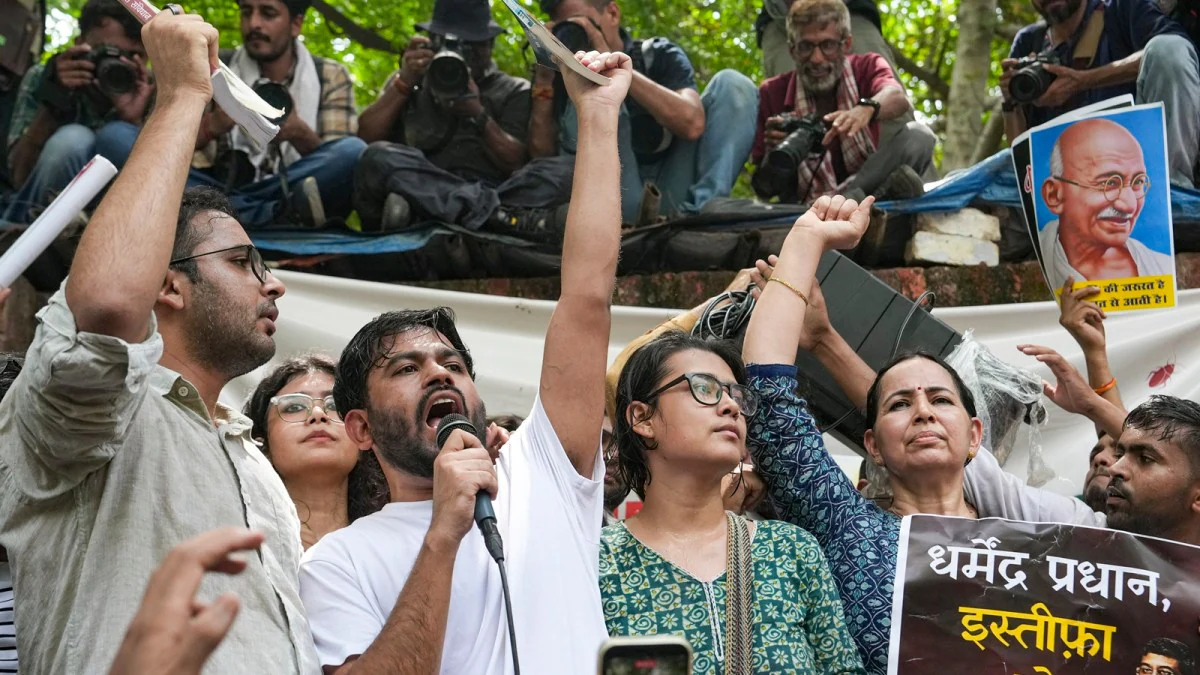
The Cockroach Janta Party protest drew a sizable crowd at Jantar Mantar in New Delhi on Saturday, as supporters demanded accountability over the alleged NEET 2026 paper leak and concerns surrounding the CBSE’s On-Screen Marking (OSM) system. Protesters called for the resignation of Union Education Minister Dharmendra Pradhan and Prime Minister Narendra Modi, raising slogans against examination irregularities and the functioning of the National Testing Agency (NTA).
Protest Focuses on NEET Leak and CBSE Evaluation Concerns
The demonstration centered on two major issues that have generated debate among students and education activists. The first was the alleged leak of the NEET 2026 examination paper, which protesters claimed had undermined the credibility of one of India’s most important entrance examinations.
The second concern involved the CBSE’s On-Screen Marking system. Protesters alleged that irregularities in the digital evaluation process had affected transparency and fairness in student assessments. Demonstrators argued that students deserve a reliable examination and evaluation framework that maintains public confidence.
Participants carried placards and banners highlighting their grievances. Several posters questioned the effectiveness of existing safeguards designed to prevent examination malpractice and evaluation disputes.
Cockroach Janta Party Protest Raises Political Demands
The Cockroach Janta Party protest also took a political turn as participants demanded the resignation of senior government leaders. Slogans such as “Dharmendra Pradhan Istifa Do,” “PM Modi Istifa Do,” “NTA Band Karo,” and “Shame Shame Narendra Modi” were heard during the gathering.
One of the posters displayed at the venue read, “We asked for Make in India, you gave us Leak in India,” reflecting criticism of recurring controversies surrounding competitive examinations.
The protest attracted supporters from different backgrounds, including students and individuals concerned about educational governance. Organizers claimed that repeated examination-related controversies have weakened trust among aspirants preparing for highly competitive tests.
Why Examination Integrity Remains a Key Public Issue?
Competitive examinations play a critical role in determining academic and professional opportunities for millions of students across India. As a result, allegations involving paper leaks or evaluation inconsistencies often generate strong public reactions.
Over the past few years, concerns related to examination management have led to calls for reforms, stronger security measures, and increased transparency. Education experts have frequently emphasized the need for robust systems that protect the integrity of question papers, evaluation processes, and result publication mechanisms.
Students preparing for national-level examinations invest significant time and resources in their studies. Any controversy affecting exam credibility can create uncertainty and anxiety among candidates and their families.
Calls for Accountability and Institutional Reforms
During the protest, participants urged authorities to conduct transparent investigations into the allegations. Several speakers highlighted the importance of restoring confidence in examination bodies responsible for conducting large-scale tests.
The National Testing Agency has faced scrutiny in the past over examination-related concerns, leading to broader discussions about governance and accountability within the education sector. Protesters argued that institutional reforms should focus on preventing future irregularities and ensuring equal opportunities for all candidates.
They also called for greater transparency in digital assessment systems, including mechanisms that allow students to better understand how marks are evaluated and reviewed.
Government Response Awaited on Protest Demands
As of Saturday evening, there was no immediate official response to the demands raised during the demonstration. The protest remained peaceful, with participants using speeches, slogans, and placards to communicate their concerns.
Observers noted that education-related issues continue to resonate strongly among students and young voters, particularly when they involve high-stakes examinations. The demands raised at Jantar Mantar are likely to contribute to ongoing discussions about examination reforms and accountability within India’s education system.
The event reflects broader concerns about fairness, transparency, and trust in public examination processes. Whether the demands result in policy action remains to be seen, but the issues highlighted by protesters are likely to remain part of the national conversation in the coming weeks.
FAQs
1. What was the Cockroach Janta Party protest about?
The Cockroach Janta Party protest at Jantar Mantar focused on allegations surrounding the NEET 2026 paper leak and concerns over the CBSE’s On-Screen Marking (OSM) system. Protesters demanded greater accountability and transparency in the examination process.
2. Where did the protest take place?
The protest was held at Jantar Mantar in New Delhi, a designated venue often used for public demonstrations and civic gatherings.
3. What demands were raised during the protest?
Protesters called for the resignation of Union Education Minister Dharmendra Pradhan and Prime Minister Narendra Modi. They also demanded action against alleged examination irregularities and reforms to improve the credibility of assessment systems.
4. Why is the NEET 2026 paper leak issue significant?
NEET is one of India’s largest medical entrance examinations. Any allegation of a paper leak can affect the credibility of the examination process and create uncertainty for lakhs of students competing for admissions.
5. What is the CBSE On-Screen Marking (OSM) system?
The On-Screen Marking system is a digital evaluation method used for assessing answer sheets. Protesters alleged irregularities in the system, although authorities have not publicly confirmed these claims.
6. Were there any notable slogans at the protest?
Yes. Protesters raised slogans including “Dharmendra Pradhan Istifa Do,” “PM Modi Istifa Do,” “NTA Band Karo,” and “Shame Shame Narendra Modi.” Several placards criticizing examination management were also displayed.
7. Has the government responded to the protest?
At the time of reporting, there was no immediate official response to the demands raised during the demonstration.
8. Why do examination controversies attract public attention?
Competitive examinations influence educational and career opportunities for millions of students. Allegations of paper leaks or evaluation errors often trigger concerns about fairness, transparency, and equal opportunity.
9. What role does the National Testing Agency (NTA) play?
The NTA is responsible for conducting several national-level entrance examinations, including NEET. Its role is to ensure examinations are conducted securely, fairly, and efficiently.
10. What could happen next after the protest?
The issues raised may lead to further public debate, demands for investigations, and discussions on examination reforms. Any official action would depend on the findings of relevant authorities and government agencies.
For more information, follow Shabdsanchi‘s social media pages today and stay updated.
- Facebook: shabdsanchi
- Instagram: shabdsanchiofficial
- YouTube: @shabd_sanchi
- Twitter: shabdsanchi