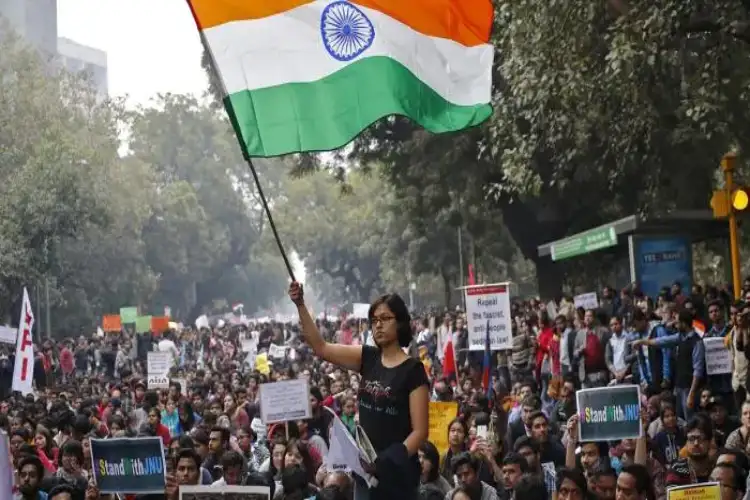
NEW DELHI: Actor Imran Khan has been officially asked to leave India by October 28 following his participation in a political protest against Chief Election Commissioner Gyanesh Kumar in Mumbai on October 10. The notice, issued under Sections 7 and 29 of the Immigration and Foreigners Act, 2025, has ignited widespread public debate concerning the legal boundaries of government authority over foreign nationals and the distinct rights held by Overseas Citizen of India (OCI) cardholders.
The actor, who holds US citizenship alongside an OCI card, was detained during the demonstration. Official action was swiftly initiated following a formal complaint filed by BJP leader Kirit Somaiya, who alleged that Khan’s active participation in the public demonstration violated domestic laws governing foreign visitors.
“There are thousands of Imrans Khans in India. They want to live here and defame the country. Action should be taken against all such people, and they should be deported,” Kirit Somaiya told reporters.
Understanding the Legal Basis: Sections 7 and 29
The enforcement notice invokes specific legislative powers designed to regulate the presence of foreign individuals within the country. Section 7 empowers the Central Government to regulate or restrict the entry, departure, or continued presence of foreign nationals in India, including the imposition of strict conditions on their stay and movement. Meanwhile, Section 29 provides the legal framework for the removal of foreign nationals under circumstances covered by the Act, such as statutory violations, breaches of administrative orders, or adverse security reports.
Police officials emphasized the core legal premise governing the case:
“Imran Khan holds foreign citizenship and is not an Indian national. Under relevant provisions of the Foreigners/Immigration Act, foreign nationals are prohibited from participating in political protests or political activities on Indian soil”.
Legal experts clarify that the issuance of the notice and the ongoing allegations do not, by themselves, establish a formal criminal offense. However, they trigger immediate administrative compliance requirements under immigration law.
What Rights Do OCI Cardholders Have in India?
An Overseas Citizen of India card is granted to eligible individuals of Indian origin who hold foreign citizenship. Despite its nomenclature, an OCI card does not confer Indian citizenship; rather, it provides privileges such as a lifelong, multiple-entry visa to India, subject to prevailing rules.
According to Amitraj Kaushal, an advocate at the Supreme Court of India, an OCI card is best understood as a long-term relationship with the country rather than a substitute for citizenship.
“It gives a lifelong multiple-entry visa and parity with NRIs on travel work and property. But the Citizenship Act 1955 keeps political rights like voting and contesting elections out of its reach,” Kaushal explained.
OCI cardholders are explicitly barred from voting in Indian elections or contesting positions in Parliament or state legislatures. Furthermore, they remain bound by immigration laws and do not possess an unconditional, absolute right to remain in the country.
Can OCI Cardholders Participate in Protests?
The intersection of immigration status and constitutional freedoms has become the focal point of the current controversy. While the law does not expressly prohibit OCI cardholders from participating in peaceful gatherings, fundamental constitutional guarantees like Article 19 (freedom to assemble peaceably) are reserved exclusively for Indian citizens.
“On protests the law is quiet rather than strict. Nothing in the Act expressly bars an OCI holder from joining a peaceful gathering. However, the freedom to assemble under Article 19 is a right of citizens. An OCI holder cannot invoke it the way a citizen can. Articles 14 and 21 still apply to every person,” Kaushal noted.
While political expression rights differ, Article 14 (equality before the law) and Article 21 (protection of life and personal liberty) extend protections to every person within India’s borders, regardless of nationality.
The Dual Threat: Immigration Removal vs. OCI Cancellation
Legal analysts point out that foreign nationals facing such disputes encounter exposure on two distinct fronts: administrative removal and OCI registration cancellation.
- Immigration Removal: The Centre exercises broad authority under the Foreigners Act to mandate the departure of a foreign national.
- OCI Cancellation: Section 7D of the Citizenship Act, 1955, governs the cancellation of OCI registration. It allows for revocation if the holder breaches Indian law or acts against public interest or national security, though this process requires a formal hearing.
This mechanism remains entirely separate from the government’s powers under general immigration laws to regulate a foreign national’s day-to-year stay.
Frequently Asked Questions (FAQs)
What is the deadline for actor Imran Khan to leave India?
Actor Imran Khan has been directed to leave India by October 28.
Which laws were invoked in the notice issued to Imran Khan?
The notice was issued under Sections 7 and 29 of the Immigration and Foreigners Act, 2025.
Does an OCI card grant Indian citizenship or voting rights?
An OCI card does not confer Indian citizenship, voting rights, or the right to contest elections.
Can OCI cardholders participate in political protests in India?
Foreign nationals and OCI cardholders are prohibited from participating in political protests or engaging in political activities on Indian soil.
What is Section 7D of the Citizenship Act, 1955?
Section 7D deals with the cancellation of OCI registration if a holder breaks Indian law or acts against public interest or national security.
Conclusion
The administrative action against Imran Khan highlights the strict legal limits placed on foreign nationals and OCI cardholders participating in domestic political activities in India. As the October 28 departure deadline approaches, the case serves as a critical test case for the enforcement powers under the Immigration and Foreigners Act, 2025. Long-term implications point toward tighter compliance monitoring for high-profile foreign visitors, ensuring strict adherence to the boundaries separating long-term residency privileges from domestic political participation.

Manish Kumar began his professional journey in digital marketing and performance marketing, and currently works as a Digital Marketing Excutive and SEO expert. With over 3 years of professional experience, he handles both strategy and execution. Currently, he manages digital marketing and performance marketing at ‘Shabd Sanchi’ (shabdsanchi.com).