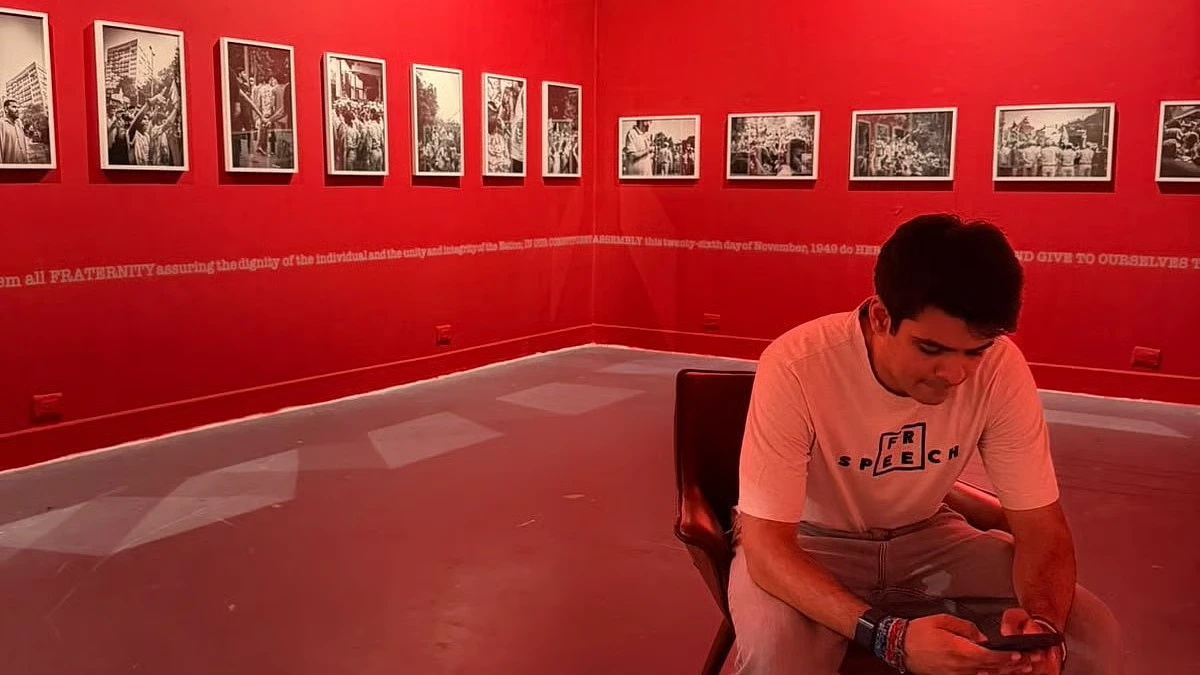
Hours before his debut contemporary art exhibition was set to open to the public at New Delhi’s premier cultural hub, Raihan Vadra, son of Congress leader Priyanka Gandhi Vadra, was forced to pull down the vast majority of his displayed works. The exhibition, titled ‘No Idea Is Final’, was scheduled at the Centre for Contemporary Art, Bikaner House—a venue managed by the Rajasthan government.
Management officials abruptly flagged the timing and content of the showcase, demanding the removal of 74 out of 105 photographs documenting recent youth protests across the national capital. The incident has triggered a fierce political debate surrounding freedom of expression, state censorship, and the cultural autonomy of prominent public spaces in India.
The Anatomy of the Censorship: What Happened at Bikaner House?
The controversy unfolded on Wednesday afternoon, just hours before the exhibition’s formal inauguration. According to Raihan Vadra, a written removal request signed by Manoj Singh, the Deputy Resident Commissioner, was handed to him at 3:30 pm. The official notice cited non-compliance with the venue’s booking policies.
Before receiving the written directive, Vadra was approached by Principal Resident Commissioner Rohit Kumar, who reportedly argued that the timing and political context of the images were inappropriate.
“My idea was to document the movements happening around me in our country. Artistically, my idea was to capture the poetry and rhythm of movements when people come together,” Raihan Vadra told NDTV.
Out of 105 curated pieces, Vadra was instructed to remove 75 photographs or face a complete cancellation of the event. Among the targeted items were frames featuring the Tiranga (the Indian national flag). Despite initial pushback, venue staff physically removed one of the flag photos while Vadra was temporarily away from the gallery space. In total, 74 images were stripped from the walls, leaving behind bare spaces marked by exposed iron nails gleaming under the gallery spotlights.
Political Fallout: Condemnation From Priyanka Gandhi and the Congress
The swift removal of the artwork drew sharp reactions from political leaders, civil rights advocates, and the broader artistic community. Priyanka Gandhi Vadra slammed the move as “ridiculous,” framing it as part of a wider pattern of suppressing youth voices nationwide.
“What do you think? He is a young boy, but I suppose you know, they are muzzling the voice of the youth across the nation. So it’s only expected that they’ll do it to anyone,” Priyanka Gandhi stated. “Today it’s him, tomorrow it’ll be another artist”.
Taking to social media, she added a sharp critique of institutional fear:
“When someone with power becomes afraid of the expression of another, he doesn’t know it, but he has already lost the very power he is trying to protect.”
Congress MP and party spokesperson Pawan Khera echoed these sentiments on X (formerly Twitter), questioning the logic of censoring baseline documentation of peaceful assemblies.
“When even the Tricolour isn’t safe from the censor’s scissors, perhaps the problem isn’t the art. It’s the regime,” Khera wrote. “The walls meant for art were left with nothing but exposed iron nails… a chilling metaphor for censorship.”
Contextualizing the Protests: Why the Timing Triggered Alarm
The exhibition’s photographs primarily documented recent political demonstrations in New Delhi, including the October 11 Congress march to the Supreme Court. The national capital has witnessed heightened civil mobilization over the past several weeks, with opposition groups—including members led by Lok Sabha MP Priyanka Gandhi, Leader of the Opposition Rahul Gandhi, and bodies like the Cockroach Janta Party—demanding accountability and the resignation of Chief Election Commissioner Gyanesh Kumar over alleged voter list irregularities.
While Bikaner House authorities and the BJP-led Rajasthan government did not issue formal statements addressing the controversy, sources indicated to NDTV that officials feared the photographs “could have triggered a political controversy” given the sensitive electoral climate.
Vadra maintained that the venue management had previously reviewed his layout sent on October 15 and responded merely with “noted,” without raising objections or requesting a pre-approval catalog.
Bruised by the censorship but undeterred, Vadra confirmed that the remaining truncated exhibition will run through October 25 at Bikaner House. Meanwhile, he intends to display the censored collection across alternative platforms and digital spaces, ensuring that the visual documentation reaches a wider audience.

Manish Kumar began his professional journey in digital marketing and performance marketing, and currently works as a Digital Marketing Excutive and SEO expert. With over 3 years of professional experience, he handles both strategy and execution. Currently, he manages digital marketing and performance marketing at ‘Shabd Sanchi’ (shabdsanchi.com).
Frequently Asked Questions (FAQs)
1. What is the title of Raihan Vadra’s art exhibition at Bikaner House?
The exhibition is titled ‘No Idea Is Final’, showcasing a visual documentation of youth protests in New Delhi.
2. Why were photographs removed from Raihan Vadra’s exhibition?
Venue officials flagged the timing and context of the images, claiming they could trigger a political controversy and violated booking guidelines.
3. How many photographs were ordered to be taken down?
Management demanded the removal of 75 out of 105 total photographs, resulting in 74 images ultimately being taken down from the gallery walls.
4. Which officials were involved in issuing the removal requests?
The written directive was signed by Deputy Resident Commissioner Manoj Singh, following initial objections raised by Principal Resident Commissioner Rohit Kumar.
5. Where and until when is the exhibition scheduled to run?
The exhibition remains open at the Centre for Contemporary Art, Bikaner House, New Delhi, through October 25.