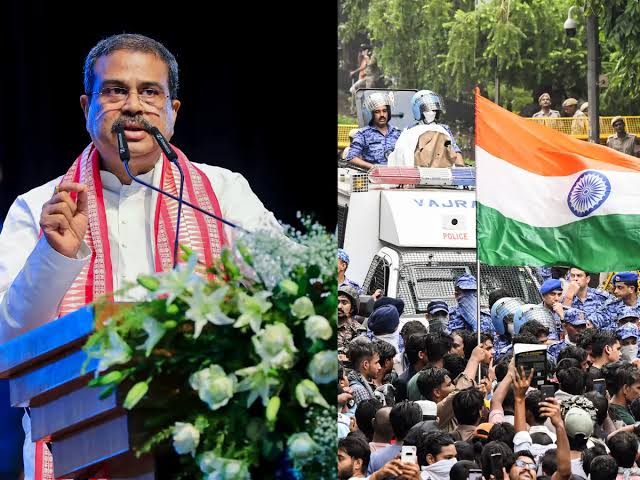
The national capital continues to witness widespread civic and political disruption as student groups and youth movements intensify their agitation over ongoing national examination irregularities. At the center of the controversy is the Dharmendra Pradhan resignation news, driven by thousands of student protesters, activists, and civil society members gathered at Jantar Mantar in New Delhi.
In a major legal development, the Delhi High Court has agreed to hear a Public Interest Litigation (PIL) seeking a comprehensive investigation into the protest organized by the Cockroach Janta Party (CJP) and its subsequent escalation. Simultaneously, public infrastructure across Delhi has felt the impact, with the Delhi Metro closing at least 16 key stations to manage crowd control and law and order near central administrative zones.
Key Highlights of the Jantar Mantar Agitation
- High Court Intervention: The Delhi High Court agrees to hear urgent petitions related to the CJP-led “Sansad Chalo” march and police actions.
- Minister Resignation Demand: Protesters explicitly demand the resignation of Union Education Minister Dharmendra Pradhan over structural examination failures.
- Rejection of Short-Term Fixes: CJP leadership argues that fast-track courts do not solve the fundamental issues causing systemic paper leaks.
- Massive Civic Impact: Multiple security cordons deployed; at least 16 Delhi Metro stations shut down to maintain order.
- Prominent Figures Joined: Environmentalist Sonam Wangchuk and youth leaders lead hunger strikes and mass representations.
Delhi High Court Accepts PIL Seeking Investigation into CJP Protest
The legal battles surrounding the demonstration reached the corridors of justice when the Delhi High Court bench, led by Chief Justice D.K. Upadhyaya, agreed to list PILs concerning the Cockroach Janta Party’s agitation.
┌───────────────────────────────────────────────────────────────────────────┐
│                       DELHI HIGH COURT PROCEEDINGS                        │
├───────────────────────────────────────────────────────────────────────────┐
│ • Petitioner Demands: Specialized probe (NIA/SIT) into funding, public    │
│   disruption, and escalation during the July 20 march.                    │
│ • Student Group Counter-Petitions: Directives against excessive force,    │
│   preservation of CCTV footage, and police accountability.                │
│ • Court Orders: Issued notices; directed preservation of digital and      │
│   video evidence across all protest venues.                               │
└───────────────────────────────────────────────────────────────────────────┘
The petitions highlight two contrasting perspectives. On one hand, pleas submitted by public interest petitioners argue that the massive gatherings disrupted emergency services and destabilized public life in the capital. On the other hand, legal representatives for student groups argue that peaceful demonstrators exercising their fundamental rights under Article 19 were met with disproportionate law enforcement measures. The court’s decision to review video evidence and direct the preservation of CCTV footage marks a pivotal moment in determining institutional accountability during major public assemblies.
Cockroach Janta Party (CJP) Responds to PM Modi’s Announcement on Fast-Track Courts
Following the Prime Minister’s announcement proposing fast-track courts to expedite trial procedures for examination-related frauds, the Cockroach Janta Party (CJP) issued an official response.
Root Cause vs. Quick Fix: Ashutosh Ranka’s Statement
CJP spokesperson Ashutosh Ranka publicly reacted to the government’s announcement, stating that establishing fast-track courts addresses post-crime prosecution rather than preventative security.
“Fast-track courts process cases after a leak has already destroyed the careers of millions of students. The real question that the government must answer is: why do paper leaks happen in the first place? Fast-tracking judicial punishment does not fix compromised exam centers, flawed digital protocols, or administrative negligence.” — Ashutosh Ranka, CJP Spokesperson
The CJP has maintained that punitive measures after the fact are insufficient unless accompanied by structural overhauls within the Ministry of Education and testing agencies.
Background: The Escalating Demand for Dharmendra Pradhan’s Resignation
The call for Union Education Minister Dharmendra Pradhan’s resignation is not an isolated event; it represents months of compounding grievances among competitive exam aspirants.
                 NEET-UG & CBSE Exam Irregularities Reported
                                     │
                                     ▼
                   Public Outcry & Digital CJP Movement
                                     │
                                     ▼
              Sonam Wangchuk Joins Indefinite Hunger Strike
                                     │
                                     ▼
             Mass Mobilization & "Sansad Chalo" March Escalation
                                     │
                                     ▼
              Legal Battle in Delhi HC & Dharmendra Pradhan Resignation Demands
NEET Paper Leak & Examination Irregularities
The current wave of dissatisfaction stems primarily from allegations surrounding major national entrance tests, including the NEET-UG exams and CBSE On-Screen Marking concerns. Students across several states reported discrepancies, compromised question banks, and systemic administrative oversights that undermined the merit-based selection process.
Sonam Wangchuk’s Hunger Strike and Movement Expansion
The demonstration gained massive momentum when renowned climate activist and educationist Sonam Wangchuk joined the protesters at Jantar Mantar, embarking on an indefinite hunger strike. Wangchuk emphasized that the integrity of the nation’s educational framework is directly tied to the country’s youth development and economic future.
Ground Impact: Delhi Metro Shutters 16 Stations Amid Protests
As thousands of aspirants, activists, and youth groups attempted to advance their demonstration toward Parliament House, law enforcement authorities enacted strict security protocols.
To prevent potential overcrowding and maintain public safety around sensitive government zones, the Delhi Metro Rail Corporation (DMRC) closed operations across at least 16 central metro stations.
| Metro Zone / Area | Impact Status | Security Measure Implemented |
| Central Secretariat & Patel Chowk | Entry/Exit Closed | Heavy barricading & police deployment |
| Janpath & Mandi House | Restricted Transit | Security cordons & perimeter control |
| Parliament Street & Connaught Place | Heavy Traffic Diversion | Section 163 BNS Prohibitory Orders invoked |
Commuters faced severe transit delays across Central Delhi, while security personnel deployed multi-layered barricades along all access roads leading to Parliament.
Irony of History: Dharmendra Pradhan’s 1997 Paper Leak Protest
A notable political talking point during the current demonstrations is the historical parallel involving Dharmendra Pradhan himself.
In 1997, nearly three decades before becoming Union Education Minister, Dharmendra Pradhan was a student activist affiliated with the Akhil Bharatiya Vidyarthi Parishad (ABVP) in Odisha. During that period, he led a peaceful protest of roughly 1,500 students outside the Odisha Secretariat—demanding government accountability over a state paper leak controversy. During police action at the venue, Pradhan sustained severe injuries and fractures.
Protesting student groups have frequently cited these historical events to argue that the issue of paper leaks has persisted across generations, emphasizing that leaders who once fought against exam leakages must now accept institutional accountability while holding office.
What Lies Ahead for Public Examination Reforms?
The ongoing situation at Jantar Mantar underscores a deeper structural crisis in India’s public examination architecture. While fast-track courts offer an accelerated judicial route for offenders, experts agree that long-term stability requires comprehensive reform:
- Encrypted Question Paper Distribution: Transitioning to secure, tamper-proof digital delivery mechanisms to minimize physical access prior to exams.
- Independent Testing Audits: Third-party technical and operational security checks for all national testing agencies.
- Whistleblower Protection: Standardized reporting mechanisms for students and administrators to report leak attempts safely.
- Institutional Accountability: Clear administrative responsibility protocols when structural failures occur during national testing cycles.
As the Delhi High Court reviews the legal petitions and public debate continues, the resolution of this crisis remains crucial for millions of students nationwide.
Frequently Asked Questions (FAQs)
1. Why are protesters demanding Union Education Minister Dharmendra Pradhan’s resignation?
Protesters, led by student groups and the Cockroach Janta Party (CJP), are demanding the Education Minister’s resignation to enforce institutional accountability over repeated paper leak allegations in national exams such as NEET-UG.
2. What is the Cockroach Janta Party (CJP)?
The Cockroach Janta Party (CJP) is a youth-led social and political movement formed in response to youth unemployment and examination irregularities, gaining significant momentum during the 2026 Jantar Mantar protests.
3. What stance did the CJP take on PM Modi’s fast-track court announcement?
CJP spokesperson Ashutosh Ranka stated that fast-track courts only punish perpetrators after a leak occurs, whereas the government must focus on preventing paper leaks from happening in the first place.
4. Why were Delhi Metro stations closed during the Jantar Mantar protest?
At least 16 Delhi Metro stations were closed as a precautionary security measure to manage crowd flow, prevent unauthorized marches toward Parliament House, and maintain law and order in Central Delhi.
5. What is the status of the PIL in the Delhi High Court regarding the CJP protest?
The Delhi High Court has agreed to hear petitions regarding the protest, issuing notices to relevant authorities while directing the preservation of CCTV and video footage from the site.
Conclusion
The developments surrounding the Dharmendra Pradhan resignation news mark a significant point in the national dialogue on education reform. With the Delhi High Court stepping in to examine petitions regarding the Cockroach Janta Party protest, the issue has transitioned into both a judicial and policy discussion. As students continue to demand transparency, systemic prevention mechanisms, and political accountability, the outcome of these protests and court hearings could reshape how public examinations are conducted across the nation.
अधिक जानकारी के लिए, आज ही Shabdsanchi के सोशल मीडिया पेजों को फ़ॉलो करें और अपडेटेड रहें।
- Facebook: shabdsanchi
- Instagram: shabdsanchiofficial
- YouTube: @shabd_sanchi
- Twitter: shabdsanchi