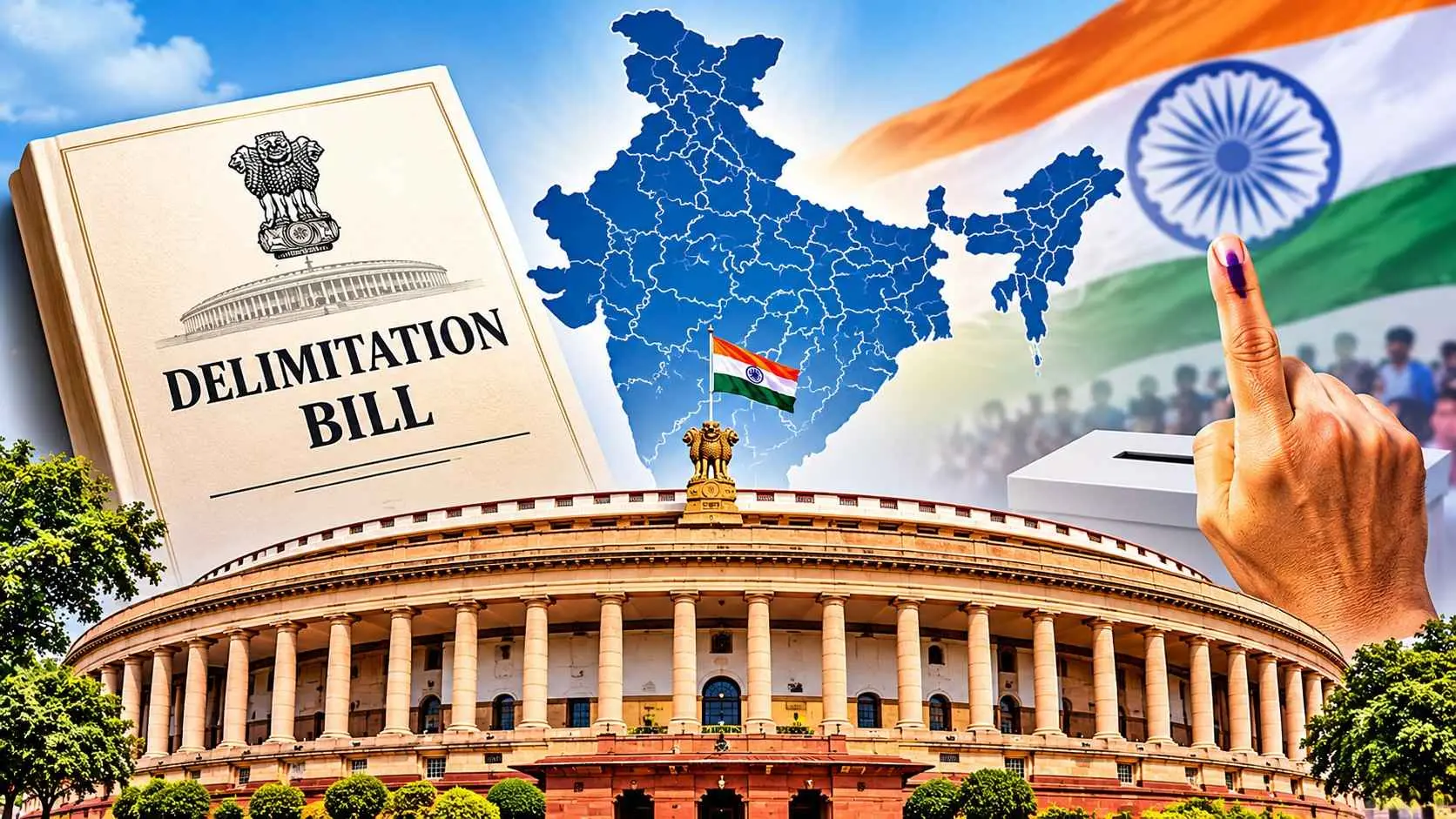
Congress president Mallikarjun Kharge on Saturday, November 28, 2026, announced that the INDIA bloc will oppose the proposed delimitation bill in Parliament starting Monday, November 30, 2026, accusing the Bharatiya Janata Party (BJP) of expanding the Lok Sabha to 850 seats to lock in permanent political control.
Addressing reporters at his New Delhi residence after an opposition meeting ahead of the special parliamentary sitting, Kharge argued that the Constitution (132nd Amendment) Bill undermines constitutional checks and fails to protect Scheduled Castes (SCs) and Scheduled Tribes (STs).
“800 Paar” Jab and Fears of Constitutional Overreach
Kharge linked the proposed 850-member Lok Sabha ceiling to Prime Minister Narendra Modi‘s pre-2024 general election slogan of “400 paar,” which fell short when the BJP won 240 seats and formed a coalition government.
“They are now aiming for ‘800 paar’. Previously, they had set a target of ‘400 paar’ in the elections, which did not materialise. Now, by increasing the number of seats to 850, they seek to seize and retain power indefinitely.” — Mallikarjun Kharge, Congress President
Framing the legislation as a structural threat to India’s parliamentary system, Kharge warned that a lopsided majority could open the door to sweeping constitutional changes.
“Once power goes into their hands, they can even change the Constitution… Just as everyone in China raises their hands together in unanimous support, Narendra Modi wants to secure a similar kind of approval here to destroy democracy in the country.” — Mallikarjun Kharge, Congress President
What the Constitution (132nd Amendment) Bill Actually Proposes
Cleared by the Union Cabinet just a day earlier, the Constitution (132nd Amendment) Bill revamps the government’s earlier 131st Amendment push that faced pushback in April 2026. According to parliamentary tracking by PRS Legislative Research and legislative texts, the revised draft pairs women’s reservation in legislatures with a 50% increase in Lok Sabha and state legislative assembly seats across every state and Union Territory.
Crucially, the bill seals the inter-state ratio of constituencies based on the 1971 Census until 2051, while using the 2011 Census to redraw constituency boundaries during the first delimitation exercise. Proponents argue that a 50% uniform expansion allows one-third of seats to be reserved for women without shrinking the existing seat pool traditionally contested by men, while easing southern states’ fears of losing relative representation.
Expanding the Lok Sabha toward 815–850 seats while keeping the Rajya Sabha capped at 250 under Article 80 alters institutional balance. PRS Legislative Research notes that a larger Lok Sabha shifts the Lok Sabha-to-Rajya Sabha ratio from roughly 2.2:1 to 3.3:1, increasing the lower house’s weight in joint sittings and presidential or vice-presidential elections, while also raising the permissible ceiling on the Council of Ministers under Article 75 from 81 to 122 (the 15% cap set by the 91st Amendment).
SC/ST Quota Concerns and the 2026 Census Question
A central pillar of Kharge‘s critique is that the bill omits explicit guarantees for proportionately higher SC and ST reserved seats under Article 330 as demographic shares evolve. With Census 2026 underway and its data awaited, Kharge contended that relying on older population benchmarks deprives growing SC and ST populations of their rightful share of constituencies.
“Under Article 330, SC/ST seats should be increased but it is not mentioned in this Bill. They haven’t told us anything about Census 2026. But if they will announce it as per the latest Census, then more seats should be given to SC/ST. But they don’t want SC/ST to get their share.” — Mallikarjun Kharge, Congress President
The Congress party’s formal stance calls for keeping the current Lok Sabha strength intact, implementing women’s reservation within the existing seat count, and maintaining the present inter-state seat distribution for 25 years without a massive expansion.
Election Commission Trust Deficit and SIR Fallout
Kharge also objected to entrusting delimitation responsibilities to the Election Commission of India (ECI) amid ongoing opposition anger over the Special Intensive Revision (SIR) of electoral rolls. Following large opposition demonstrations in central Delhi in October 2026 that demanded the removal of Chief Election Commissioner Gyanesh Kumar, opposition leaders have questioned the poll body’s neutrality.
“The very same tainted Election Commission that has removed more than 10 crore people from the voters’ list is being handed the responsibility of delimitation. This is not acceptable to us.” — Mallikarjun Kharge, Congress President
Fractures Inside the INDIA Bloc Before the Vote
While Kharge spoke alongside leaders and MPs from parties including the Trinamool Congress (TMC), Rashtriya Janata Dal (RJD), Samajwadi Party (SP), Shiv Sena (UBT), CPI(M), CPI, National Conference, IUML, and Kapil Sibal, fault lines within the alliance were hard to miss.
Supriya Sule and Sharad Pawar‘s NCP (Sharadchandra Pawar) faction skipped the meeting and have signaled openness to the revised proposals. Meanwhile, the Dravida Munnetra Kazhagam (DMK) passed a resolution after a meeting at Chief Minister M. K. Stalin‘s residence backing the 50% across-the-board seat increase, which aligns with long-standing southern state demands.
With the Lok Sabha reconvening on November 30, 2026 and the Rajya Sabha meeting from December 2 through December 3, 2026, parliamentary arithmetic remains tight. Constitutional amendments require a special majority—a majority of total membership and at least two-thirds of members present and voting—meaning around 359 affirmative votes in the Lok Sabha if 538 members vote (excluding the Speaker and accounting for current vacancies and suspensions).
Frequently Asked Questions (FAQs)
1. What does the proposed delimitation bill do to Lok Sabha seats?
The Constitution (132nd Amendment) Bill proposes a 50% increase in Lok Sabha and state assembly seats across every state and Union Territory, taking the Lok Sabha ceiling up to 850.
2. Why is Mallikarjun Kharge comparing the bill to “800 paar”?
Kharge alleges that expanding the Lok Sabha to 850 seats is a strategy to consolidate power permanently after the BJP fell short of its “400 paar” target in 2024.
3. Which census data is used under the bill, and what happens until 2051?
The bill freezes the inter-state allocation of seats based on the 1971 Census until 2051, while using the 2011 Census to redraw constituency boundaries in the first delimitation exercise.
4. Why are opposition parties divided ahead of the Parliament session?
While Congress and several INDIA bloc partners plan to oppose the bill over SC/ST quota concerns and Election Commission oversight, the DMK supports the 50% seat hike and NCP (SP) stayed away from the opposition huddle.
5. When will Parliament take up the delimitation bill?
Special sittings of Parliament begin on November 30, 2026 in the Lok Sabha and December 2, 2026 in the Rajya Sabha, running through December 3, 2026.
What Happens Next
Over the coming days, the government will test whether defections, regional allies like the DMK, and non-aligned or NCP (SP) lawmakers can deliver the two-thirds threshold needed for a constitutional amendment during the November 30–December 3, 2026 sittings. Even if the bill clears Parliament, its long-term consequences—reshaping Lok Sabha debate time, shifting federal weight toward the lower house, and locking in seat ratios until 2051—will define Indian electoral politics for a generation.

Manish Kumar began his professional journey in digital marketing and performance marketing, and currently works as a Digital Marketing Excutive and SEO expert. With over 3 years of professional experience, he handles both strategy and execution. Currently, he manages digital marketing and performance marketing at ‘Shabd Sanchi’ (shabdsanchi.com).