

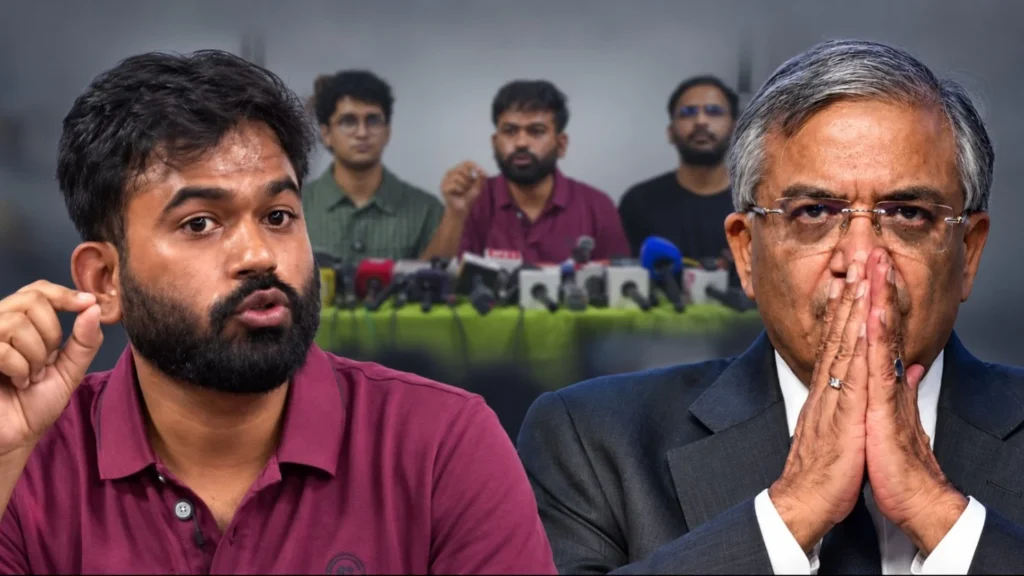
NEW DELHI — Police detained AAP Delhi president Saurabh Bharadwaj and party MLA Sanjeev Jha in New Delhi on Friday after they arrived at Jantar Mantar to lead a massive demonstration against Chief Election Commissioner CEC Gyanesh Kumar. The detentions follow escalating nationwide agitations led by political parties and student organizations demanding Gyanesh Kumar’s immediate resignation over the controversial Special Intensive Revision (SIR) of electoral rolls.
“Despite the peaceful protest, Delhi Police arrested MLA Sanjeev Jha ji and Saurabh. But the movement will continue!” the official Aam Aadmi Party account posted on X shortly after the crackdown.
Despite the heavy security deployment and formal denial of police permits in both metro cities, demonstrators gathered in large numbers to raise serious concerns over electoral integrity and administrative transparency.
High Voltage Drama at Jantar Mantar: AAP Leaders Detained
High voltage drama unfolded near Jantar Mantar as Delhi Police intercepted opposition leaders ahead of the scheduled rally. Saurabh Bharadwaj noted on social media that over 500 people reached the venue early in the day, expressing enthusiasm over youth participation with the message, “GenZ rocks.”
Prohibitory orders under Section 163 of the Bharatiya Nagarik Suraksha Sanhita (BNSS) are currently active across the New Delhi district. The regulation strictly prohibits assemblies of five or more persons, processions, demonstrations, and dharnas without prior written authorization.
Despite these legal restrictions, youth and student groups—including the All India Students’ Association (AISA), National Students’ Union of India (NSUI), and Indian Youth Congress (IYC)—joined the call to action alongside AAP at Jantar Mantar.
CJP Launches ‘Jail Bharo Andolan’ at Mumbai’s Shivaji Park
Simultaneously in Mumbai, the Cockroach Janta Party (CJP) launched its promised “Jail Bharo Andolan” targeting Gate No. 6 of Shivaji Park at 4:00 PM. CJP founder Abhijeet Dipke issued a public appeal encouraging residents and commuters across Mumbai to join the agitation.
In a viral promotional video shared on social media, Dipke was seen posing with an auto-rickshaw driver calling on citizens to gather at the iconic venue. The driver echoed the rally phrase, “Shivaji Park 4 baje,” as momentum built ahead of the scheduled agitation.
“Appointment of CEC should be transparent; there should be involvement of civil society,” stated CJP founder Abhijeet Dipke during his address in Mumbai.
What Triggered the Resignation Demand?
The core controversy stems from the execution of the Special Intensive Revision (SIR) of electoral rolls. Political parties and civil society groups claim that the methodology applied under CEC Gyanesh Kumar lacks oversight and compromises fair voter representation.
Tensions flared significantly after public revelations revealed severe internal disagreements within the Election Commission of India (ECI) itself. Reports confirmed that Election Commissioners Sukhbir Singh Sandhu and Vivek Joshi had formally recorded objections on at least 14 occasions over 10 months regarding official decisions.
Critics highlighted that several of these orders were allegedly issued without the prior knowledge or consensus of the two panel members.
In response to the allegations, the Election Commission issued an official clarification, asserting that the three-member body had taken all administrative decisions—including those relating to the SIR—unanimously. However, this clarification failed to placate opposition factions, leading directly to Friday’s widespread street protests.
Security Escalation across Delhi and Mumbai
Both Delhi Police and Mumbai Police denied permission for the demonstrations citing potential law-and-order disruptions. Security personnel deployed heavily around key government zones, including roads leading to Jantar Mantar and Shivaji Park.
Barricades were erected across New Delhi to filter incoming traffic and prevent large crowds from assembling. Police officials reiterated that violations of Section 163 BNSS would result in immediate detention and legal action.
Frequently Asked Questions (FAQs)
Why are political parties protesting against CEC Gyanesh Kumar?
Protesters are demanding the resignation of Chief Election Commissioner Gyanesh Kumar over concerns regarding the Special Intensive Revision (SIR) of electoral rolls. Concerns deepened after reports indicated two fellow election commissioners recorded objections to several decisions over 10 months.
Who was detained during the Delhi protests?
AAP Delhi president Saurabh Bharadwaj and party MLA Sanjeev Jha were detained by Delhi Police on Friday. They were stopped while attempting to reach the protest site at Jantar Mantar.
What is the ‘Jail Bharo Andolan’ at Shivaji Park?
The ‘Jail Bharo Andolan’ is a mass protest organized by the Cockroach Janta Party (CJP) and its founder Abhijeet Dipke. The agitation was scheduled for 4:00 PM at Gate No. 6, Shivaji Park, Mumbai to demand the CEC’s resignation.
What legal restrictions are currently enforced in Delhi?
Prohibitory orders under Section 163 of the Bharatiya Nagarik Suraksha Sanhita (BNSS) are in force across the New Delhi district. This bans public gatherings of five or more people, demonstrations, and processions without prior written permission.
How did the Election Commission respond to internal dissent allegations?
The Election Commission clarified that all administrative decisions, including those regarding the Special Intensive Revision (SIR) of electoral rolls, were made unanimously by the three-member commission.
Long-Term Implications and What Happens Next
The escalating street demonstrations in Delhi and Mumbai mark a significant political challenge for the leadership of the Election Commission of India. The combination of political opposition from parties like AAP, grassroots mobilization by the CJP, and active involvement from student bodies like AISA, NSUI, and IYC signals that public scrutiny over electoral processes is reaching a critical peak.
Furthermore, public discussions regarding administrative transparency—specifically regarding how decisions are made within multi-member constitutional bodies—will likely pressure regulatory authorities to adopt clearer governance frameworks. As opposition leaders promise to sustain their movement despite detentions and police prohibitions, public focus will remain firmly on CEC Gyanesh Kumar and the Election Commission’s upcoming official statements.