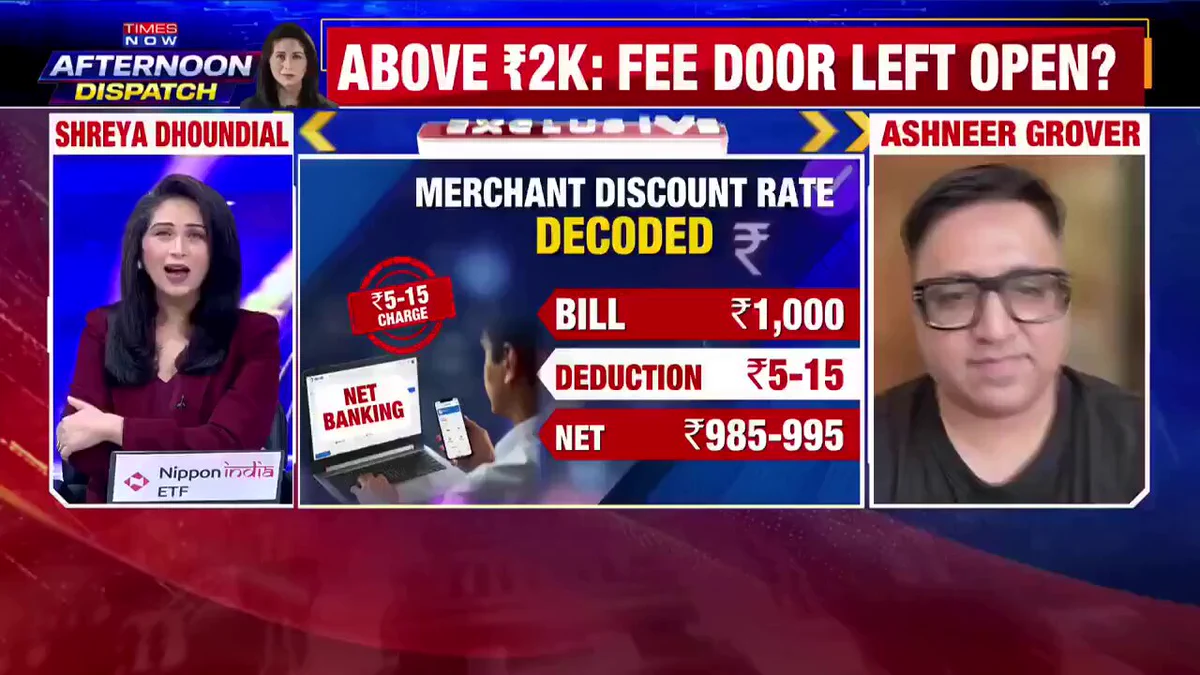
Former BharatPe co-founder and fintech entrepreneur Ashneer Grover has sparked a intense debate surrounding the implementation of a merchant charge on Unified Payments Interface (UPI transactions) above ₹2,000. Despite formal clarifications from the government stating that person-to-person (P2P) transfers will remain entirely free, Grover argued that any levy imposed on merchant transactions ultimately damages consumer interests and should be labeled transparently as a tax.
The controversy follows discussions around introducing a Merchant Discount Rate (MDR) for higher-value UPI transactions, altering the long-standing zero-MDR framework that accelerated digital adoption across India.
Ashneer Grover’s Argument: “Call It Tax”
During an interview with Times Now, Ashneer Grover strongly rejected the logic presented by proponents of the upi charge who claim that merchants can easily afford the transaction fees.
“Then call it tax. Why are you calling it a ‘charge’, ‘MDR’, or claiming that it won’t affect the customer?” Grover remarked.
To highlight the flawed reasoning behind imposing charges based on an entity’s ability to pay, Grover offered a striking comparison: he asked whether an individual would be willing to pay ₹500 every month simply for breathing air just because they have the financial capability to afford it. Video clips of his remarks quickly went viral across social media platforms, igniting widespread discussions among small business owners, retail consumers, and fintech experts.
According to regulatory definitions, a Merchant Discount Rate is a processing fee shared among payment service providers, acquiring banks, and network operators. However, Grover emphasized that renaming or reclassifying fees does not alter their real-world economic weight.
Financial Metrics Countering the UPI Charge Rationale
Expanding on his arguments in a subsequent post on X (formerly Twitter), Grover listed several core financial metrics to challenge the narrative that the banking system requires monetization from UPI transactions to sustain its digital infrastructure:
- RBI Surplus to Government: ₹2.87 lakh crore (US$30 billion)
- Total Listed Bank Profits: ₹4.11 lakh crore (US$42 billion)
- NPCI Pre-Tax Surplus: ₹1,888 crore (US$200 million) reported by the operator of UPI
| Metric | Reported Value |
|---|---|
| RBI Surplus Transfer | ₹2.87 Lakh Crore (~$30 Billion) |
| Total Listed Bank Net Profits | ₹4.11 Lakh Crore (~$42 Billion) |
| NPCI Pre-Tax Surplus | ₹1,888 Crore (~$200 Million) |
Grover questioned the logic of introducing a new levy by asking: “So, who is facing any loss from UPI and which subsidy is the government paying on UPI?” Furthermore, he noted that operating physical ATMs and managing cash logistics carry significantly higher overheads, suggesting that authorities should focus on replacing costly physical infrastructure with streamlined digital channels instead of penalizing merchants.
Consumer Impact: Will Buyers Pay the Price?
Official government statements assure the public that the UPI merchant fee only targets merchant payments above ₹2,000 and that person-to-person transfers will remain free regardless of the amount transferred. Authorities estimate that roughly 96% of everyday merchant transactions will remain completely unaffected because they fall below the ₹2,000 threshold or fall under existing zero-MDR provisions for small businesses.
Despite these assurances, Grover insisted that the consumer impact is real and unavoidable. He drew an analogy to fuel pricing to illustrate how indirect levies operate in retail markets:
“The government says we collect excise from oil companies, the consumer won’t be affected. But is that the case? We pay ₹100 at the pump for a petrol that costs ₹40-50, all because of the excise and tax… End of the day who pays? Whether it is tax or any other charge, the consumer pays.”
In practical terms, merchants faced with higher payment processing expenses often adjust by raising retail prices, setting minimum purchase requirements, or introducing hidden surcharges. Thus, even if a consumer is not billed directly on their UPI app, they absorb the expense at the point of sale.
Frequently Asked Questions (FAQs)
What is the new UPI merchant charge proposal?
The proposal introduces a Merchant Discount Rate (MDR) on merchant UPI payments exceeding ₹2,000. It aims to generate revenue for payment service providers and banks while keeping smaller retail transactions and person-to-person (P2P) transfers entirely free of cost.
Why does Ashneer Grover refer to the UPI merchant charge as a tax?
Grover argues that regardless of whether a fee is labeled as an MDR or a merchant charge, the financial burden is eventually passed on to retail customers through higher product prices, making it function like an indirect tax.
Will everyday personal UPI transfers remain free?
Yes, all person-to-person (P2P) transfers between individuals remain completely free of transaction charges, regardless of the transfer amount. The proposed fees apply solely to commercial transactions conducted with merchants.
What percentage of transactions are affected by the ₹2,000 threshold?
According to official figures, around 96% of all merchant transactions will stay unaffected. Most daily retail purchases fall under ₹2,000 or remain protected under the zero-MDR framework designed for small business operators.
What is the zero-MDR framework in UPI?
The zero-MDR framework is a government mandate ensuring that merchants incur zero fees when accepting payments via UPI or RuPay debit cards. It was designed to encourage digital payment adoption across small merchants.
Conclusion
The debate ignited by Ashneer Grover highlights the friction between building a sustainable financial infrastructure for digital payments and preserving a seamless, low-cost ecosystem for Indian consumers. While regulatory updates aim to balance banking profitability with user growth, business leaders maintain that any merchant-side cost will inevitably trickle down to everyday shoppers. Moving forward, transparent policy choices will remain essential to protecting consumer trust while sustaining India’s digital payment momentum.