The landscape of digital payments in India is preparing for a strategic evolution. Following recent discussions surrounding the Taxation and Other Laws (Amendment) Bill, 2026, concerns surfaced regarding potential fees on UPI transactions. Finance Minister Nirmala Sitharaman addressed these concerns, confirming that end users and consumers will continue to enjoy zero transaction fees on UPI payments.
The proposed changes target the Merchant Discount Rate (MDR) framework, ensuring that any financial adjustment applies exclusively to businesses and merchants rather than retail customers. Here is a comprehensive breakdown of the new bill, how Section 10(A) is changing, and what this means for the digital payments ecosystem.
The Core Announcement: End Users Pay Nothing
Responding to statements raised by Opposition leader Jairam Ramesh, Finance Minister Nirmala Sitharaman clarified that rumors regarding customer-facing fees are unfounded. The government’s intent behind modifying the zero-MDR mandate is to build a sustainable monetization framework for payment infrastructure without burdening the general public.
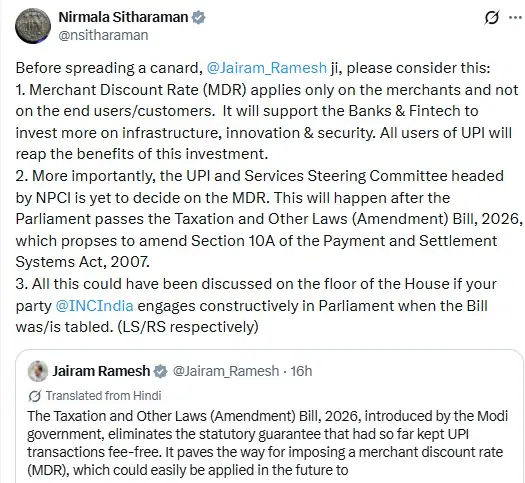
“Merchant Discount Rate (MDR) applies only on the merchants and not on the end users/customers. It will support the Banks & Fintech to invest more on infrastructure, innovation & security. All users of UPI will reap the benefits of this investment.” — Nirmala Sitharaman, Union Finance Minister
For everyday consumers sending money to friends, paying utility bills, or making purchases at retail outlets, UPI transactions remain completely free.
Read Also: Awarapan 2 Trailer: Shivam Pandit Returns in an Intense Revenge Saga
What is the Taxation and Other Laws (Amendment) Bill, 2026?
The Taxation and Other Laws (Amendment) Bill, 2026 is a legislative package designed to update multiple fiscal and financial frameworks. Beyond tax provisions, it contains vital amendments concerning payment systems in India.
| Key Highlights of the 2026 Bill |
|---|
| • Amends Section 10(A) of the Payment and Settlement Systems Act, 2007. |
| • Enables legal flexibility to tweak the mandatory zero-MDR rule. |
| • Protects end-users/consumers from any transactional costs. |
| • Directs funds toward banking security and fintech scalability. |
Modifying Section 10(A) of the Payment and Settlement Systems Act, 2007
In 2019, Section 10(A) was inserted into the Payment and Settlement Systems Act of 2007 to mandate a zero-MDR regime, prohibiting banks and service providers from charging any fee on RuPay and UPI transactions. While this policy spurred widespread adoption across the country, it also placed financial pressure on acquiring banks and fintech firms that bear the operational costs of maintaining servers, fraud prevention engines, and payment gateways.
The 2026 amendment gives legal authority back to the government to specify payment modes where a reasonable MDR can be reintroduced for commercial entities.
Demystifying Merchant Discount Rate (MDR) in UPI Transactions
To understand the impact of the bill, it is essential to define Merchant Discount Rate (MDR). MDR is the processing fee that a merchant pays to the acquiring bank and payment service provider (PSP) for processing digital payments through debit cards, credit cards, or UPI.
| Stage / Entity | Action / Relationship |
| Customer | Pays ₹1,000 via UPI (0% Fee) |
| Merchant | Processes transaction |
| Payment Gateway / Acquiring Bank / Fintech | Retains small MDR percentage |
| Bank / Fintech Infrastructure | Receives funds for infrastructure support |
Why Banks and Fintechs Need Infrastructure Reinvestment
Processing billions of UPI transactions every month requires server capacity, cybersecurity infrastructure, continuous software updates, and customer support channels. Under a strict zero-MDR rule, financial institutions rely on government subsidies, which often do not cover total operational expenses.
By allowing a controlled MDR on commercial merchants, the ecosystem generates revenue that banks and fintech companies can reinvest into:
- Enhanced System Uptime: Reducing transaction failure rates during peak hours.
- Advanced Fraud Prevention: Implementing AI-driven security layers to counter digital scams.
- Feature Innovation: Accelerating cross-border payments, offline UPI, and conversational voice payments.
NPCI’s Role and Next Steps for Implementation
The Finance Minister emphasized that introducing the enabling law in Parliament does not mean instant fee implementation. The exact rate structures, caps, and eligibility criteria will be decided by the UPI and Services Steering Committee, led by the National Payments Corporation of India (NPCI).
This committee will evaluate parameters such as merchant turnover categories (e.g., separating small vendors from large enterprise retailers) and transaction thresholds before finalizing any fee model.
Parliamentary Proceedings and Political Context
The bill passed amid lively parliamentary proceedings during the Monsoon session. In response to opposition critiques regarding the lack of floor debate, Union Minister Nirmala Sitharaman noted that detailed deliberations could have taken place had the opposition engaged constructively during the sessions in the Lok Sabha and Rajya Sabha.
With the legislative framework cleared, regulatory authorities can now work toward balancing merchant growth with sustainable digital infrastructure development.
Read Also: Usha Nadkarni’s Untold Story: Trauma, Independence, and Living Alone at 80
Frequently Asked Questions
Q1: Will I have to pay any extra fee when making a purchase via UPI?
Answer: No, end-users and customers will not be charged any fees for making UPI transactions. The proposed Merchant Discount Rate (MDR) applies exclusively to business owners and merchants accepting digital payments. Consumer transfers remain entirely free.
Q2: What is the Merchant Discount Rate (MDR) in simple terms?
Answer: Merchant Discount Rate (MDR) is a small processing fee paid by merchants to banks and payment service providers for handling digital transactions. It helps payment companies cover operational expenses, hardware maintenance, system security, and network infrastructure costs.
Q3: Why is the government changing Section 10(A) of the Payment Systems Act?
Answer: Section 10(A) previously enforced a strict zero-fee rule across all UPI payments. The amendment provides the government legal flexibility to allow banks and fintechs to collect reasonable MDR from merchants, supporting long-term investments in payment security and platform stability.
Q4: When will the new UPI merchant charges go into effect?
Answer: The charges will not take effect immediately. Following the passage of the Taxation Bill 2026, the Steering Committee under NPCI will carefully review market conditions and determine appropriate rates, merchant categories, and operational timelines.
Q5: Will small street vendors and local shopkeepers be affected by MDR?
Answer: The NPCI committee is expected to design tiered structures that protect small vendors and micro-merchants. The primary goal is to target commercial entities and higher-value transaction tiers without discouraging small-scale digital adoption.
Conclusion
The debate surrounding UPI transactions highlights the balance between user convenience and backend sustainability. By clarifying that consumers remain exempt from charges, the Finance Ministry has safeguarded public trust in digital payments. Simultaneously, enabling a structured MDR for merchants ensures that banks, fintech providers, and NPCI can continuously upgrade payment security, scale infrastructure, and drive financial innovation across India.