



NEW DELHI — Prime Minister Narendra Modi paid homage to Mahatma Gandhi on October 2, 2026, sharing a timeless Sanskrit Subhashitam on X that highlights Bapu’s lifelong dedication to truth, non-violence, compassion, and service. The Prime Minister emphasized that Bapu’s principles serve as an enduring beacon light for humanity.
“पूज्य बापू का संपूर्ण जीवन सत्य, अहिंसा, करुणा और सेवा का ऐसा प्रकाशस्तंभ है, जो हर युग में मानवता का मार्ग प्रशस्त करता रहेगा।”
अद्वेष्टा सर्वभूतानां मैत्रः करुण एव च।
निर्ममो निरहङ्कारः समदुःखसुखः क्षमी॥
(Bhagavad Gita, Chapter 12, Verse 13)
The Essence of the Sanskrit Subhashitam
The Sanskrit verse posted by the Prime Minister directly defines the spiritual and ethical criteria of a high seeker—traits deeply embodied by Bapu throughout India’s freedom struggle.
The verse translates to: A person who harbors zero hatred toward any living creature, who treats every entity with friendship and compassion, who lives detached from material possessiveness (Nirmamo) and personal ego (Nirahankara), and who maintains mental equanimity in both pleasure and pain while remaining perpetually forgiving—such a soul represents the highest spiritual ideal.
By referencing this specific verse from the Bhagavad Gita, PM Narendra Modi highlighted how Mahatma Gandhi converted abstract philosophical principles into practical, real-world tools for social transformation and national liberation.
National Tributes Mark Gandhi Jayanti 2026
The national commemoration commenced early on Friday morning, as leaders across the political spectrum gathered at Rajghat in New Delhi to offer floral tributes.

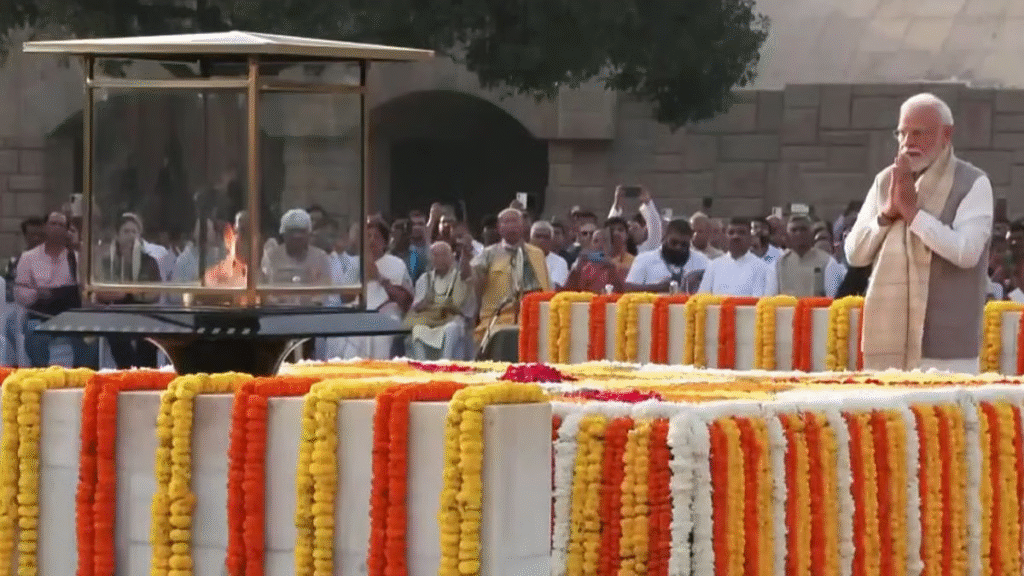
Key constitutional authorities and political figures present at the memorial included:
- President Droupadi Murmu
- Prime Minister Narendra Modi
- Lok Sabha Speaker Om Birla
- Union Minister Manohar Lal Khattar
- Delhi Chief Minister Rekha Gupta and Delhi Lieutenant Governor Taranjit Singh Sandhu
- Leader of the Opposition in Lok Sabha Rahul Gandhi and Congress President Mallikarjun Kharge
Official statements released by the Prime Minister’s Office (PMO) and published via the Press Information Bureau (PIB) highlighted Bapu’s vision as foundational to achieving a Viksit Bharat (Developed India).
Renewed Call for Swadeshi and Khadi
Beyond spiritual tributes, PM Modi issued an actionable call to all citizens to adopt indigenous goods, linking Gandhi’s historical economic model with modern economic self-reliance.
“Gandhi Ji always promoted Swadeshi, and Khadi was one of its most prominent symbols. I request everyone to buy a Khadi product on October 2 and proudly declare, ‘This is Swadeshi.’”
— PM Narendra Modi
Government ministries simultaneously launched the implementation phase of Special Campaign 6.0 and nationwide cleanliness drives under the Swachhata Hi Seva Campaign 2026. Local governance units across rural sectors organized Special Gram Sabhas to launch the People’s Plan Campaign 2026-27, titled ‘Sabki Yojana, Sabka Vikas’.
Global Resonance: International Day of Non-Violence
In 2007, the United Nations General Assembly (UNGA) officially designated October 2 as the International Day of Non-Violence.
Global diplomatic missions and international institutions marked the occasion by reaffirming the relevance of Gandhian principles in resolving contemporary global conflicts and fostering sustainable development goals.
Frequently Asked Questions (FAQs)
What Sanskrit Subhashitam did PM Modi share on Gandhi Jayanti 2026?
PM Narendra Modi shared the verse “Adveshta Sarvabhootanam Maitrah Karuna Ev Cha…” from Chapter 12, Verse 13 of the Bhagavad Gita. The verse highlights complete freedom from malice, selflessness, equanimity, and universal kindness as the ultimate human virtues embodied by Mahatma Gandhi.
What is the meaning of “Adveshta Sarvabhootanam”?
“Adveshta Sarvabhootanam” means harboring no hatred or ill will toward any living being. It emphasizes living with universal friendship, active empathy, and unconditional forgiveness without ego or selfish attachment.
How did PM Modi connect Mahatma Gandhi’s ideals to modern India?
PM Modi linked Bapu’s emphasis on Swadeshi and self-reliance to modern nation-building initiatives aimed at creating a Viksit Bharat. He urged citizens to actively purchase local Khadi items as a commitment to sustainable domestic production.
Who paid tributes to Mahatma Gandhi at Rajghat on October 2, 2026?
Top national leaders paid floral tributes at Rajghat, including President Droupadi Murmu, PM Narendra Modi, Lok Sabha Speaker Om Birla, and Leader of Opposition Rahul Gandhi. Representatives across party lines joined to honor Bapu’s legacy.
Why is October 2 celebrated globally as the International Day of Non-Violence?
The United Nations established October 2 as the International Day of Non-Violence to honor Mahatma Gandhi’s global impact. The day promotes peace, tolerance, and conflict resolution through non-violent political and social means.
Definitive Conclusion & Long-Term Policy Implications
PM Narendra Modi’s invocation of classical Sanskrit literature to commemorate Mahatma Gandhi signals a deliberate alignment of cultural heritage with contemporary governance strategies. By positioning Bapu’s ethics—specifically non-violence, service, and Swadeshi—as operational benchmarks, the administration reinforces key socio-economic agendas.
Looking ahead, integrating Gandhian self-reliance into national policies like Make in India and local governance programs (Sabki Yojana, Sabka Vikas) serves a dual objective: driving domestic manufacturing growth and strengthening grassroots civic participation. As global geopolitical tensions persist, India’s diplomatic positioning anchored in the International Day of Non-Violence continues to offer a strategic, values-based approach to international peacebuilding and sustainable development.