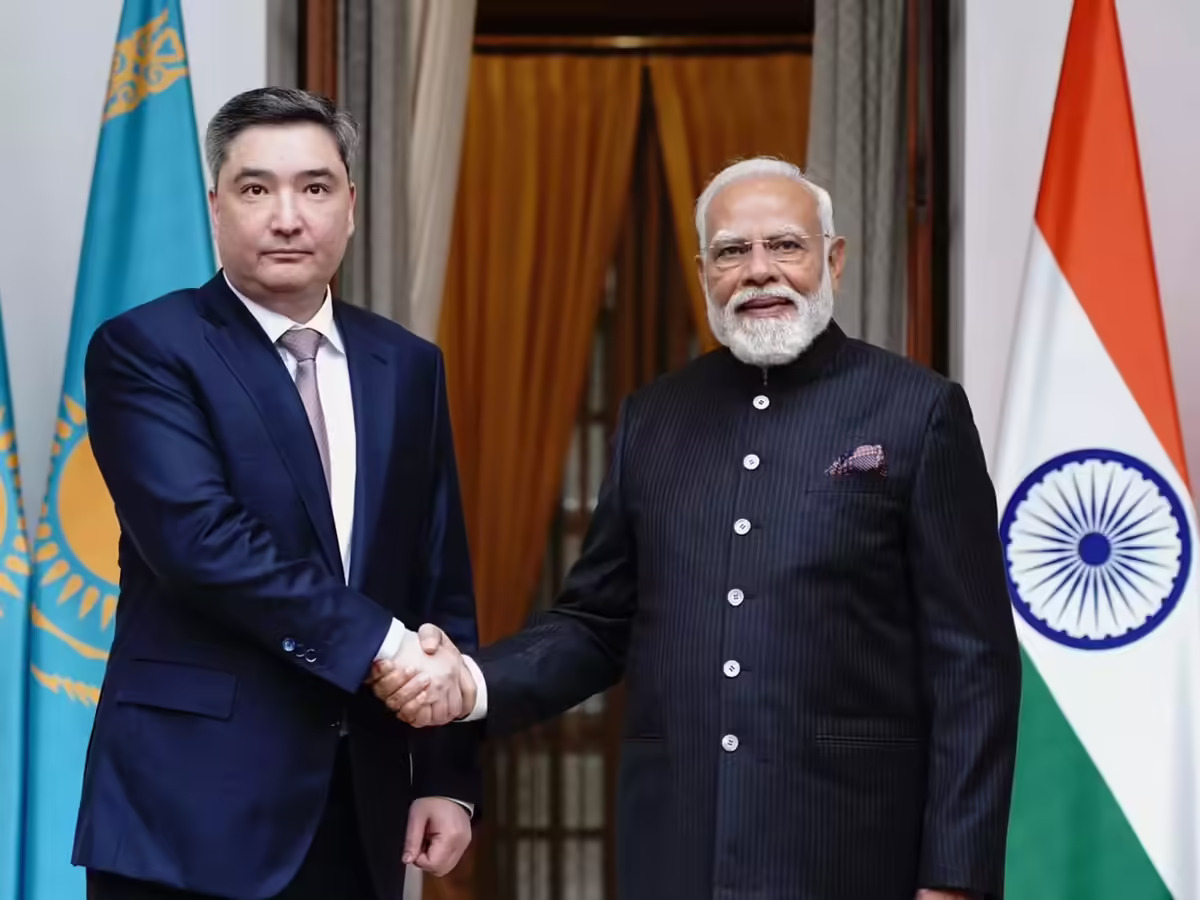
Prime Minister Narendra Modi held a high-level bilateral meeting with Kazakhstan Prime Minister Olzhas Bektenov on Thursday, focusing on a roadmap to strengthen strategic partnership between the two nations. The discussions took place on the sidelines of the India-AI Impact Summit 2026 at Bharat Mandapam, New Delhi. Both leaders reviewed existing cooperation while identifying new avenues in technology and energy.
Deepening Bilateral Cooperation Across Sectors
The meeting between the two leaders served as a pivotal moment to reassess the multifaceted relationship between India and Central Asia’s largest economy. According to the Ministry of External Affairs (MEA), the dialogue covered a wide spectrum of bilateral interests. The primary focus remained on how to strengthen strategic partnership by integrating modern technological needs with traditional sectors like trade and defense.
Spokesperson Randhir Jaiswal noted that the leaders explored ways to deepen ties in security, connectivity, and people-to-people exchanges. Kazakhstan remains a key partner for India’s “Extended Neighborhood” policy, acting as a bridge between South Asia and the Eurasian landmass.

Focus on Energy and Emerging Technologies
Energy security stood at the forefront of the discussions. Kazakhstan is one of India’s most reliable suppliers of natural resources, particularly uranium. The leaders discussed expanding this cooperation to include renewable energy projects and sustainable mining practices.
Furthermore, given the venue of the meeting—the AI Impact Summit—emerging technologies took center stage. India’s rapid advancement in Digital Public Infrastructure (DPI) and AI-driven governance models was offered as a template for further collaboration. Both nations expressed a keen interest in co-developing AI solutions that can address civic challenges in health and agriculture.
Strengthening Regional Connectivity
Connectivity remains a bottleneck for India-Central Asia trade. During the talks, the leaders touched upon the International North-South Transport Corridor (INSTC) and the potential of the Chabahar Port in Iran to facilitate smoother cargo movement. By improving these routes, both nations hope to significantly boost bilateral trade volumes, which currently do not reflect the true potential of their economies.
A Global Hub: The AI Impact Summit 2026
The diplomatic calendar in New Delhi has reached a fever pitch with the ongoing India-AI Impact Summit. Apart from the Kazakh delegation, Prime Minister Modi also engaged in separate talks with leaders from Croatia, Serbia, Finland, and Spain. High-profile attendees like UN Secretary-General Antonio Guterres and Google CEO Sundar Pichai have turned the summit into a melting pot of geopolitics and technology.
Minister of State for External Affairs Kirti Vardhan Singh, who received PM Bektenov at the airport, emphasized that such high-level visits provide a fresh “fillip” to robust partnerships. The summit, running from February 16 to 20, highlights India’s growing role as a global moderator in the ethics and implementation of Artificial Intelligence.
Security and Defense Collaboration
Security cooperation, especially in the context of regional stability, was another critical pillar of the talks. Both India and Kazakhstan share concerns regarding counter-terrorism and maritime security. The leaders agreed to enhance military-to-military cooperation, which includes joint exercises and training programs. This alignment is seen as vital for maintaining peace in the volatile Central Asian region.
To learn more, follow Shabdsanchi’s social media pages today and stay updated.
- Facebook: shabdsanchi
- Instagram: shabdsanchiofficial
- YouTube: @shabd_sanchi
- Twitter: shabdsanchi