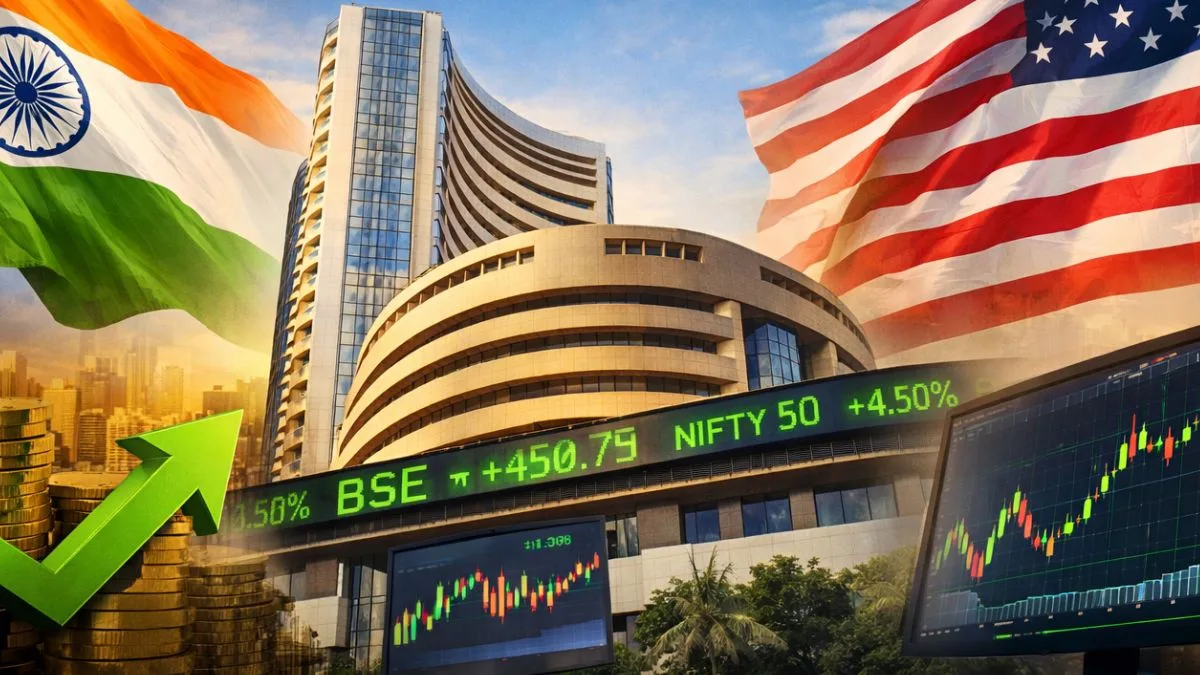
Benchmark equity indices Sensex and Nifty opened higher in early trade on Tuesday, November 17, 2026, propelled by robust foreign fund inflows and a constructive dip in global crude oil prices. The 30-share BSE Sensex advanced 108.83 points to trade at 82,184.33, while the 50-share NSE Nifty rose 31.90 points to reach 25,325.75. As trading progressed, momentum expanded further with the Sensex quoting 248.98 points higher at 82,353.77 and the Nifty moving up 64.45 points to 25,354.20, underlining structural domestic resilience.
Macroeconomic Tailwinds: FII Inflows and Cooling Crude
The domestic market’s ability to withstand negative global sentiment stems directly from powerful domestic and macroeconomic catalysts. Foreign Institutional Investors (FIIs) injected substantial capital, purchasing equities worth ₹4,864.68 crore on Monday, November 16, according to official exchange data.
Simultaneously, global oil benchmark Brent crude traded 0.88% lower at $91.65 per barrel. For an energy-importing economy like India, oil dipping below the critical $92 threshold drastically improves fiscal metrics, lowers import bills, and protects corporate margins.
“The tailwinds that made India the best-performing market in November so far continue to get stronger. Brent crude dipping below $92 will further strengthen India’s macros. The FPI inflows into India in November, so far, have reached ₹84,166 crore,” said V.K. Vijayakumar, Chief Investment Strategist, Geojit Investments Ltd.
Mr. Vijayakumar emphasized that this dramatic reversal of Foreign Portfolio Investment (FPI) flows, coupled with impressive corporate earnings growth reflected in recent Q2 results, grants the Indian market elite insulation against external turbulence.
Sectoral Performance and Market Breadth
Market breadth remained strongly in favor of buyers during the morning session. Leading the pack within the Sensex basket were blue-chip heavyweights:
- InterGlobe Aviation
- Maruti Suzuki
- Adani Ports
- Mahindra & Mahindra
- Axis Bank
- State Bank of India (SBI)
Conversely, selective profit booking dragged down a few counters, with Tech Mahindra, HCL Tech, Power Grid, and NTPC trading among the early laggards.
On Monday, November 16, the broader market closed on a solid footing where the Sensex climbed 512.34 points (or 0.63%) to settle at 82,104.79, and the Nifty advanced 146.80 points (or 0.58%) to close at 25,291.10.
Global Divergence: The U.S. Tech Wind-Down and India’s Advantage
While Indian indices marched upward, global markets presented a contrasting picture. Asian indices—including South Korea’s Kospi, Japan’s Nikkei 225, Shanghai’s SSE Composite, and Hong Kong’s Hang Seng—traded lower.
This followed a sharp sell-off in U.S. equity markets on Monday, November 16, where the Nasdaq Composite tanked 2.49%, the S&P 500 dropped 1.92%, and the Dow Jones Industrial Average declined 1.41%.
Market experts note that the ongoing winding down of the artificial intelligence (AI) trade in the United States is disproportionately impacting tech-heavy export economies like South Korea, Taiwan, and Japan. Analysts view this rotation away from overheated tech sectors as an indirect benefit for Indian equities, which offer a diversified domestic consumption story and stable structural inflows.
Frequently Asked Questions (FAQs)
Q: What drove the rise in Indian stock markets today?
A: Indian stock markets rose in early trade due to steady foreign institutional investor (FII) inflows and a beneficial drop in global crude oil prices.
Q: How much did the Sensex and Nifty gain in early trade?
A: The 30-share BSE Sensex advanced 108.83 points to 82,184.33, while the 50-share NSE Nifty rose 31.90 points to 25,325.75 during early exchanges.
Q: What is the current price of Brent crude oil affecting the markets?
A: Brent crude traded 0.88% lower at $91.65 per barrel, strengthening India’s macroeconomic fundamentals.
Q: What are the total FII inflows into India for November so far?
A: FPI inflows into Indian equities have reached a massive ₹84,166 crore for the month of November.
Q: Which major stocks were top gainers in the Sensex pack?
A: Major winners included InterGlobe Aviation, Maruti Suzuki, Adani Ports, Mahindra & Mahindra, Axis Bank, and State Bank of India.
Analytical Summary & Outlook
The divergence between Indian outperformance and regional Asian weakness highlights a structural shift in investor preference. With cumulative November FPI inflows crossing ₹84,166 crore and Brent crude remaining subdued below $92, India’s macro buffer remains exceptionally robust.
Looking ahead, market resilience will heavily depend on sustained domestic retail participation via Mutual Funds (SIPs) and whether FII buying momentum absorbs ongoing global tech corrections. Investors should maintain a stock-specific approach, focusing on fundamentally strong domestic cyclicals while tracking global commodity trends closely.

Manish Kumar began his professional journey in digital marketing and performance marketing, and currently works as a Digital Marketing Excutive and SEO expert. With over 3 years of professional experience, he handles both strategy and execution. Currently, he manages digital marketing and performance marketing at ‘Shabd Sanchi’ (shabdsanchi.com).