



The Indian Army is evaluating a landmark proposal to abolish the Brigadier rank, paving the way for a direct career transition from Colonel to Major General. Driven by the urgent need to bridge a stark promotion-timing disparity with civil services and streamline modern military command structures ahead of the 8th Central Pay Commission, this structural overhaul could fundamentally redefine officer career trajectories across the tri-services.
The Core Catalyst: Bridging the Promotion Gap
To understand why this structural shift is on the table, one must examine the current pyramidal hierarchy of the Indian armed forces. At junior and mid-level tiers, the officer pool is densely populated, creating severe bottlenecks as personnel vie for scarce higher-level vacancies.
Statistics indicate that an Indian Army officer currently requires an average of 32 to 33 years of dedicated service to attain the prestigious Major General pay scale. In stark contrast, officers entering elite civil services such as the Indian Administrative Service (IAS) and Indian Police Service (IPS) scale equivalent executive and pay tiers within a compressed span of 16 to 18 years.
This glaring systemic lag has long sparked discussions regarding officer retention, morale, and career progression stagnation. While a similar structural review was deliberated back in 2018 under the tenure of the late Chief of Defence Staff General Bipin Rawat, the proposal was shelved before implementation. Today, evolving operational demands have brought the concept back to the forefront of military strategy.
Command Architecture and Operational Implications

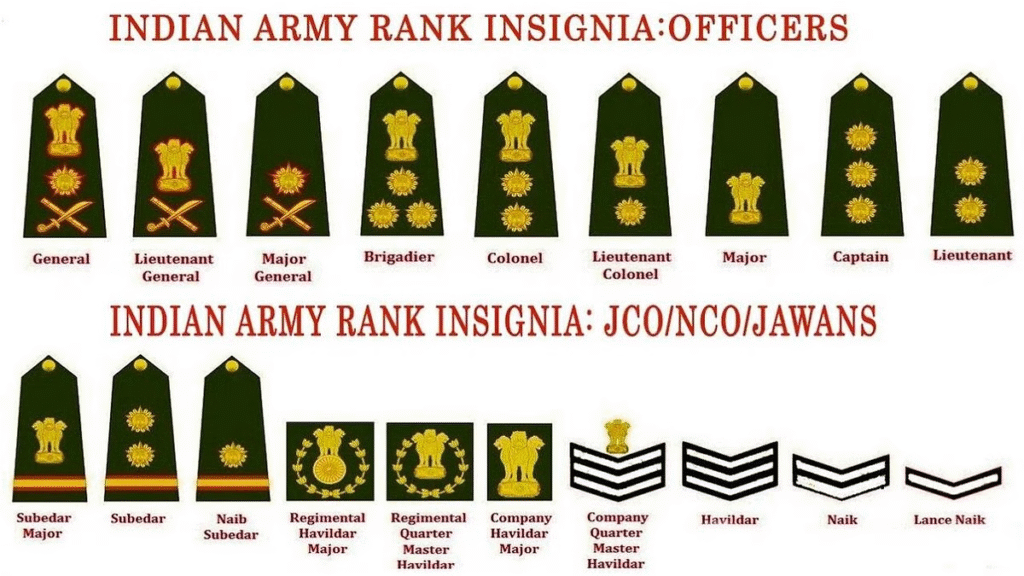
If officially sanctioned by the Ministry of Defence, the removal of the Brigadier rank will trigger cascading adjustments in field commands and administrative hierarchies:
- Brigade-Level Commands: Under the revised framework, tactical brigades would potentially be commanded by Major General-ranked officers, who would simultaneously retain broader divisional oversight responsibilities.
- Retirement and Service Brackets: The framework opens up policy discussions around establishing the Major General rank as a more accessible baseline retirement benchmark for regular officers.
- Tri-Service Ripple Effects: Because military parity is strictly maintained across branches, the abolishment of the Army’s Brigadier rank directly implicates equivalent ranks in sister services—specifically Commodores in the Indian Navy and Air Commodores in the Indian Air Force.
Strategic Realities and Implementation Hurdles
While streamlining the hierarchy offers long-term administrative relief, executing such a massive transition involves complex logistical and structural hurdles.
The Indian military is already in the midst of implementing revolutionary tactical formations, such as Integrated Battle Groups (IBGs). Each IBG functions as a nimble, self-contained fighting unit comprising approximately 5,000 troops. Introducing a major rank restructuring while simultaneously operationalizing IBGs requires meticulous calibration of command responsibilities.
Defense experts note that the primary challenge lies in the meticulous readjustment of existing billets, functional responsibilities, and seniority matrices. Any definitive execution remains strictly contingent upon comprehensive reviews by military planners and final clearance from the Union government.
Frequently Asked Questions (FAQs)
1. Is the Brigadier rank officially abolished in the Indian Army?
No, the removal of the Brigadier rank is currently a high-level proposal under active consideration and has not yet been formally enacted or approved by the government.
2. What is the primary objective behind this proposed structural change?
The primary objective is to eliminate promotion bottlenecks, bridge the massive career-growth gap between military officers and civil servants, and prepare the force for modern warfare structures.
3. How long does it currently take an Army officer to reach the rank of Major General?
An officer currently requires an average of 32 to 33 years of service to reach the Major General pay tier.
4. How will this proposal affect the Indian Navy and Indian Air Force?
Because naval Commodores and Air Force Air Commodores hold equivalent rank status to Army Brigadiers, any reform in the Army will necessitate corresponding structural adjustments across all three services.
5. Where will this proposal be formally presented?
Defense sources indicate that the finalized restructuring framework is slated to be placed before the upcoming 8th Central Pay Commission for official consideration.
Analytical Conclusion and Future Outlook
The debate over restructuring the mid-to-senior officer tier touches the very heart of military human resource management. As modern warfare demands leaner, faster, and more adaptable decision-making networks, traditional bureaucratic pyramids risk slowing operational responsiveness.
Whether the Ministry of Defence ultimately greenlights the direct Colonel-to-Major-General transition will depend on balancing institutional tradition with the urgent demand for career parity. If implemented, it will mark one of the most profound structural transformations in modern Indian military history, reshaping leadership pipelines for decades to come.


Manish Kumar began his professional journey in digital marketing and performance marketing, and currently works as a Digital Marketing Excutive and SEO expert. With over 3 years of professional experience, he handles both strategy and execution. Currently, he manages digital marketing and performance marketing at ‘Shabd Sanchi’ (shabdsanchi.com).