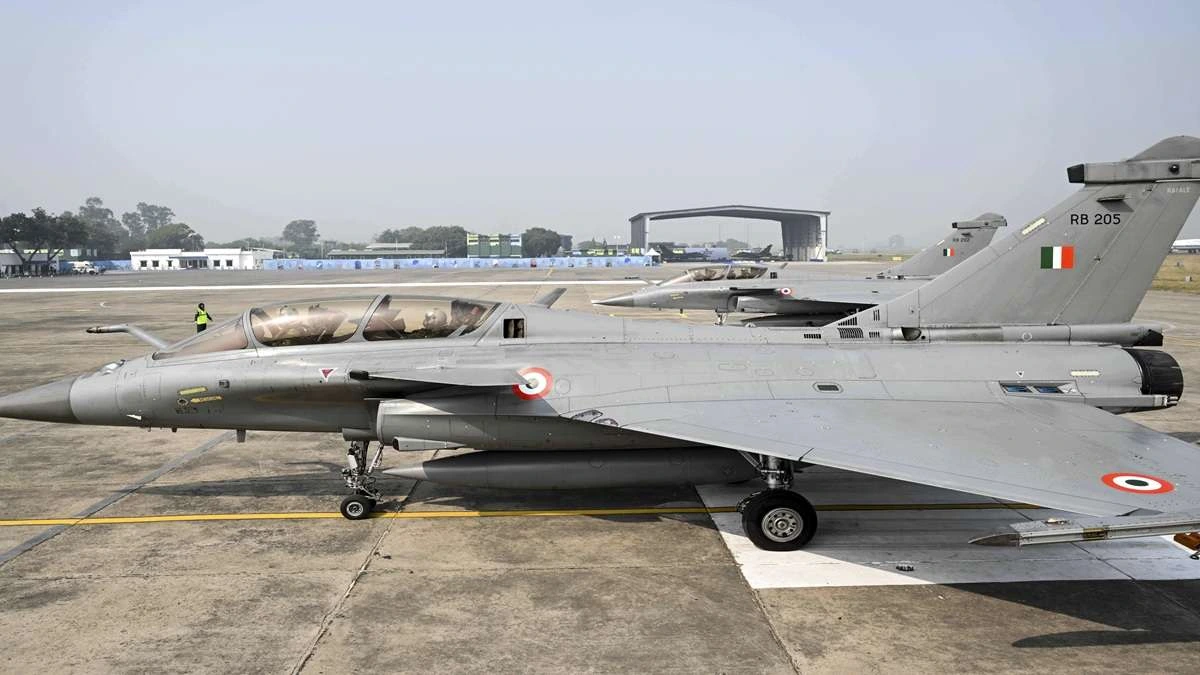
British aviation publication FlightGlobal has revised its estimate of the IAF Rafale active fleet down to 32 aircraft from 35 in its latest World Air Forces directory, but Ministry of Defence (MoD) officials have disputed the figure, stating that the numbers did not come from the ministry or the Indian Air Force (IAF).
The revision surfaces roughly 18 months after Operation Sindoor in May 2025, reigniting public debate over combat attrition claims, open-source defense estimates, and India’s broader fighter jet expansion plans.
What the FlightGlobal Revision Actually Says
According to the latest edition of FlightGlobal‘s World Air Forces directory, compiled using Cirium‘s military fleet database, active Rafale jets in IAF service now stand at 32. That represents a drop of three aircraft from the 35 active jets listed in FlightGlobal‘s 2026 edition published in late 2025, and four below the 36 fighters India originally procured from France.
India’s original IAF contract from France comprised 28 single-seat EH variants and eight twin-seat DH variants. However, the latest directory assessment does not identify which specific airframes were excluded from the active count or state the exact reason behind the downward revision.
“The latest assessment, compiled using Cirium’s military fleet database, does not specify which aircraft were excluded from the active inventory or the reasons behind the revision.”
Cirium tracks military aircraft at the individual airframe level using publicly available sources such as aircraft sightings, flight-tracking data, and defense reporting. Analysts note that changes in active fleet estimates can reflect aircraft undergoing scheduled maintenance, upgrades, or structural repairs, or simply conservative classification when confirmation is limited.
Why the Defence Ministry Pushes Back
Senior Ministry of Defence officials rejected the 32-jet figure as an external assessment rather than an official disclosure. Officials emphasized that the IAF did not supply these numbers and noted the lack of airframe-level evidence supporting the Rafale fighter count cut.
To underscore that all 36 jets remain accounted for within the service’s sustainment framework, officials pointed out that the IAF issued a tender in June seeking “bridge support” across all 36 Rafale aircraft. Maintenance and bridge-support contracts are tied to fleet sustainment requirements, making the June tender a key counter-argument from the MoD side.
“In June this year, the IAF issued a tender seeking ‘bridge support’ for all 36 Rafale aircraft, underlining that the entire fleet remains part of its support and maintenance requirements.”
Operation Sindoor Context and Narrative Friction
The debate carries heightened political and strategic weight because it follows Operation Sindoor, launched in May 2025 after the April 22 terror attack in Pahalgam‘s Baisaran Valley in Jammu and Kashmir killed 26 people, mostly tourists. The strikes triggered a four-day military confrontation between India and Pakistan before an understanding to halt firing was reached on May 10.
Following Operation Sindoor, the IAF stated that “losses are a part of combat,” while declining to disclose exact numbers or types of aircraft involved. Meanwhile, FlightGlobal‘s latest directory also trimmed its estimate of Pakistan‘s Saab 2000 Erieye airborne early warning and control (AEW&C) fleet from nine to seven, keeping regional air-power math under intense scrutiny.
For defense analysts and information-warfare observers, outside fleet estimates often become flashpoints during sensitive post-conflict periods. Because open-source databases rely on public signals rather than classified air-force ledgers, any dip in a Rafale active fleet estimate can quickly be cited in competing narratives even without proof of permanent loss.
Broader Procurement Picture: 114 IAF Jets and 26 Naval Rafales
Even as the Rafale jet count sparks headlines, New Delhi’s broader commitment to the platform is expanding rather than shrinking. India is pursuing the acquisition of 114 additional Rafale fighters from France for the IAF, with defence procurement approvals covering major fleet and surveillance additions.
Separately, the Indian Navy signed a contract in 2025 for 26 Rafale-Marine fighter jets to operate from its aircraft carriers, including INS Vikrant and INS Vikramaditya. Together, ongoing IAF plans and naval inductions mean the India Rafale fighter jet count story is defined far more by long-term force expansion and local industrial participation than by a single directory table.
Frequently Asked Questions
What is the current active Rafale count in the IAF according to FlightGlobal?
FlightGlobal‘s latest World Air Forces directory puts the active IAF Rafale count at 32 aircraft, down from 35 in its previous edition.
Does the Ministry of Defence accept the 32-aircraft figure?
No, senior Ministry of Defence officials disputed the assessment, saying the data did not come from the ministry or the IAF and lacks specifics on any excluded jets.
How many Rafale jets did India originally buy for the Air Force?
India procured 36 Rafale fighter jets from France, consisting of 28 single-seat EH jets and eight twin-seat DH jets.
Why do open-source fleet numbers sometimes differ from official stances?
Directories like FlightGlobal and Cirium rely on public tracking, sightings, and defense reporting, which may reflect maintenance or conservative estimates rather than classified service records.
What other Rafale deals are underway for India’s armed forces?
India is pursuing 114 additional Rafale fighters for the IAF and signed a 2025 contract for 26 Rafale-Marine jets for the Indian Navy.
What Happens Next
Expect the Ministry of Defence to continue treating external fleet tallies as non-authoritative unless operational losses or retirements are formally announced. Over the medium to long term, the strategic story around IAF Rafale strength will hinge on contract execution for the 114 additional fighters, induction of the 26 Rafale-Marine jets, and sustaining fleet availability across both land and carrier operations.

Manish Kumar began his professional journey in digital marketing and performance marketing, and currently works as a Digital Marketing Excutive and SEO expert. With over 3 years of professional experience, he handles both strategy and execution. Currently, he manages digital marketing and performance marketing at ‘Shabd Sanchi’ (shabdsanchi.com).