


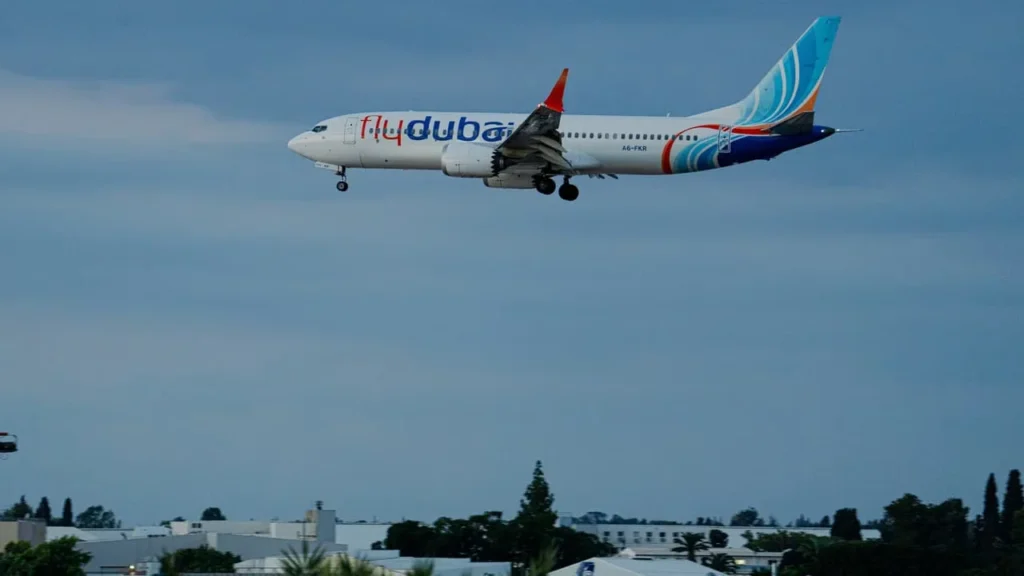
A major investigative report by The Wall Street Journal (WSJ) has revealed that a severe cockpit security incident aboard FlyDubai Flight 1073 was the result of a complex, multi-layered security failure spanning three Middle Eastern nations. The pilot, identified as Hamam al-Hammami, was able to access the flight’s cockpit and reach for an emergency axe behind the captain despite prior radicalization red flags raised in Oman.
The systemic breakdown involved operational and intelligence gaps across regulators and airlines in Oman, the United Arab Emirates (UAE), and Israel. The incident has exposed vulnerability in international aviation security, pilot vetting, and cross-border intelligence sharing.
Stage 1: The Initial Threat Detection in Oman
The earliest warning signs regarding Hamam al-Hammami emerged during his employment at Oman Air. According to findings published by the WSJ, Omani authorities conducted a targeted review of his digital footprint after detecting suspicious online behavior.
“Authorities found that al-Hammami was displaying an alarming interest in radical ideology, prompting immediate intervention by airline safety officials.”
Following these findings, Oman Air stripped al-Hammami of his flying duties. He was mandated to complete an internal de-radicalization program and subsequently reassigned to a non-flight desk position.
However, this critical security event remained strictly internal. Omani aviation authorities and Oman Air failed to disseminate these findings, national security alerts, or risk profiles to international aviation databases, neighboring civil aviation regulators, or foreign commercial carriers.
Stage 2: UAE Hiring Gaps and Deployment to Tel Aviv
In February 2026, FlyDubai hired Hamam al-Hammami as a commercial pilot. Sources connected to FlyDubai’s recruitment process confirmed that while the airline conducted standard criminal background checks, it did not contact his previous employer, Oman Air, to verify the specific circumstances surrounding his transition out of active flight status.
As a result, the critical safety concerns identified in Muscat were never brought to the attention of UAE aviation screeners. Following his recruitment, al-Hammami was cleared to operate flights on the sensitive Dubai-Tel Aviv route, completing multiple operations along this corridor prior to the incident on Flight 1073.
Following the revelations, UAE authorities initiated a formal investigation into FlyDubai personnel involved in the screening and onboarding of flight crews. FlyDubai management has declined to comment publicly while the official inquiry remains ongoing.
Stage 3: Israel’s Oversight and Manifest Verification Failures
The final layer of security screening failed upon the aircraft’s arrival in Israeli airspace. Under international security standards, pilots from nations that do not maintain diplomatic relations with Israel—such as Oman—are restricted from operating flights into Israeli territory. Al-Hammami’s nationality alone should have triggered an automated border access denial.
Prior to departure, FlyDubai submitted the standard flight manifest for Flight 1073 to Israeli authorities. According to the Israel Tax Authority, the complete passenger and crew data file was processed and stored within the national passenger data system. However, no proactive security assessment was conducted using this information.
“The Ministry of Transport lacked both the statutory authority and technical expertise to audit foreign airline crew members, having never accessed or cross-checked the database since its establishment in 2023.”
The Israel Ministry of Transport acknowledged that it was unaware it had access privileges to this data system. Instead, the ministry relied entirely on written assurances from FlyDubai that the airline conducted its own background and nationality checks on all assigned crew members.
Unheeded Warnings: The 2024 Classified Security Report
The WSJ investigation further disclosed that Israeli authorities had been explicitly warned about these operational vulnerabilities well before Flight 1073 took off. A classified security audit produced in 2024 identified gaps in how foreign commercial flights entering Israel were screened.
The 2024 report cited significant blind spots in crew manifest verification protocols, cross-agency data integration, and reliance on foreign air carrier self-policing. Despite these explicit internal warnings, the regulatory framework remained uncorrected, directly enabling Hamam al-Hammami to operate FlyDubai Flight 1073.
Frequently Asked Questions (FAQs)
What triggered the security incident on FlyDubai Flight 1073?
The incident occurred when pilot Hamam al-Hammami, who had a history of radicalization flagged in Oman, entered the cockpit during the flight and picked up an emergency axe behind the aircraft captain.
Why did Oman Air remove Hamam al-Hammami from flight duty?
Oman Air grounded Hamam al-Hammami after an internal investigation revealed he was engaging with radical ideological content online. He was placed into a de-radicalization program and moved to a ground-based desk job.
How was Hamam al-Hammami hired by FlyDubai?
FlyDubai hired Hamam al-Hammami in February 2026 after running standard criminal background checks. However, the airline failed to contact Oman Air regarding his previous employment history or reason for grounding.
Why was an Omani pilot allowed to fly into Israel?
Although pilots from countries without diplomatic ties to Israel are barred from flying into the country, Israeli border authorities failed to cross-reference FlyDubai’s crew manifest against their national database.
Were Israeli regulators warned about these aviation security gaps?
Yes, a classified security report issued in 2024 warned Israeli officials about major gaps in foreign airline crew screening. However, these recommendations were not implemented prior to Flight 1073.
Definitive Conclusion & Long-Term Implications
The breakdown on FlyDubai Flight 1073 highlights a structural vulnerability in global commercial aviation: regional intelligence silos. While individual state mechanisms successfully identified a security threat—as demonstrated by Oman Air’s early detection—the lack of mandatory, cross-border intelligence-sharing frameworks allowed a high-risk individual to bypass security systems.
Moving forward, international aviation regulators, including the International Civil Aviation Organization (ICAO) and the International Air Transport Association (IATA), face mounting pressure to establish unified global databases for flight crew background verification. Air carriers operating across politically sensitive routes, such as the Dubai-Tel Aviv corridor, will likely be required to implement mandatory biometric verification, real-time crew manifest integration with host country intelligence systems, and stringent background auditing protocols. Until such cross-border standards become mandatory, commercial flight operations in high-risk zones will remain exposed to regulatory blind spots.


Manish Kumar began his professional journey in digital marketing and performance marketing, and currently works as a Digital Marketing Excutive and SEO expert. With over 3 years of professional experience, he handles both strategy and execution. Currently, he manages digital marketing and performance marketing at ‘Shabd Sanchi’ (shabdsanchi.com).