
The Middle East aviation sector is regaining stability as Emirates resumes flights Dubai following a temporary suspension. A recent security incident involving a drone near the airport disrupted global travel networks. Authorities have now cleared the airspace, allowing the international carrier to safely restore its regular flight schedules.
Emergency Response to the Airport Security Incident
Early Monday morning, operations at the world’s busiest international transit hub came to a sudden halt. The Dubai Media Office reported a drone incident in the immediate vicinity of Dubai International Airport. The unauthorized aerial vehicle impacted one of the airport’s primary fuel tanks, triggering an immediate emergency protocol.
Emergency response teams from Dubai Civil Defence arrived at the site within minutes. They successfully contained the resulting fire near the critical fuel storage area. Authorities quickly confirmed that no injuries occurred during the incident. However, the proximity of the threat to aviation infrastructure necessitated a strict ground stop.
Emirates Resumes Flights Dubai Amid Global Disruptions
The temporary shutdown forced Emirates to suspend all outgoing and incoming flights. Dozens of aircraft already en route had to change course or hold in specific airspace corridors until safety clearances were issued. As the situation stabilized, the airline initiated its recovery protocols.
Now that Emirates resumes flights Dubai, the carrier is operating on a reduced, carefully managed schedule. The primary focus remains on clearing the massive backlog of delayed flights. Reintegrating diverted aircraft into the daily rotation requires precise coordination between air traffic controllers, ground staff, and flight crews.
The Ripple Effect on International Travel
Dubai serves as a critical connecting point for passengers traveling between Asia, Europe, Africa, and the Americas. Because of this hub-and-spoke business model, a disruption in the UAE immediately impacts global travel. A single grounded flight in Dubai can cause passengers to miss connecting itineraries in London, Singapore, or New York.
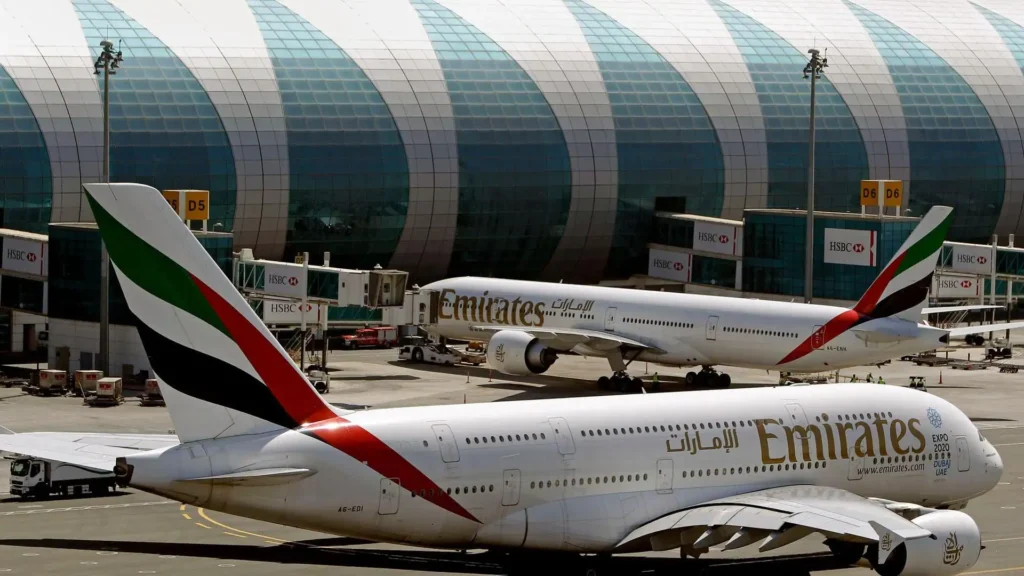
During the operational pause, thousands of travelers experienced sudden cancellations and extended delays. Terminals quickly filled with stranded transit passengers. The airline coordinated closely with airport authorities to manage crowd control and distribute updated boarding information across all concourses.
Passenger Advisories and Rebooking Procedures
Airline representatives are actively urging travelers to verify their flight status before traveling to the airport. Flight schedules remain subject to abrupt changes as the logistics network normalizes. Passengers holding tickets for canceled sectors are advised to utilize the airline’s mobile application or official website for automated rebooking.
Customer service channels are currently handling high volumes of inquiries. Priority rebooking is generally given to passengers who were stranded mid-journey. Travelers should expect longer-than-usual wait times for terminal services, baggage claim, and security checkpoints over the next 24 to 48 hours.
Geopolitical Tensions: The Broader Aviation Context
This drone incident occurs against a backdrop of heightened geopolitical instability. Ongoing conflicts involving Iran, the US, and Israel have forced regional aviation authorities to remain on high alert. Transport infrastructure, particularly high-value targets like major international airports, requires intensified security monitoring.
Commercial airlines operating in the Middle East constantly evaluate threat levels to ensure passenger safety. While standard weather events or technical issues frequently cause delays, security-related airspace closures demand a much more rigorous clearance process before flights can restart.
Operational Resilience at a Major Transit Hub
Aviation analysts point out that the swift containment of the fire and the organized restart of operations highlight significant institutional resilience. Major international carriers maintain complex contingency plans for sudden airspace closures. These systems are designed to minimize systemic collapse, even when operations pause unexpectedly.
Safety remains the absolute priority for the aviation sector. The airline continues to work alongside civil aviation regulators to ensure that all restored services meet strict operational safety guidelines. The coming days will test the efficiency of the airport’s recovery systems as normal operations fully resume.
To learn more, follow Shabdsanchi’s social media pages today and stay updated.
- Facebook: shabdsanchi
- Instagram: shabdsanchiofficial
- YouTube: @shabd_sanchi
- Twitter: shabdsanchi