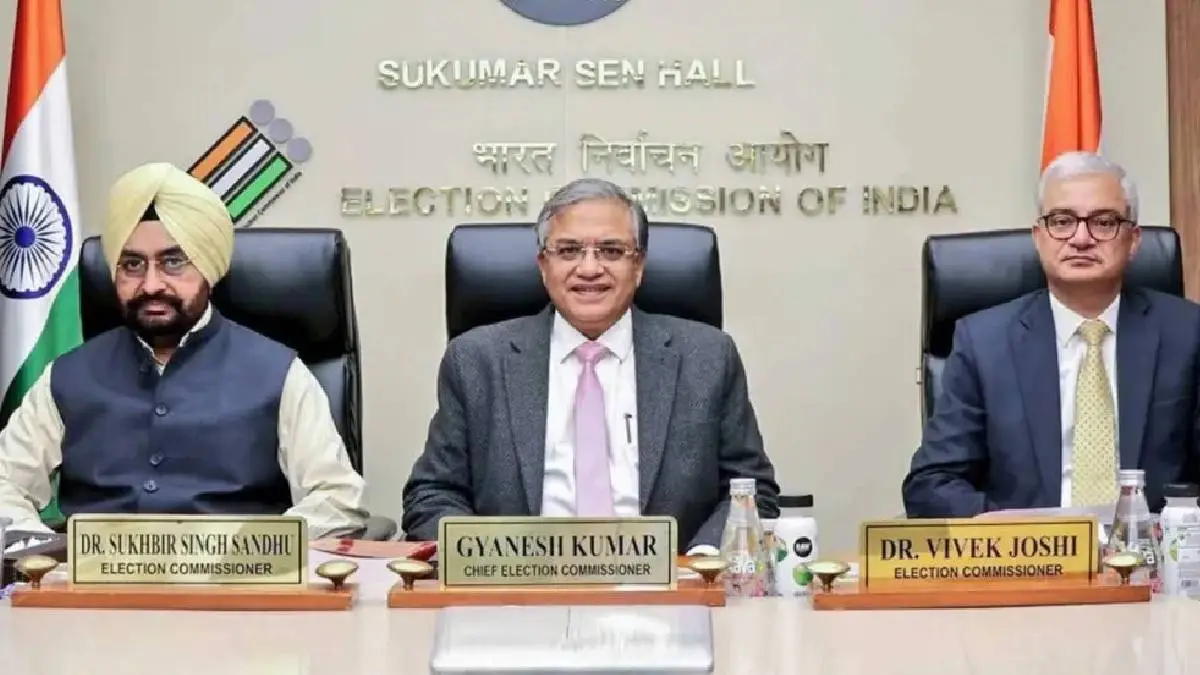
NEW DELHI — Breaking its silence amid mounting political pressure, the Election Commission of India (ECI) filed a definitive affidavit in the Supreme Court, asserting that all decisions regarding the Special Intensive Revision (SIR) of voter lists were adopted unanimously. The poll body dismissed ongoing legal challenges as petitions built exclusively on newspaper reports, urging the top court to dismiss them.
Inside the ECI’s Supreme Court Affidavit
The high-stakes affidavit comes in response to reports alleging internal dissent within the poll panel. Specifically, allegations surfaced claiming that two of the three Election Commissioners were sidelined or kept in the dark regarding the methodology adopted for the SIR process and new voter inclusions.
Refuting these claims, the Commission detailed its statutory workflow under Section 18 of the 2023 Act, explaining that files move sequentially through the hierarchy:
- The Routing Process: Files put up by respective divisions are sent first to one Election Commissioner, then to the second Election Commissioner, and finally to the Chief Election Commissioner (CEC).
- Formal Sign-offs: Approved decisions bear the physical signatures of both Election Commissioners and the CEC before notification and implementation by the ECI Secretariat.
- Deliberation vs. Decision: The Commission clarified that preliminary questions, queries, observations, or varying views expressed by individual members during file considerations do not constitute final institutional decisions.
“In any decision-making process, any suggestion, observation or query by the Chief Election Commissioner or the Election Commissioners either to other Election Commissioner/Chief Election Commissioner or to any officer of the Commission – does not constitute a decision of the Election Commission under Section 18 of the 2023 Act,” the affidavit stated.
Clearing the Air on Form 6 and SIR Orders
The controversy also centered around alterations to voter registration documents. The ECI firmly rejected allegations that changes were made to the statutory ‘Form 6‘.
- Form 6 Status: The Commission clarified that Form 6 remains entirely unaltered as the standard prescribed document for new voter registrations.
- Declaration Form: The separate ‘Declaration Form’ that triggered public debate was introduced strictly as an additional supplementary document utilized alongside Form 6 during the SIR rollout.
- Chronology of Orders: The poll body reiterated that the three core orders governing the SIR process—issued in June 2025, October 2025, and May 2026—were all approved unanimously.
Political Backlash and the Upcoming Supreme Court Hearing
The unfolding dispute erupted following media reports claiming that Election Commissioners Sukhbir Singh Sandhu and Vivek Joshi raised objections to multiple decisions and formally complained to the Chief Secretary.
These reports catalyzed a wave of opposition petitions. A batch of seven petitions is lined up for hearing before the Supreme Court. High-profile petitioners include senior Congress leader Rahul Gandhi, opposition figures Digvijay Singh, and Asaduddin Owaisi, among others. Many of these petitions demand the suspension of Chief Election Commissioner Kumar, directly challenging the procedural legitimacy of the poll panel’s decision-making framework.
Previously, on October 5, the Supreme Court issued notices on the initial round of petitions, emphasizing that judicial orders cannot rely solely on newspaper reports without hearing the respondents first. The bench underscored that any ECI decision proven to contravene the law will be promptly annulled.
Frequently Asked Questions (FAQs)
What is the core issue behind the Supreme Court petitions against the Election Commission?
The petitions challenge the procedural validity of the Special Intensive Revision (SIR) of voter lists, driven by reports alleging internal dissent among Election Commissioners.
Did the Election Commission change Form 6 for voter registration?
No, the ECI has clarified that statutory ‘Form 6’ remains unchanged, while a separate ‘Declaration Form’ was introduced exclusively for the SIR process.
Are the ECI’s SIR orders adopted unanimously according to the poll body?
Yes, the Election Commission asserted in its Supreme Court affidavit that all three SIR orders issued in June 2025, October 2025, and May 2026 were adopted unanimously.
Which political leaders have filed petitions in the Supreme Court?
Petitions have been filed by prominent opposition figures, including Rahul Gandhi, Digvijay Singh, and Asaduddin Owaisi.
What did the Supreme Court state regarding newspaper report-based petitions?
The top court previously noted that it cannot pass substantive orders based purely on newspaper reports without hearing official respondents.
Conclusion & Future Outlook
As the Supreme Court prepares to hear the batch of petitions, the ECI’s detailed affidavit establishes a rigid defense of its internal operational framework under the 2023 Act. While opposition leaders continue to press for accountability and potential suspensions, the judiciary’s upcoming evaluation will set a crucial precedent for institutional transparency and administrative independence within India’s apex election machinery.

Manish Kumar began his professional journey in digital marketing and performance marketing, and currently works as a Digital Marketing Excutive and SEO expert. With over 3 years of professional experience, he handles both strategy and execution. Currently, he manages digital marketing and performance marketing at ‘Shabd Sanchi’ (shabdsanchi.com).