A 5.3 magnitude earthquake struck eastern Nepal at 7:02 AM IST on Tuesday, November 24, 2026, near the Sikkim border, sending brief tremors across parts of India, Nepal, Bhutan, Bangladesh, and China, with no immediate reports of casualties or major structural damage.
According to India’s National Centre for Seismology (NCS), the tremor originated at a depth of 20 km, with its epicentre located at 27.855° N latitude and 87.909° E longitude in Nepal’s Koshi Province. Preliminary reports indicate the shake lasted only a few seconds in several locations, catching early risers indoors during chilly morning conditions.
Seismic Readings And Epicentre Details
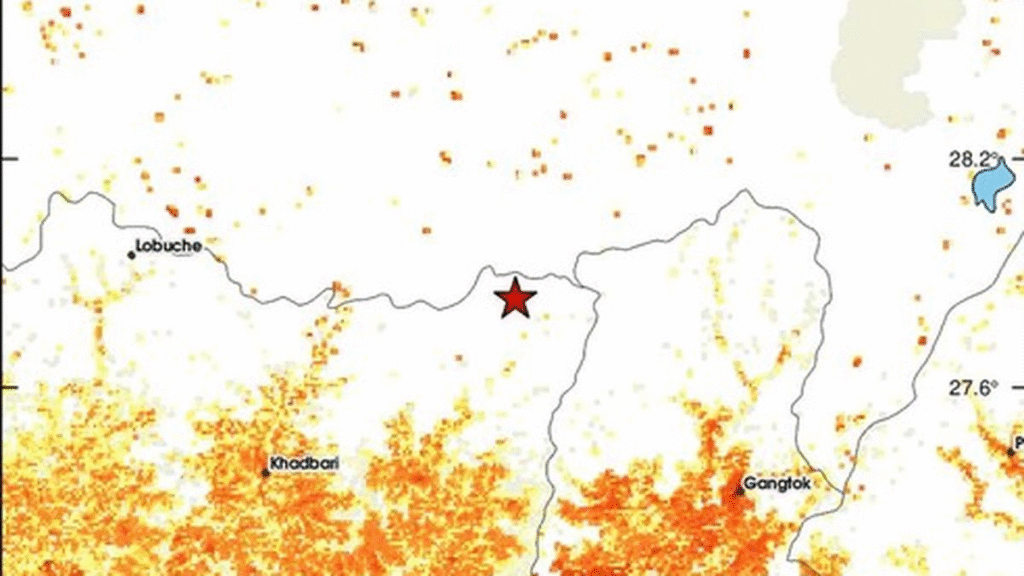
Geospatial data places the focus in Taplejung district of eastern Nepal, roughly 61 km north-northwest of Yuksom in West Sikkim and about 254 km east of Kathmandu. Across the border, it sits roughly 175 km from Thimphu in Bhutan and about 315 km northeast of Muzaffarpur in Bihar.
Different monitoring agencies published slightly varied technical parameters right after the event due to regional velocity models and magnitude scales. While the NCS recorded a 5.3 magnitude quake at a 20 km depth, the United States Geological Survey (USGS) estimated a shallower depth of 10 km near Mangan, and Nepal’s National Earthquake Monitoring and Research Centre (NEMRC) logged a local magnitude of 5.6 near Olangchung Gola.
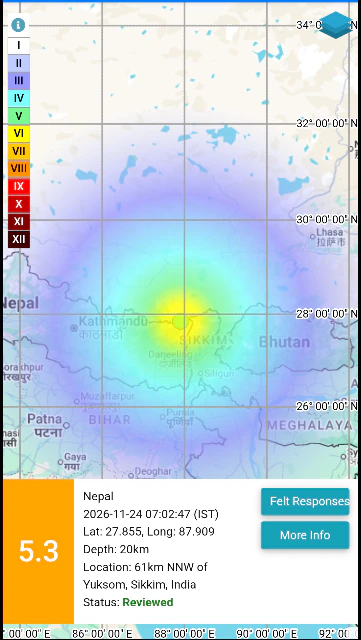
“EQ of M: 5.3, On: 24/11/2026 07:02:47 IST, Lat: 27.855 N, Long: 87.909 E, Depth: 20 Km, Location: Nepal.” — National Centre for Seismology (NCS) official seismic bulletin
Officials at the NCS shared the initial telemetry on social media and directed residents and local responders to track verified updates on its official earthquake monitoring platform. Authorities across the cross-border belt continued assessing remote high-altitude settlements and transport corridors throughout the morning.
How Tremors Played Out Across Bihar, Sikkim, And Neighbouring Areas
In Bihar, residents across multiple districts—including Samastipur, Patna, Darbhanga, Muzaffarpur, Supaul, Purnea, Araria, Sheohar, Begusarai, and Siwan—reported feeling the ground move for roughly two to three seconds. In Samastipur, shaking lasted around two seconds, with some people stepping outdoors while others initially paused to tell whether the movement came from an earthquake or routine morning activity.
Tremors were also reported in Sikkim, Siliguri and other parts of North Bengal, Meghalaya, and across borders in Nepal, Bhutan, Bangladesh, and China. Because the Nepal earthquake hit at 7:02 AM IST during cold weather, many people were still inside homes or preparing for work and school, which shaped how quickly the brief ground motion registered.
Separately, early on Tuesday, November 24, 2026, at 3:39 AM IST, the NCS also recorded a minor 2.5 magnitude tremor at a 15 km depth in Assam’s Karbi Anglong district (25.743° N, 93.355° E). That low-energy event was distinct from the eastern Nepal earthquake and did not alter the broader assessment of the Sikkim border earthquake.
Why This Matters Now: Tectonic Stress And Secondary Hazards
The eastern Nepal earthquake underscores ongoing strain along the Himalayan arc, where the Indian tectonic plate converges northward into the Eurasian plate at roughly 4 to 5 cm per year. Friction along locked fault systems such as the Main Himalayan Thrust periodically releases accumulated energy through shallow and intermediate shocks across Nepal, Sikkim, North Bengal, and the Indo-Gangetic plains.
Even when a 5.3 magnitude earthquake causes no immediate collapsed buildings in major towns, two practical risks demand attention right after shaking:
- Aftershocks and slope instability: Moderate quakes in rugged terrain can loosen fractured rock and soil, raising the chance of landslides or rockfalls along steep valleys and mountain roads such as NH-10.
- Alluvial soil amplification in the plains: Soft riverine sediments across Bihar and North Bengal can amplify long-period waves from distant Himalayan events, making upper-floor residents feel sway even when surface damage stays low.
For households and local agencies, a moderate tremor acts as a real-world readiness check rather than a reason for panic. Checking older masonry cracks, keeping emergency kits and clear exit paths accessible, and relying on official agencies rather than unverified social media forwards remain practical baseline steps.
Frequently Asked Questions
What was the magnitude and timing of the Nepal earthquake on November 24, 2026?
India’s National Centre for Seismology (NCS) recorded a 5.3 magnitude earthquake at 7:02 AM IST on November 24, 2026, at a depth of 20 km near the Sikkim border. Nepal’s NEMRC reported a local magnitude of 5.6, while the USGS noted a 10 km depth.
Which Indian states felt tremors from the Sikkim border earthquake?
Tremors were reported across Sikkim, North Bengal (including Siliguri), multiple districts of Bihar (including Samastipur, Patna, Darbhanga, and Muzaffarpur), and Meghalaya, with no immediate reports of casualties or major damage.
Why do agencies report slightly different numbers for the same earthquake?
Different seismological networks—such as the NCS, USGS, and NEMRC—use distinct station arrays, crust velocity models, and magnitude scales, which routinely produces minor differences in depth or magnitude estimates.
Why is eastern Nepal near the Sikkim border prone to earthquakes?
Continuous northward movement of the Indian plate into the Eurasian plate at 4 to 5 cm per year builds stress along fault zones like the Main Himalayan Thrust, leading to frequent seismic activity across Nepal and neighbouring states.
What should residents watch for after a 5.3 magnitude quake?
Residents should monitor official advisories from the NCS and local disaster authorities for potential aftershocks, and commuters in hilly areas should stay alert for landslides and rockfalls.
What Happens Next And Long-Term Implications
In the immediate hours ahead, the focus for Nepal and Indian authorities is verifying remote hill reports, keeping highway and border links clear of debris, and watching for aftershocks while confirming no delayed damage emerges. Over the longer term, the November 24, 2026 event reinforces a familiar structural reality across South Asia: Himalayan plate convergence is continuous, so resilient building enforcement, slope stabilization, and fast public warning systems remain essential long before a larger rupture ever occurs.

Manish Kumar began his professional journey in digital marketing and performance marketing, and currently works as a Digital Marketing Excutive and SEO expert. With over 3 years of professional experience, he handles both strategy and execution. Currently, he manages digital marketing and performance marketing at ‘Shabd Sanchi’ (shabdsanchi.com).