




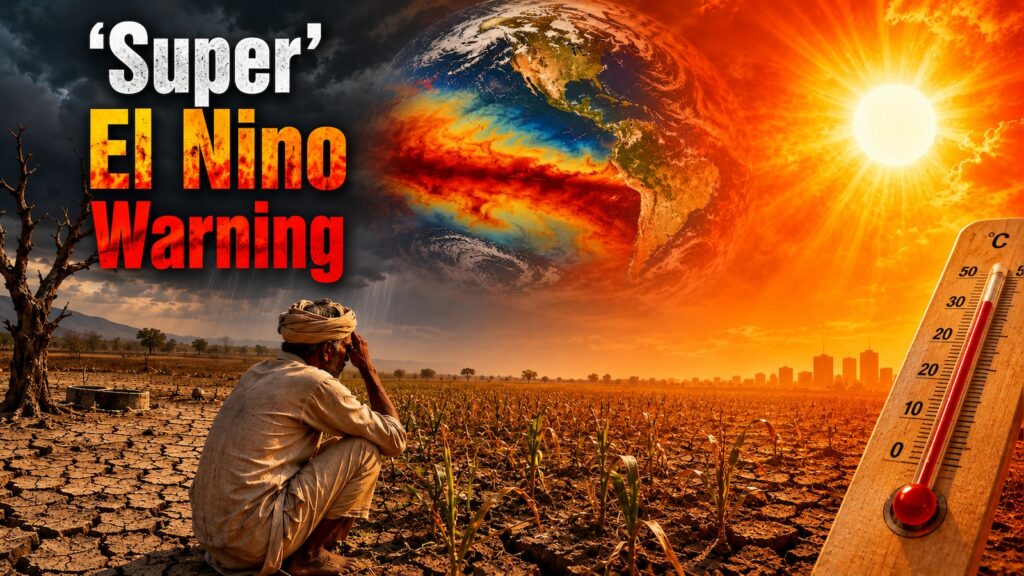
A growing Super El Niño warning has drawn attention from climate experts after unusual warming trends were observed across parts of the Pacific Ocean. Scientists say the phenomenon could influence global weather patterns, increasing the likelihood of heatwaves, drought conditions, and extreme weather events in several regions, including India.
Why Scientists Are Watching Pacific Ocean Temperatures?
Climate monitoring agencies have reported exceptionally warm sea surface temperatures across large sections of the equatorial Pacific Ocean. These temperature anomalies are a key indicator used to assess the development and intensity of El Niño events.
El Niño is a naturally occurring climate pattern that develops when ocean waters in the central and eastern Pacific become warmer than average. The event can alter atmospheric circulation, affecting rainfall, temperature, and storm activity across different continents.
Researchers are paying close attention because current ocean conditions have shown signs that resemble those associated with some of the strongest El Niño episodes recorded in recent decades. While forecasts continue to evolve, experts say the possibility of a more intense event cannot be ignored.
Read Also: El Nino Alert: UN Warns of Higher Global Temperatures and Extreme Weather Risks
What Makes a Super El Niño Different?
The term “Super El Niño” is generally used to describe exceptionally strong El Niño events that produce widespread impacts across the globe. Such events are relatively rare but can significantly influence weather systems for months.
Unlike moderate El Niño episodes, stronger events can amplify temperature increases and disrupt seasonal rainfall patterns over large geographical areas. Regions that normally receive adequate rainfall may face prolonged dry spells, while others may experience flooding linked to altered atmospheric conditions.
Climate scientists note that every El Niño event behaves differently. Local impacts depend on several factors, including ocean conditions, atmospheric circulation, and interactions with other climate systems.
Super El Niño Warning and Possible Impact on India
The current Super El Niño warning has sparked discussions about potential consequences for India, particularly in relation to rainfall and agriculture.
Historically, some strong El Niño years have coincided with weaker monsoon performance. Reduced rainfall can place pressure on water reservoirs, agricultural production, and rural livelihoods. Farmers dependent on seasonal rains often face greater uncertainty when monsoon patterns become erratic.
Higher temperatures are another concern. During strong El Niño phases, many regions experience warmer-than-normal conditions. Combined with ongoing global warming, this could increase the frequency and intensity of heatwaves.
Several sectors closely linked to weather conditions, including agriculture, water management, and energy demand, may require careful monitoring if forecasts continue to indicate a strengthening climate event.
Read Also: IND-W vs WI-W: India Women Begin T20 World Cup Preparations with Mixed Start Against West Indies
Global Effects Could Extend Beyond South Asia
The influence of El Niño is not limited to India. The phenomenon often affects weather conditions across Asia, Australia, Africa, North America, and South America.
Some regions may experience severe drought conditions, while others could face heavier rainfall and flooding. Changes in ocean temperatures can also influence marine ecosystems, fisheries, and biodiversity.
Global temperatures frequently rise during strong El Niño periods because additional heat stored in the Pacific Ocean is released into the atmosphere. This effect can contribute to record-breaking annual temperature averages.
International climate organizations have repeatedly highlighted the importance of preparedness as weather-related risks continue to increase in many parts of the world.
Experts Urge Monitoring Rather Than Panic
Climate experts caution that forecasts should be interpreted carefully. While current ocean conditions are notable, predicting the exact strength and impacts of a future El Niño event remains complex.
Weather agencies continue to analyze satellite observations, ocean temperature data, and atmospheric indicators before issuing long-term projections. Updated forecasts are expected as more data becomes available in the coming months.
Scientists emphasize that preparedness and early planning are more effective than reacting after weather disruptions occur. Governments, agricultural agencies, and disaster management authorities often use seasonal forecasts to support decision-making and risk reduction measures.
Climate Change Adds Another Layer of Concern
Many researchers believe climate change may intensify the impacts associated with natural climate patterns such as El Niño. Rising global temperatures can increase baseline heat levels, potentially making heatwaves more severe when El Niño conditions develop.
Although scientists continue to study the relationship between climate change and El Niño intensity, there is broad agreement that warmer global conditions increase vulnerability to extreme weather.
This combination of natural climate variability and long-term warming has become a major focus for policymakers and environmental agencies worldwide.
Conclusion
The latest Super El Niño warning reflects growing concern among climate scientists about unusually warm Pacific Ocean conditions and their potential influence on global weather patterns. While the exact outcome remains uncertain, experts say the possibility of increased heat, rainfall disruptions, and agricultural challenges warrants close attention. Based on available details and ongoing climate assessments, authorities are expected to continue monitoring developments and issuing updates as new information emerges.
Read Also: PM Modi Cabinet Reshuffle: Punjab Likely to Get Two Ministerial Berths
FAQs
What is a Super El Niño?
A Super El Niño is an exceptionally strong El Niño event characterized by significantly warmer-than-average sea surface temperatures in the central and eastern Pacific Ocean. Such events can influence weather patterns across the world and often lead to extreme climate conditions.
Why is the current Super El Niño warning attracting attention?
Scientists have observed unusually high ocean temperatures in parts of the Pacific Ocean. These conditions have raised concerns that a powerful El Niño event could develop, potentially affecting rainfall, temperatures, and weather systems globally.
How could a Super El Niño affect India?
A strong El Niño may weaken monsoon rainfall in some regions of India, increase the risk of drought, and contribute to above-normal temperatures. However, the exact impact depends on several climate factors and ongoing weather developments.
Can a Super El Niño cause heatwaves?
Yes. Strong El Niño events are often associated with higher global temperatures. Many regions may experience more frequent or intense heatwaves during such periods, especially when combined with long-term global warming trends.
Does a Super El Niño affect only Asia?
No. El Niño is a global climate phenomenon. Its effects can be felt across Asia, Australia, Africa, North America, and South America, influencing rainfall, droughts, storms, and temperature patterns.
Is a Super El Niño certain to happen?
No. Scientists are closely monitoring Pacific Ocean conditions, but climate forecasts can change as new data becomes available. A warning indicates increased risk, not a guaranteed outcome.
What sectors are most vulnerable to a Super El Niño?
Agriculture, water resources, energy supply, fisheries, and disaster management systems are among the sectors that may be most affected by major changes in rainfall and temperature patterns.
How is climate change related to El Niño?
El Niño is a natural climate cycle, while climate change is a long-term warming trend. Scientists believe that rising global temperatures can amplify some impacts associated with El Niño, such as extreme heat and weather-related risks.
For more information, follow Shabdsanchi‘s social media pages today and stay updated.
- Facebook: shabdsanchi
- Instagram: shabdsanchiofficial
- YouTube: @shabd_sanchi
- Twitter: shabdsanchi