


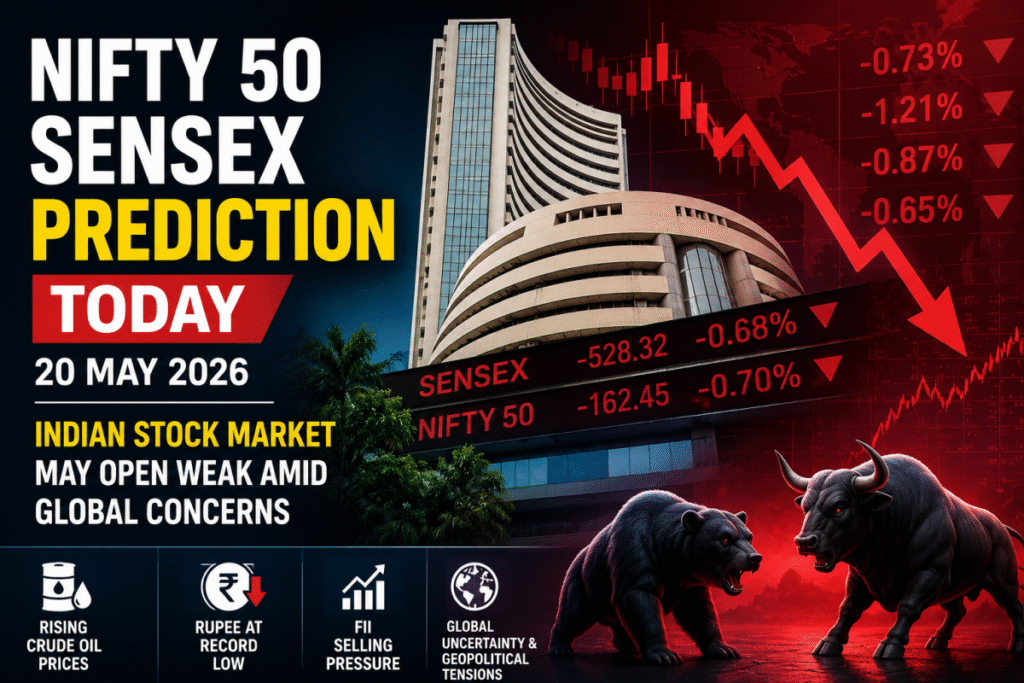
New Delhi: Stock markets decline marked the start of trading on Tuesday as investors reacted cautiously to fresh geopolitical concerns surrounding the ongoing U.S.–Iran negotiations. Weak global cues and uncertainty over diplomatic progress added pressure on equities, leading to losses across key benchmark indices during early market hours.
The 30-share BSE Sensex fell 296.19 points to 73,971.30 in initial deals, while the NSE Nifty dropped 103.30 points to 23,272.25. Market participants remained focused on developments in the Middle East, where repeated setbacks in diplomatic discussions have raised concerns about regional stability and energy market disruptions.
Why Investors Are Watching U.S.–Iran Negotiations Closely?
Global investors often monitor developments involving the United States and Iran because of their potential impact on crude oil supplies, international trade, and overall market confidence. Recent reports indicating difficulties in reaching a breakthrough have increased uncertainty among traders.
Analysts noted that geopolitical tensions tend to push investors toward safer assets while reducing appetite for riskier investments such as equities. As a result, several Asian markets opened lower, reflecting broader concerns about the international economic environment.
The latest developments have also renewed fears of volatility in energy prices. Any disruption to oil supply routes or changes in export policies could influence inflation expectations across major economies.
Stock Markets Decline Amid Weak Global Sentiment
The domestic market mirrored weakness seen across several international exchanges. Selling pressure emerged in multiple sectors as investors assessed the potential economic consequences of prolonged geopolitical uncertainty.
Market experts said global sentiment remains a key driver for short-term market movements. While domestic economic indicators continue to show resilience, external risks often influence investor behavior, particularly when uncertainty rises in major geopolitical regions.
Financial stocks, technology shares, and select large-cap companies witnessed early selling activity. Traders also preferred reducing exposure ahead of further updates related to diplomatic talks and global policy developments.
The decline, however, remained measured during the opening session, suggesting that investors are closely monitoring developments rather than reacting to any immediate economic disruption.
Impact of Oil Prices on Market Direction
One of the primary concerns linked to U.S.–Iran relations is the potential impact on crude oil markets. Iran remains an important player in global energy supply, and any escalation in tensions can influence oil price movements.
Higher crude oil prices often create challenges for oil-importing countries by increasing import costs and inflationary pressures. For India, sustained increases in energy prices can affect transportation costs, manufacturing expenses, and consumer spending patterns.
Market participants therefore continue to evaluate whether the latest diplomatic setbacks could eventually lead to tighter energy supplies or higher commodity prices in the coming weeks.
Investors are also tracking movements in global bond yields and currency markets, which frequently respond to geopolitical developments and changing risk perceptions.
Domestic Factors Continue to Offer Support
Despite the weak opening, analysts believe several domestic factors continue to provide underlying support to Indian equities. Strong participation from domestic institutional investors, steady economic activity, and improving corporate earnings expectations remain important positives.
Recent economic indicators have highlighted continued growth in sectors such as manufacturing, services, and infrastructure. These factors have helped maintain confidence in the broader growth outlook despite periodic global uncertainties.
Some market observers believe volatility may persist in the near term, but long-term investment sentiment remains linked to economic fundamentals rather than short-term geopolitical headlines.
Investors are also awaiting upcoming economic data releases and policy signals from major central banks, which could influence global capital flows and market direction.
What Traders Will Watch Next?
The next phase of market movement is likely to depend on developments surrounding the U.S.–Iran discussions, global crude oil trends, and investor sentiment across international markets.
Any indication of renewed diplomatic progress could help improve risk appetite and support equity markets. Conversely, prolonged uncertainty may continue to keep investors cautious.
Market participants will also monitor foreign institutional investment flows, currency movements, and sector-specific trends for clues about near-term direction. Corporate announcements and economic indicators are expected to remain additional drivers of trading activity.
For now, traders appear focused on balancing strong domestic fundamentals against rising geopolitical concerns. The coming sessions may provide greater clarity on whether current market weakness remains temporary or develops into a broader risk-off trend.
FAQs
Q1. Why did stock markets decline in early trade?
Stock markets declined as investors reacted to repeated setbacks in U.S.–Iran negotiations, which increased concerns about geopolitical stability and potential disruptions in global energy markets.
Q2. How much did the Sensex and Nifty fall?
In early trading, the BSE Sensex dropped 296.19 points to 73,971.30, while the NSE Nifty fell 103.30 points to 23,272.25.
Q3. Why are U.S.–Iran talks important for financial markets?
The negotiations can influence global crude oil supplies and energy prices. Any uncertainty or escalation in tensions may affect inflation, trade, and investor sentiment worldwide.
Q4. How do rising oil prices impact the Indian economy?
Higher crude oil prices can increase import costs, fuel prices, transportation expenses, and inflationary pressures, which may affect businesses and consumers.
Q5. Which sectors were under pressure during early trade?
Financial stocks, technology companies, and several large-cap shares witnessed selling pressure as investors adopted a cautious approach.
Q6. Are domestic economic factors still supporting Indian markets?
Yes. Strong domestic investor participation, steady economic growth, infrastructure spending, and improving corporate earnings expectations continue to provide support.
Q7. What will investors watch next?
Investors will closely monitor developments in U.S.–Iran talks, global crude oil prices, foreign investment flows, central bank signals, and upcoming economic data releases.
Q8. Is the current market decline a sign of a long-term downturn?
Not necessarily. Analysts believe the weakness is currently linked to geopolitical uncertainty. Long-term market direction will depend on economic fundamentals, corporate performance, and global developments.
Q9. How can geopolitical tensions affect stock markets?
Geopolitical tensions often increase uncertainty, reduce risk appetite, and encourage investors to move funds into safer assets, leading to volatility in equity markets.
Q10. Can markets recover if diplomatic progress is made?
Yes. Any positive breakthrough in U.S.–Iran negotiations could improve investor confidence, stabilize energy markets, and support a recovery in equities.
For more information, follow Shabdsanchi‘s social media pages today and stay updated.
- Facebook: shabdsanchi
- Instagram: shabdsanchiofficial
- YouTube: @shabd_sanchi
- Twitter: shabdsanchi