




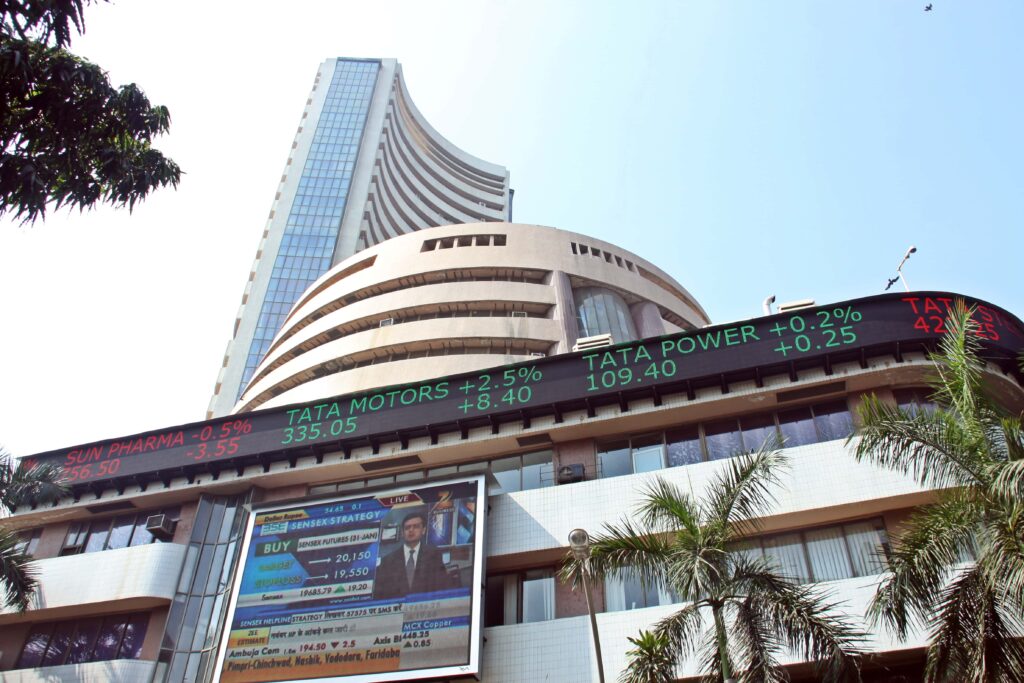
Stock Market Today: The Indian equity markets faced a wave of volatility on Monday, June 29, 2026, cutting short their recent structural winning streak. The benchmark indices, BSE Sensex and NSE Nifty 50, closed in the red as a potent mix of global geopolitical friction, spiking crude oil prices, and high-profile domestic corporate leadership transitions forced institutional investors to reassess risk boundaries.
By the closing bell, the 30-share BSE Sensex declined by 372.10 points (0.48%) to settle at 76,728.37, recovering marginally from an intraday low of 76,621.75. Concurrently, the broader 50-share NSE Nifty dropped 109.75 points (0.46%) to end below a key psychological threshold at 23,946.25.
The Core Triggers: What Unnerve Investors on Monday?
The market correction was primarily driven by headline risks arising over the weekend, altering the immediate macroeconomic calculus for emerging markets like India.
1. Renewed US-Iran Hostilities and the Strait of Hormuz Crisis
The global risk sentiment turned guarded following a sharp flare-up in military exchanges between the United States and Iran. Hostilities escalated significantly after an Iranian projectile strike targeted a cargo vessel in the critical maritime choke point of the Strait of Hormuz. While both diplomatic channels and temporary standstills have been deployed to halt immediate further attacks, the event re-embedded a high degree of headline uncertainty into financial ecosystems. Investors are carefully watching the durability of these temporary peace frameworks, fearing a broader breakdown could disrupt maritime trade.
2. Spurt in Brent Crude Oil Prices
Directly tied to the Middle Eastern friction, global oil markets reacted immediately. Brent crude futures jumped 1.51% to $73.09 per barrel. For a major oil-importing economy like India, a sustained upward trajectory in crude prices threatens the fiscal deficit balance, increases local input costs, and acts as a persistent inflationary pressure. This immediate spike caused visible profit booking in consumer-facing and high-energy-consumption sectors like aviation, automobiles, and paints.
Read Also: PM Modi Cabinet Reshuffle: Shaktikanta Das Tipped for Finance Minister in Major Modi 3.0 Overhaul
Corporate Shockwaves: Kotak Bank Plummets on CEO Ashok Vaswani’s Exit Announcement
Beyond macro headwinds, the banking sector index faced internal pressure. From the Sensex pack, Kotak Mahindra Bank closed 3.24% lower after a major regulatory filing on Saturday shook investor confidence regarding leadership continuity.
The private lender announced that its Managing Director and CEO, Ashok Vaswani, will step down upon completing his initial three-year term on December 31, 2026, citing personal reasons. He will not seek re-appointment.
Expert Takeway: This transition represents the second major CEO succession process at Kotak Mahindra Bank in less than three years. Coming at a time when the bank is systematically emerging from intense regulatory technology audits and looking to position itself as India’s third-largest private bank by after-tax profit, the unexpected transition timeline triggered a short-term correction as analysts call for clarity on long-term structural replacements.
Market Performance at a Glance (The Numbers)
Monday’s trading session saw a dominant bears’ grip, especially during the post-lunch sessions where localized profit-booking accelerated.
| Index | Opening Level | Intraday Low | Closing Level | Net Change | Percentage Change |
| BSE Sensex | 77,055.21 | 76,621.75 | 76,728.37 | -372.10 | -0.48% |
| NSE Nifty 50 | 24,061.75 | 23,890.10 | 23,946.25 | -109.75 | -0.46% |
Sectoral Breakdown: Winners and Losers of the Day
The downside momentum was highly pronounced across interest-rate-sensitive counters, heavy industries, and export-driven spaces:
- The Laggards: Alongside Kotak Mahindra Bank, major industrial and manufacturing heavyweights like Mahindra & Mahindra, Maruti Suzuki, Larsen & Toubro (L&T), UltraTech Cement, and InterGlobe Aviation (IndiGo) faced downward pressure. The combination of high crude prices affecting aviation turbines and general margin worries impacted auto and cement lines.
- The Defensives: Bucking the broader negative trend, select consumption and defensive names provided a structural cushion. Mid-to-long-term gainers included Trent, Eternal, Bharat Electronics (BEL), and NTPC, reflecting a selective rotational shift towards value spaces and utility sectors less vulnerable to immediate global supply chain shocks.
Technical Outlook: Key Nifty and Bank Nifty Levels to Watch
From a purely technical charting framework, market experts point out that the structural multi-month momentum has not completely broken down, but has slipped into a defensive, watchful range.
- Nifty 50 Levels: The index has established an immediate, vital support floor near the 23,800 zone. For the structural bullish bias to remain intact, this level must be sustained on a closing basis. On the upside, Nifty faces a tough overhead resistance barrier positioned at 24,350. A decisive, high-volume breach above 24,350 is mandatory to restore clear upward conviction.
- Bank Nifty Levels: Despite the Kotak Bank drag, the banking index maintains crucial support near its 100-period Moving Average (MA) placed around the 56,400 zone. If sustained, technical researchers suggest a medium-term target consolidation heading back toward 59,300.
Conclusion: Strategy for Retail Investors in Volatile Times
Sudden global market corrections driven by structural geopolitical standoffs require logical execution rather than emotional panic. While foreign institutional flows (FIIs) remained minor net buyers ahead of the weekend break, the immediate threat of escalating energy prices means that high-beta sectors may see extended consolidation. Retail investors should focus on companies with rock-solid balance sheets, robust domestic pricing power, and minimal structural exposure to import-dependent supply chains. Utilizing temporary dips to accumulate secular growth leaders remains the most practical system-level approach.
Read Also: Maharashtra TET Paper Leak Bihar Connection: Assets Worth Crores Traced to Delhi & Patna
Frequently Asked Questions (FAQs)
Q1. Why did the Indian stock market drop on June 29, 2026?
The primary triggers were external geopolitical tensions involving fresh military exchanges between the US and Iran over the Strait of Hormuz, alongside an immediate 1.51% spike in global Brent crude oil prices. Locally, a sharp 3.24% drop in Kotak Mahindra Bank further weighted down the financial indices.
Q2. Why did Kotak Mahindra Bank share price fall sharply today?
Kotak Bank shares corrected significantly after the bank announced over the weekend that its current MD and CEO, Ashok Vaswani, will step down at the end of his single term on December 31, 2026, for personal reasons. This initiates a new leadership transition phase, raising near-term succession questions among institutional investors.
Q3. What are the key support and resistance levels for Nifty 50 now?
According to technical research analysts, Nifty 50 has major intermediate support at the 23,800 level. On the upside, the index faces significant resistance near the 24,350 zone, which needs to be crossed cleanly to resume a structural upward rally.
Q4. How do rising crude oil prices impact Indian stock indices?
India imports roughly 80-85% of its crude oil requirements. When Brent crude prices rise, it raises input costs for key domestic sectors like aviation, automobiles, paints, chemicals, and logistics, sparking margin contraction worries and general market-wide inflationary concerns.
For more information, follow Shabdsanchi‘s social media pages today and stay updated.
- Facebook: shabdsanchi
- Instagram: shabdsanchiofficial
- YouTube: @shabd_sanchi
- Twitter: shabdsanchi