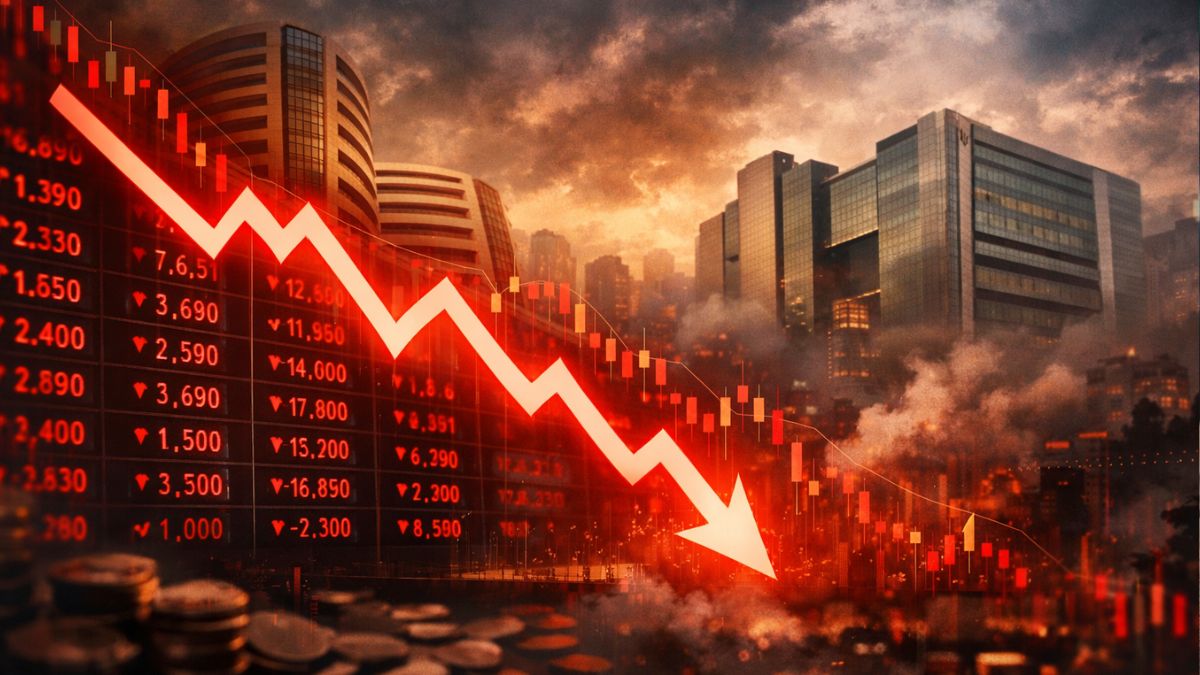
Investors witnessed a massive stock market crash today as escalating geopolitical tensions in the Middle East rattled global sentiment. The BSE Sensex tumbled over 2,100 points, and the Nifty50 opened below the crucial 24,000 mark. This sharp equity sell-off was primarily driven by Brent crude surging past $114 per barrel.
Massive Wealth Wipeout on Dalal Street
The trading week began on a highly volatile note for Indian equities. Within the first ten minutes of the opening bell, the steep sell-off erased over ₹12.39 lakh crore from the combined market capitalisation of all BSE-listed companies. Consequently, the total market valuation dropped sharply to ₹437 lakh crore.
By late morning, the NSE Nifty50 was trading at 23,753.85, marking a significant decline of 692.90 points or 2.8%. Similarly, the BSE Sensex plunged 2,190.19 points, or 2.78%, to trade at 76,728.71. Nearly all components of the 30-share packed Sensex were trading in the red. Heavyweights like State Bank of India (SBI) and IndiGo emerged among the worst-hit stocks during the early hours of trading.
This severe downturn follows a weak closing on Dalal Street last week. During that period, eight of the ten most valued companies saw their combined market capitalisation shrink by a staggering ₹2,81,581.53 crore. The current stock market crash today only accelerates that ongoing downward trend.
Iran War Triggers Massive Oil Price Surge
The primary catalyst behind the stock market crash today is the rapid escalation of conflict in the Middle East. Oil prices jumped sharply on Monday, climbing above $114 per barrel for the first time since 2022. The intensifying conflict involving Iran has sparked severe fears of supply chain disruptions.

Market participants are particularly concerned about the risks to vital shipping routes in the Middle East. The global benchmark, Brent crude, rose past $114 a barrel shortly after trading reopened on the Chicago Mercantile Exchange. This marks a massive 23% surge from Friday’s close of $92.69 per barrel.
For India, which imports more than 80% of its crude oil requirements, such a drastic spike in energy prices is a major economic red flag. Higher crude prices directly inflate the national import bill, potentially widening the current account deficit. Furthermore, it threatens to push domestic inflation higher, which could delay any anticipated interest rate cuts by the Reserve Bank of India (RBI).
FII Withdrawals and Global Market Impact
Adding to the domestic market’s woes is the continuous outflow of foreign funds. Foreign institutional investors (FIIs) have significantly stepped up their selling in Indian equities over the last few days.
Over the past four trading sessions alone, foreign investors withdrew nearly ₹21,000 crore, which translates to roughly $2.3 billion. They are rapidly pulling money out of emerging markets as the crisis in the Middle East intensifies, seeking safer assets instead. This aggressive withdrawal of foreign capital is a major factor fueling the stock market crash today.
The panic is not limited to Indian borders. Stock markets across Asia experienced sharp losses this morning as regional investors reacted to the weekend’s geopolitical developments. Hong Kong’s Hang Seng Index (HSI) plunged over 700 points, or 2.7%, dropping to 25,053.
Meanwhile, Japan’s Nikkei index tumbled an astonishing 3,880 points to trade at 51,740. South Korea’s Kospi also took a major hit, falling by 7% in early trading. This widespread regional sell-off indicates a broader shift in global capital allocation away from riskier equity assets.
Expert Outlook on Market Volatility
Market analysts expect these geopolitical developments to remain the primary factor guiding market direction throughout this week. Investors globally will be closely watching how the ongoing crisis in the Middle East influences crude oil prices in the coming days.
According to Ajit Mishra, SVP of Research at Religare Broking Ltd, external factors will remain critical for market movement in the near term. “This week, movements in global crude oil prices and further geopolitical developments in West Asia will remain critical external variables influencing market direction,” Mishra explained. He also noted that upcoming key macroeconomic releases could shape near-term sentiment.
Therefore, domestic triggers have taken a back seat while international events dictate Dalal Street’s trajectory. Market participants will strictly track global cues and the trading behaviour of foreign investors to gauge any potential recovery.
What Should Investors Track Now?
Ponmudi R, CEO of Enrich Money, advised that investors should prepare for continued volatility. The geopolitical tensions will likely continue to dominate market thinking and influence daily trading patterns.
He emphasized that trends in foreign institutional investor flows and currency movements will be critical metrics to watch. These data points often reflect broader shifts in global capital confidence, especially concerning emerging markets like India.
For retail investors, market veterans generally advise against panic selling during such geopolitical shocks. Instead, assessing portfolio quality and maintaining adequate liquidity is often recommended. As the stock market crash today demonstrates, volatility can wipe out short-term gains rapidly, making a long-term perspective essential.
To learn more, follow Shabdsanchi’s social media pages today and stay updated.
- Facebook: shabdsanchi
- Instagram: shabdsanchiofficial
- YouTube: @shabd_sanchi
- Twitter: shabdsanchi