




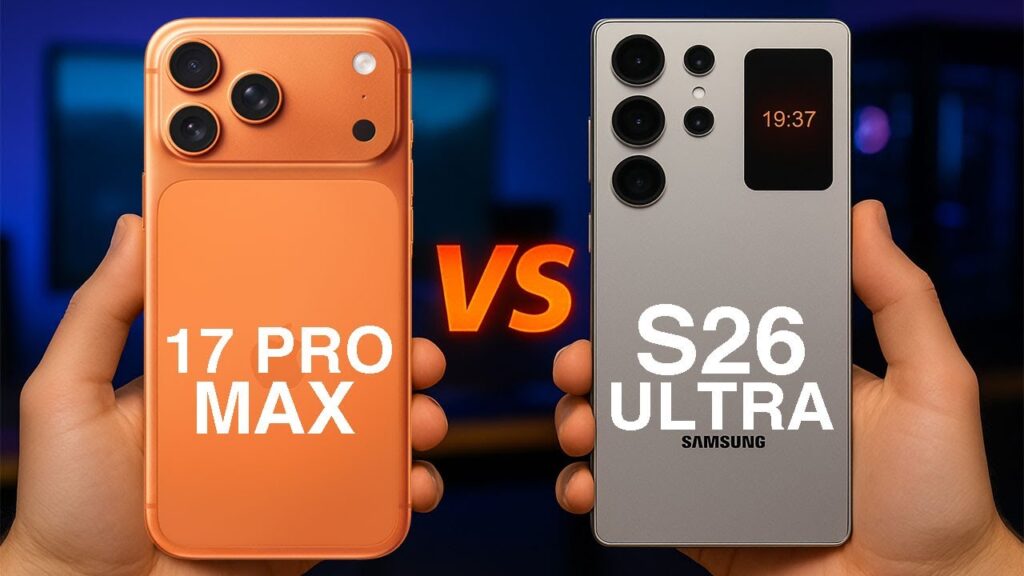
The premium smartphone market is witnessing a fierce new battle. With recent global launches, the Samsung S26 Ultra vs iPhone 17 Pro Max debate is dominating tech discussions. This detailed analysis compares their latest hardware, pricing, and camera systems, while also weighing them against the previous generation Galaxy S25 Ultra.
Pricing Strategies in the Indian Market
Pricing remains a critical deciding factor for Indian consumers upgrading to ultra-premium devices. The Samsung Galaxy S26 Ultra enters the market with a starting price of ₹1,39,999 for the 256GB storage and 12GB RAM variant. This marks a noticeable premium over its predecessor, the Galaxy S25 Ultra, which launched at ₹1,29,999 for the same base configuration.
On the other side of the spectrum, Apple maintains its luxury pricing tier. The iPhone 17 Pro Max begins at ₹1,59,900 for the 256GB model. For power users seeking maximum storage, the 1TB variant of the S26 Ultra costs ₹1,89,999, whereas the top-tier iPhone 17 Pro Max peaks at ₹1,99,900. Consumers must weigh these substantial investments against the technological leaps offered by each brand.
Display Innovations and Design Shifts
Display technology has seen significant upgrades this year. The Galaxy S26 Ultra features a massive 6.9-inch QHD+ Dynamic AMOLED 2X display. Notably, it introduces hardware-level Privacy Display technology. This built-in feature restricts side-angle visibility, offering enterprise-grade privacy for everyday users.
Meanwhile, the iPhone 17 Pro Max counters with a similarly sized 6.9-inch Super Retina XDR display. Apple has integrated ProMotion technology alongside a staggering peak brightness of 3000 nits, protected by their latest Ceramic Shield. By comparison, last year’s Galaxy S25 Ultra offered a slightly smaller 6.8-inch screen with a peak brightness of 2600 nits. Both new flagships ensure exceptional outdoor visibility, but Samsung’s privacy feature provides a unique functional edge.
Processing Power: Snapdragon Meets Apple Silicon
Performance metrics define the ultra-premium segment. Samsung has equipped the S26 Ultra with the highly anticipated Snapdragon 8 Elite Gen 5 for Galaxy. This customized chipset claims a 19% improvement in CPU processing and a massive 39% jump in Neural Processing Unit (NPU) capabilities over the previous generation.
Apple’s iPhone 17 Pro Max runs on the proprietary A19 Pro chip. Built on an advanced 2nm process, this processor focuses heavily on high-efficiency cores and an integrated AI engine explicitly designed to power Apple Intelligence. The older Galaxy S25 Ultra, powered by the Snapdragon 8 Elite Gen 4, still holds its ground with robust performance, but the newer silicon in the S26 and iPhone 17 models represents the pinnacle of mobile computing.
Camera Systems: Megapixels and Sensor Upgrades
Smartphone photography continues to evolve through different engineering philosophies. The Samsung Galaxy S26 Ultra retains its signature high-resolution approach. It features a massive 200MP main sensor with a wider F1.4 aperture for enhanced low-light performance. This is complemented by a 50MP ultra-wide lens, a 50MP telephoto lens offering 5x optical zoom, and a 10MP telephoto lens for 3x optical zoom.
Conversely, the iPhone 17 Pro Max utilizes a uniform high-resolution sensor array. It sports a 48MP main camera, a 48MP ultra-wide, and a 48MP telephoto lens with 5x optical zoom. Apple’s strategy ensures consistent color science and detail across all focal lengths. The Galaxy S25 Ultra also featured a 200MP main sensor but utilized a lower-resolution 12MP ultra-wide, making the S26 Ultra a definitive upgrade for landscape photographers.
Battery Efficiency and Charging Speeds
Endurance and power replenishment are vital for power users. The Galaxy S26 Ultra maintains the industry-standard 5,000 mAh battery capacity found in the S25 Ultra. However, Samsung has significantly upgraded the charging infrastructure. The S26 Ultra now supports 60W wired charging, capable of reaching a 75% charge in just 30 minutes.+1
The iPhone 17 Pro Max takes a different approach. It houses an estimated 4,683 mAh battery. While the capacity is slightly lower on paper, Apple’s tight hardware-software integration traditionally yields excellent battery life. Charging speeds for the iPhone remain conservative, supporting 30W wired and 25W MagSafe wireless charging.
Software Experience: Android 16 vs iOS 19
The operating system ultimately dictates the user experience. The Galaxy S26 Ultra debuts with Android 16, layered with Samsung’s intuitive One UI 8.5. This updated interface focuses heavily on AI integration and system fluidity. The iPhone 17 Pro Max operates on iOS 19, which brings refined privacy controls and deeper Apple Intelligence features. For those considering older models, the Galaxy S25 Ultra currently runs on Android 15 with One UI 7, which remains a highly capable and refined software ecosystem.


To learn more, follow Shabdsanchi’s social media pages today and stay updated.
- Facebook: shabdsanchi
- Instagram: shabdsanchiofficial
- YouTube: @shabd_sanchi
- Twitter: shabdsanchi