


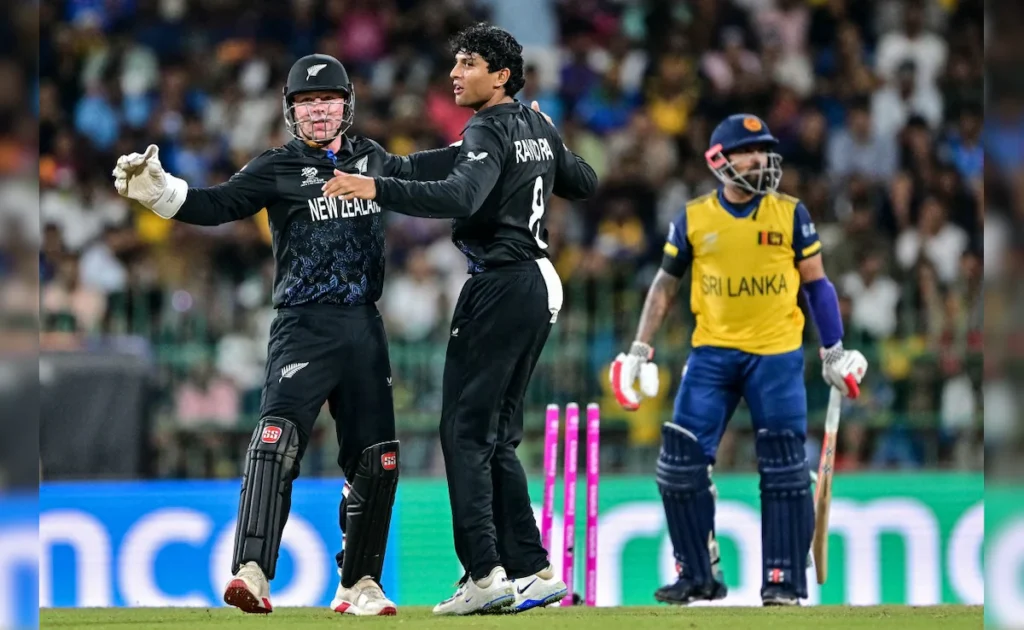
In a high-stakes T20 World Cup encounter, New Zealand staged a dramatic recovery to deflate Sri Lankan hopes at the Premadasa Stadium. How Mitchell Santner exploited short boundaries became the defining narrative of the match, as the Kiwi captain turned a precarious 86/6 into a match-winning total through sheer tactical awareness and shot selection.
The atmosphere at the R. Premadasa Stadium, popularly known as Khettarama, was electric. With the DJ pumping high-decibel bass and the local crowd sensing a Sri Lankan victory, New Zealand found themselves in deep waters. Six wickets down with only seven overs remaining, the Black Caps needed more than just talent; they needed a roadmap to survival.
Analyzing the Ground Dimensions
Mitchell Santner, widely regarded as one of the most astute thinkers in the modern game, identified the game’s “X-factor” before even facing a ball. While Sri Lanka had the home advantage, it was Santner who accurately read the lopsided ground dimensions. One square boundary measured a daunting 75 metres, while the other was a tempting 62 metres.


The Turning Point at 98/6
By the end of the 16th over, New Zealand were crawling at 98/6. The pitch offered exaggerated spin, and the Sri Lankan duo of Dushmantha Chameera and Maheesh Theekshana seemed to have a stranglehold on the game. However, Santner and Cole McConchie, who was playing his first game of the tournament, remained resolute. They calculated that on this surface, 150 was not just a par score, but a winning one.
Targeting Dushmantha Chameera
The acceleration began in the 17th over. Facing Chameera, McConchie decided to stop reacting and start pre-empting. Using the short leg-side boundary to his advantage, he dispatched a 120kph slower ball over the ropes with a powerful flick. When Chameera attempted to go wide across the crease to avoid the arc, McConchie expertly cut the ball past point, yielding an 18-run over that shifted the momentum.
The Breakdown of Sri Lanka’s Death Bowling
The pressure soon mounted on Sri Lanka’s premier spinner, Maheesh Theekshana. The plan was simple: bowl wide of Santner’s off-stump to force him toward the longer 75-metre boundary. Instead, Theekshana faltered, delivering balls into Santner’s preferred hitting zone. A high full-toss was punished over long-on, resulting in a 21-run over.
Tactical Mastery: How Mitchell Santner Exploited Short Boundaries
The final two overs saw the floodgates open completely. New Zealand focused almost exclusively on the 62-metre fence. By manipulating their crease position—standing deep or moving across the stumps—Santner and McConchie forced the bowlers to abandon their lengths. In total, the Kiwis accumulated 80 runs off the last four overs, with the vast majority coming from the shorter side of the field.
Disappointment in the Sri Lankan Camp
Sri Lankan captain Dasun Shanaka did not hide his frustration after the match. He noted that while the bowlers were instructed to execute wide yorkers, the execution was missing. Shanaka attributed the collapse to a “mental block,” suggesting that his bowlers panicked once the Kiwi pair began their assault.

Rachin Ravindra’s All-Round Show
While the Santner-McConchie partnership set the stage, Rachin Ravindra provided the finishing touches. After a brisk 32 with the bat, Ravindra dismantled the Sri Lankan chase with a four-wicket haul. He later praised his senior teammates, noting that the ability to stay clear-headed while “accessing difficult angles” was the hallmark of an elite T20 performance.
To learn more, follow Shabdsanchi’s social media pages today and stay updated.
- Facebook: shabdsanchi
- Instagram: shabdsanchiofficial
- YouTube: @shabd_sanchi
- Twitter: shabdsanchi