



The political landscape of Bihar is standing at the threshold of a historic transformation. Nitish Kumar, the state’s longest-serving Chief Minister and the face of the “Vikas Purush” image, officially filed his nomination for the Rajya Sabha on March 5. This strategic shift confirms that Nitish Kumar Rajya Sabha nomination is not merely a routine legislative move, but a precursor to a new power-sharing arrangement within the NDA.
A Calculated Exit from Patliputra
Nitish Kumar’s decision to move to the Upper House of Parliament marks the conclusion of an era that redefined Bihar’s social and infrastructure fabric. Having turned 75 on March 1, the veteran leader has reportedly been grappling with health issues for some time. Insiders suggest that the rigors of state administration and the constant friction of coalition politics have prompted this transition toward a more advisory, national role.
The timing of this move is particularly significant. Following the massive mandate in the recent Assembly elections, where the NDA secured 202 out of 243 seats, the alliance is at its strongest. However, the internal arithmetic has shifted. For the first time in nearly two decades, the BJP holds the upper hand with 89 seats compared to JD(U)’s 85, providing the saffron party with the leverage required to claim the Chief Minister’s chair.
The Succession Calculus: Enter Nishant Kumar
The most talked-about aspect of this transition is the political debut of Nishant Kumar, Nitish’s son. Historically, Nitish Kumar maintained a distance between his family and the CMO, often using this “anti-dynasty” stance to attack rivals like the RJD. However, survival instincts within the JD(U) appear to have overridden previous reservations.
Sources indicate that a section of the party, led by confidantes like Manish Verma, believes that Nishant’s entry is essential to keep the JD(U) “flock together.” While Nishant was initially considered for the Rajya Sabha seat, his reported preference for state politics suggests he may be positioned for a significant role in the Bihar cabinet, possibly as a Deputy Chief Minister.
Will the BJP Install Its First Chief Minister?
With the Nitish Kumar Rajya Sabha nomination finalized, the focus shifts to the BJP’s strategy. Despite being the dominant partner, the BJP has always played second fiddle to Nitish to secure the Extremely Backward Class (EBC) and Kurmi-Koeri vote banks. Now, the party is poised to install its own nominee in the top post.


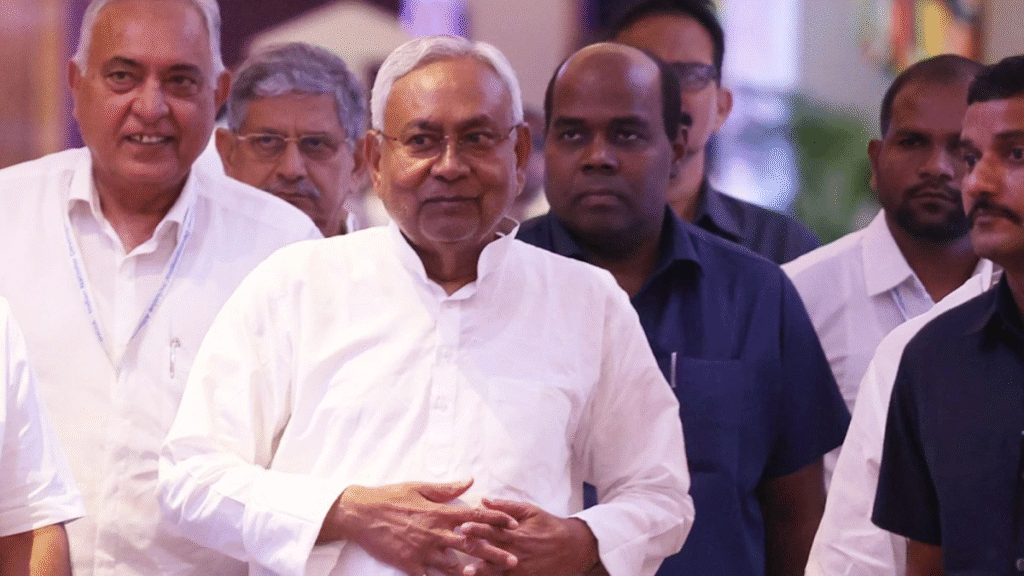
Speculation is rife regarding the potential candidate. Unlike the traditional approach, the BJP has recently favored surprising choices in states like Madhya Pradesh and Rajasthan. However, in Bihar, caste arithmetic is non-negotiable. The frontrunners include:
- Samrat Choudhary: The current Deputy CM and a prominent OBC face.
- Nityanand Rai: Union Minister with deep roots in the Yadav heartland.
- Dilip Jaiswal & Sanjiv Chaurasia: Significant organizational players representing the Vaishya and Brahmin-Kayastha blocs respectively.
Balancing the EBC Vote Bank
The biggest challenge for a BJP-led government will be retaining the trust of the EBCs, who constitute roughly 36% of the population. This demographic has been the bedrock of Nitish Kumar’s “Silent Vote” success. If the transition is perceived as a “betrayal” or a forceful ousting of Nitish, the BJP risks alienating a crucial segment before the next general elections.
To mitigate this, the JD(U) is likely to be offered two Deputy Chief Minister positions. This ensures that while the BJP holds the steering wheel, the JD(U) remains visible in the governance structure, providing a sense of continuity to the electorate.
The National Dimension for Nitish
Moving to the Rajya Sabha allows Nitish Kumar to leverage his experience on the national stage. As a senior statesman with a clean image, he could become a key interlocutor for the NDA in New Delhi, especially in managing complex federal relations or heading high-level policy committees. His presence in the capital provides the JD(U) with a direct line to the central leadership, ensuring the party’s interests are protected even if its influence in Patna wanes.


Opposition’s Counter-Strategy
The RJD, led by Tejashwi Yadav, is closely monitoring these developments. For the opposition, Nitish’s departure is a double-edged sword. While it removes their most formidable opponent from the state scene, it also consolidates the NDA under a potentially more aggressive BJP leadership. The RJD is expected to ramp up its “Mandal vs Kamandal” rhetoric, attempting to woo disgruntled JD(U) cadres who might feel sidelined in a BJP-dominated regime.
Challenges for the ‘Political Rookie’
Nishant Kumar faces an uphill task. Unlike Tejashwi Yadav or Chirag Paswan, who have spent years in the political trenches, Nishant is a newcomer. He will need to quickly master the intricate “Luv-Kush” (Kurmi-Koeri) alliance and the developmental narrative that his father spent thirty years building. The transition is not just about a change in name, but about the survival of a specific governance model that prioritized social engineering.
To learn more, follow Shabdsanchi’s social media pages today and stay updated.
- Facebook: shabdsanchi
- Instagram: shabdsanchiofficial
- YouTube: @shabd_sanchi
- Twitter: shabdsanchi