


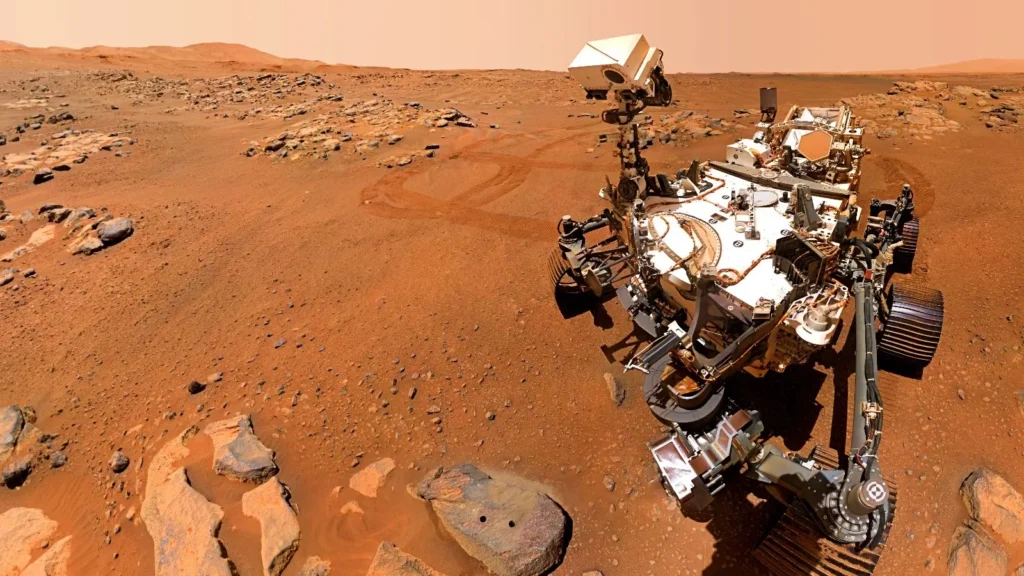
PASADENA, CA — NASA’s Jet Propulsion Laboratory (JPL) has revealed critical new findings from the Perseverance rover that could reshape safety protocols for future crewed missions to Mars. Analyzing dust accumulation over 1,645 Martian days, scientists discovered ultrafine dust particles measuring approximately 100 nanometres, raising urgent concerns regarding astronaut health and habitat design.
Unprecedented Precision in Martian Dust Analysis
Using the rover’s advanced PIXL (Planetary Instrument for X-ray Lithochemistry) instrument, researchers examined dust samples gathered on calibration targets and spacesuit material samples like Teflon and Vectran.
While earlier measurements could only resolve particles down to roughly 3 micrometres, this latest analysis successfully detected particles smaller than 2.5 micrometres, alongside ultrafine particles around 100 nanometres. To put this scale into perspective, a human hair is approximately 70 micrometres wide, making the smallest detected particles about 700 times thinner than a human hair.
“Different surfaces attracted different particle sizes, with static electricity appearing to influence how dust adhered to them.”
Health Risks and Toxic Compounds
The discovery carries serious health implications. Particles under 2.5 micrometres are small enough to penetrate deep into human lungs, while Earth-based research indicates ultrafine particles can potentially travel from the nasal cavity toward the brain along the olfactory nerve.
Furthermore, Martian dust contains hazardous silicate minerals and chemically reactive compounds, including perchlorates—which can disrupt thyroid function—and reactive iron compounds capable of damaging human cells.
Engineering Solutions for Future Mars Missions
With the motto “Proceed with caution” guiding mission planners, NASA is actively utilizing these insights to engineer safer exploration gear:
- Advanced Spacesuits: Engineers are selecting specialized suit materials and protective coatings designed to minimize dust collection.
- Contamination Control: Mission architects are considering suitports and dual-chamber airlocks to prevent toxic dust from entering living habitats.
- Operational Protocols: Future surface operations will likely incorporate strict health standards and improved dust-removal procedures.
Frequently Asked Questions (FAQs)
What did NASA’s Perseverance rover discover about Mars dust?
Perseverance detected fine and ultrafine Martian dust particles measuring around 100 nanometres and smaller than 2.5 micrometres accumulated over 1,645 Martian days.
Why are ultrafine Martian dust particles dangerous to astronauts?
These particles are small enough to penetrate deep into human lungs and potentially travel toward the brain, while containing toxic compounds like perchlorates and reactive iron.
What instrument did NASA use to analyze the Martian dust?
Scientists used the rover’s PIXL instrument, which analyzes chemical composition using X-rays on calibration targets and spacesuit materials.
How are engineers planning to protect astronauts from Mars dust?
NASA is developing specialized spacesuit coatings, suitports, and dual-chamber airlocks to keep toxic dust out of habitats.
Conclusion
The direct measurements of fine and ultrafine dust under actual Martian surface conditions provide invaluable baseline data for human exploration. As NASA prepares for extended stays on the Red Planet, understanding how abrasive and toxic Martian dust behaves will be essential for safeguarding astronaut health and ensuring long-term mission success.


Manish Kumar began his professional journey in digital marketing and performance marketing, and currently works as a Digital Marketing Excutive and SEO expert. With over 3 years of professional experience, he handles both strategy and execution. Currently, he manages digital marketing and performance marketing at ‘Shabd Sanchi’ (shabdsanchi.com).