



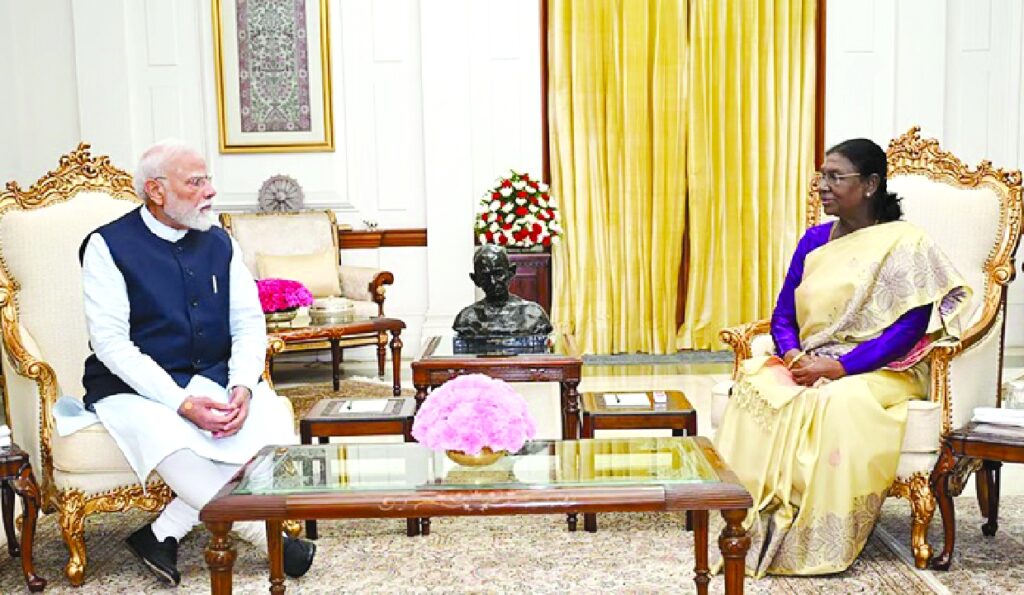
Delhi, June 24, 2026: The political corridors of New Delhi are buzzing with intense speculation as a massive overhaul of Prime Minister Narendra Modi’s Council of Ministers and the Bharatiya Janata Party (BJP) organizational structure looks imminent. Late Tuesday evening on June 23, 2026, Prime Minister Narendra Modi met President Droupadi Murmu at Rashtrapati Bhavan. Analysts suggest this meeting was far from a routine courtesy call; it marks the finalization of the Modi government’s high-stakes ‘Mid-Term Reset’ and cabinet expansion.
The blueprint for this impending reshuffle is heavily driven by the assembly elections scheduled for early 2027 in five crucial states: Uttar Pradesh, Punjab, Uttarakhand, Goa, and Manipur. The BJP’s mega plan is explicitly designed to halt the momentum of the Samajwadi Party’s (SP) ‘Cycle’ in Uttar Pradesh and neutralize the Aam Aadmi Party’s (AAP) ‘Broom’ in Punjab.
The Exit of George Kurian and the ‘One Person, One Post’ Rule
The catalyst for this sudden momentum was the resignation of senior BJP leader and Minister of State for Minority Affairs, George Kurian. Following the completion of his Rajya Sabha tenure on June 21, 2026, the party leadership chose not to re-nominate him to the Upper House, leading to his subsequent resignation being accepted by President Murmu.
Kurian’s exit has paved the way for a wider cabinet restructuring. Sources indicate that the BJP is strictly implementing its foundational ‘One Person, One Post’ policy. Consequently, several high-profile ministers who have recently been handed major organizational roles are expected to step down from the cabinet soon:
- Pankaj Chaudhary (UP): The Minister of State for Finance has been appointed as the new Uttar Pradesh BJP Chief. To focus entirely on this critical electoral battleground, he is expected to relinquish his ministerial portfolio.
- Harsh Malhotra (Delhi): Appointed as the Delhi BJP President, the Minister of State for Road Transport and Highways is also likely to exit the cabinet to manage the capital’s party apparatus.
- Ravneet Singh Bittu (Punjab): The Minister of State’s Rajya Sabha tenure has concluded, and he is now slated to transition entirely back to grassroots politics in Punjab.
Uttar Pradesh 2027: Social Engineering to Halt the ‘Cycle’
Winning Uttar Pradesh in 2027 is a matter of absolute prestige for the BJP. In the current political landscape, the Samajwadi Party’s ‘PDA’ (Picchda, Dalit, Alpasankhyak) coalition formula poses a formidable challenge to the ruling party. To counter this, the Modi cabinet reshuffle is deploying an aggressive social engineering masterstroke.
1. The OBC Card via Pankaj Chaudhary
By appointing Pankaj Chaudhary as the UP BJP Chief, the party has sent a clear signal that it aims to consolidate the crucial non-Yadav OBC vote bank. Relieving him of ministerial duties allows him to dedicate his full energy to reinforcing the organizational machinery at the booth level.
2. Balancing Purvanchal and Western UP
The upcoming cabinet expansion will strategically induct MPs from UP who can strike a delicate caste balance on the ground. Expect a strong preference for Most Backward Classes (MBCs) and non-Jatav Dalit faces to effectively dent the opposition’s core support base.
Read Also: Assam HSLC Compartment Result 2026 (Out): Direct Link To Download Scorecard Here
Punjab 2027: Relying on Ravneet Bittu to Counter AAP
Punjab is currently governed by the Aam Aadmi Party (AAP). With the Shiromani Akali Dal (SAD) significantly weakened, the BJP sees a historic opportunity to emerge as the primary alternative in the state. The linchpin of this strategy is the firebrand leader Ravneet Singh Bittu.
Strategic Pivot: By choosing not to return Ravneet Singh Bittu to the Rajya Sabha, the BJP central leadership has made its intentions clear. Bittu is being pulled out of Delhi’s bureaucratic circles and sent directly to the streets of Punjab. He is poised to be the primary face of the BJP for the 2027 Punjab Assembly Elections.
The objective behind anchoring Bittu to Punjab is to build deep inroads among the Sikh electorate and rural agrarian communities—areas where the BJP has traditionally lacked a robust foothold. Bittu is being given a mandate to corner both AAP and Congress on localized agricultural issues and governance shortfalls.
Governance Review: Performance-Driven Accountability
As the NDA administration progresses into its 12th year, Prime Minister Modi recently concluded a comprehensive performance review of all union ministries. The findings of this evaluation will heavily reflect in the reshuffle.
Ministers who have underperformed on delivering flagship central welfare schemes or those whose public connect has dwindled are likely to be drafted back into organizational work. In their place, a wave of energetic, result-oriented, and younger MPs will be inducted. The objective is twofold: combat regional anti-incumbency and push a refreshed narrative of good governance (Suprasashan).
Conclusion: The Ultimate Road to the 2027 ‘Semi-Finals’
The impending Modi Cabinet Reshuffle 2026 is far more than a simple musical chairs of portfolios. It is a calculated, strategic roadmap aimed squarely at the 2027 assembly elections and, by extension, the 2029 general elections. From reinforcing social engineering in Uttar Pradesh to projecting a powerful local Sikh voice in Punjab, the BJP is setting up its electoral chessboard well in advance. The political maneuvers of the next few days will undoubtedly dictate the trajectory of Indian politics for the next three years.
Read Also: Maharashtra Politics: Massive Blow to Shiv Sena UBT as 6 Uddhav Camp MPs Join Eknath Shinde
Frequently Asked Questions (FAQs)
Q1. What triggered the sudden urgency for the Modi Cabinet Reshuffle in June 2026?
Answer: The momentum escalated following the official resignation of Union Minister George Kurian and a crucial late-evening meeting between PM Narendra Modi and President Droupadi Murmu at Rashtrapati Bhavan.
Q2. Who will be affected by the BJP’s ‘One Person, One Post’ rule?
Answer: Prominent ministers like Pankaj Chaudhary (recently appointed UP BJP Chief) and Harsh Malhotra (appointed Delhi BJP President) are highly likely to step down from their ministerial roles to handle party organizational work full-time.
Q3. What is the BJP’s primary strategy for the Uttar Pradesh 2027 elections?
Answer: The BJP is employing deep social engineering by balancing regional representation and heavily prioritizing non-Yadav OBC and Dalit leaders in both the cabinet and the state organization to counter the Samajwadi Party’s alliance.
Q4. What will be Ravneet Singh Bittu’s role in Punjab after his Rajya Sabha term ends?
Answer: Ravneet Singh Bittu is shifting completely to state politics. He is expected to lead the BJP’s grassroots campaign in the 2027 Punjab elections, focusing on building strong ties with rural and Sikh voters to counter the ruling AAP.
For more information, follow Shabdsanchi‘s social media pages today and stay updated.
- Facebook: shabdsanchi
- Instagram: shabdsanchiofficial
- YouTube: @shabd_sanchi
- Twitter: shabdsanchi