


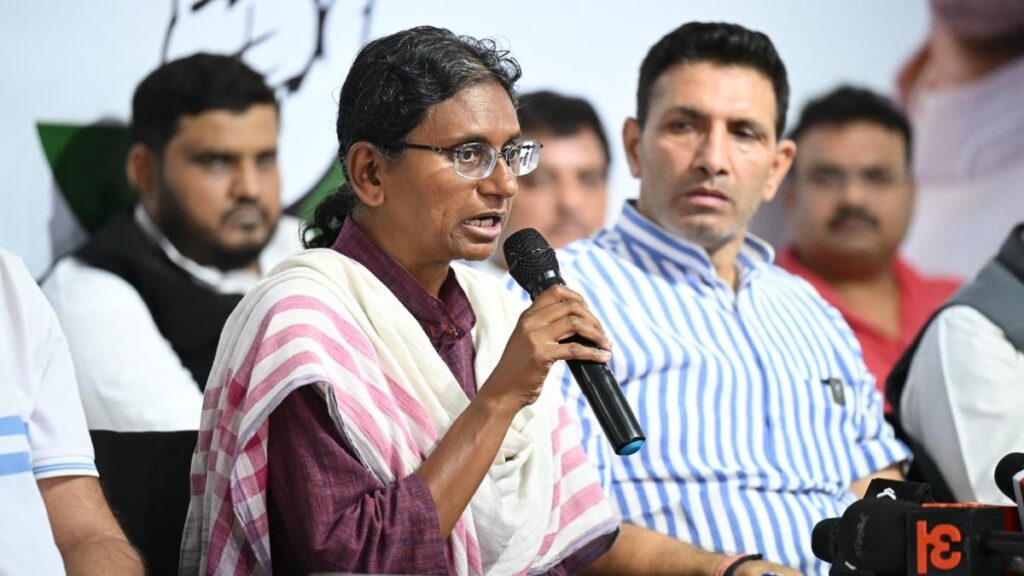
The Meenakshi Natarajan nomination rejection controversy has intensified after the Congress party approached the Election Commission of India, challenging the Returning Officer’s decision in the Madhya Pradesh Rajya Sabha election. The party has alleged that the nomination was rejected on grounds that have no legal basis under election rules.
Congress Challenges Rejection of Rajya Sabha Nomination
A fresh political dispute has emerged in Madhya Pradesh after Congress candidate Meenakshi Natarajan’s nomination for the Rajya Sabha election was rejected during scrutiny. The development has triggered strong reactions from the opposition party, which has moved the Election Commission of India (ECI) seeking immediate intervention.
A 10-member Congress delegation met Election Commission officials in New Delhi and submitted its objections against the Returning Officer’s decision. Party leaders argued that the rejection was inconsistent with established legal procedures and could affect the fairness of the electoral process.
The issue has also led to protests in Bhopal, where Congress leaders and workers announced a collective fast to register their opposition to the decision.
What Congress Told the Election Commission?
Speaking to reporters after the meeting, Congress leader and senior advocate Abhishek Manu Singhvi said the Returning Officer had erred in interpreting the legal position related to the case cited against Natarajan.
According to Singhvi, the basis for the rejection does not exist under the relevant provisions governing election nominations. He maintained that the matter referred to by election authorities involved only a court notice and not an active criminal proceeding requiring disclosure under nomination rules.
The Congress delegation urged the Election Commission to examine the facts urgently and correct what it described as an unlawful decision. Party leaders said the matter was serious because it concerned a candidate’s right to contest an election.
Sources familiar with the discussions indicated that the Commission assured the delegation that the complaint would be examined promptly. Congress leaders later claimed that the poll body had indicated a decision could be taken within a short period.
Understanding the Legal Dispute Behind the Meenakshi Natarajan Nomination Rejection
At the centre of the controversy is the interpretation of a court notice issued in a previous matter involving Natarajan.
Congress leaders argued that receiving a notice from a court does not automatically amount to the existence of a criminal case that must be declared in election documents. They said the court had only sought clarification on whether proceedings should move forward.
Under criminal procedure, a magistrate first decides whether sufficient grounds exist to take cognisance of a complaint. Only after cognisance is taken does a criminal case formally proceed through the judicial system.
The party maintains that since no cognisance had been taken in the matter cited against Natarajan, there was no legal obligation to disclose it as a pending criminal case. Therefore, according to Congress, rejecting the nomination on that basis was unjustified.
Political Reactions and Protest in Bhopal
The issue has quickly acquired political significance because it directly affects the Rajya Sabha election in Madhya Pradesh.
Congress leaders have accused the authorities of applying election rules incorrectly and have demanded transparency in the scrutiny process. The party has also sought a review of all documents examined during nomination verification.
In Bhopal, Congress workers and senior leaders organised a collective fast to protest the rejection. The demonstration was aimed at drawing attention to what the party described as an attack on democratic rights.
Political observers believe the dispute could remain in focus until the Election Commission delivers its final view. Any intervention by the Commission may influence the course of the ongoing election process.
What Happens Next?
The Election Commission is expected to examine the legal arguments submitted by the Congress delegation, along with the records relied upon by the Returning Officer during scrutiny.
Election experts note that nomination disputes often depend on technical interpretations of election law and disclosure requirements. As a result, the Commission’s decision may clarify how similar cases should be handled in future elections.
For now, the Congress party continues to insist that the rejection was legally flawed and has called for corrective action at the earliest opportunity. The outcome will determine whether further legal or administrative steps become necessary.
The controversy has highlighted the importance of transparency and consistency in the scrutiny of election nominations. Based on the available details, all eyes are now on the Election Commission as it reviews the complaint and considers its next course of action.
FAQs
Q1. Why was Meenakshi Natarajan’s nomination rejected?
According to the Returning Officer, the nomination was rejected during the scrutiny process over an alleged issue related to the disclosure of a court matter. Congress has challenged the decision, arguing that the cited case did not qualify as a pending criminal case under election rules.
Q2. What is the controversy surrounding the Meenakshi Natarajan nomination rejection?
The controversy centers on whether a court notice received by Natarajan should have been disclosed in her nomination papers. Congress claims that no criminal proceedings had formally begun because the court had not taken cognisance of the matter.
Q3. What did Congress tell the Election Commission?
A Congress delegation led by senior leaders met the Election Commission and argued that the rejection was legally incorrect. The party requested immediate intervention and a review of the Returning Officer’s decision.
Q4. What does ‘taking cognisance’ mean in a criminal case?
Taking cognisance refers to a magistrate formally recognizing a matter and deciding that legal proceedings should begin. Congress argues that this stage had not been reached in the matter cited against Natarajan.
Q5. Has the Election Commission made a final decision?
At the time of reporting, the Election Commission was reviewing the complaint submitted by Congress. A final decision was awaited.
Q6. How has Congress responded to the rejection?
Apart from approaching the Election Commission, Congress leaders and workers organized a collective fast in Bhopal and publicly protested the rejection of the nomination.
Q7. Could the decision affect the Madhya Pradesh Rajya Sabha election?
Yes. The outcome of the Election Commission’s review could have implications for the Rajya Sabha election process in Madhya Pradesh, depending on the legal and procedural findings.
Q8. Who is Meenakshi Natarajan?
Meenakshi Natarajan is a senior Congress leader and former Lok Sabha MP from Madhya Pradesh. She was nominated by the Congress party for the Rajya Sabha election from the state.
For more information, follow Shabdsanchi‘s social media pages today and stay updated.
- Facebook: shabdsanchi
- Instagram: shabdsanchiofficial
- YouTube: @shabd_sanchi
- Twitter: shabdsanchi