

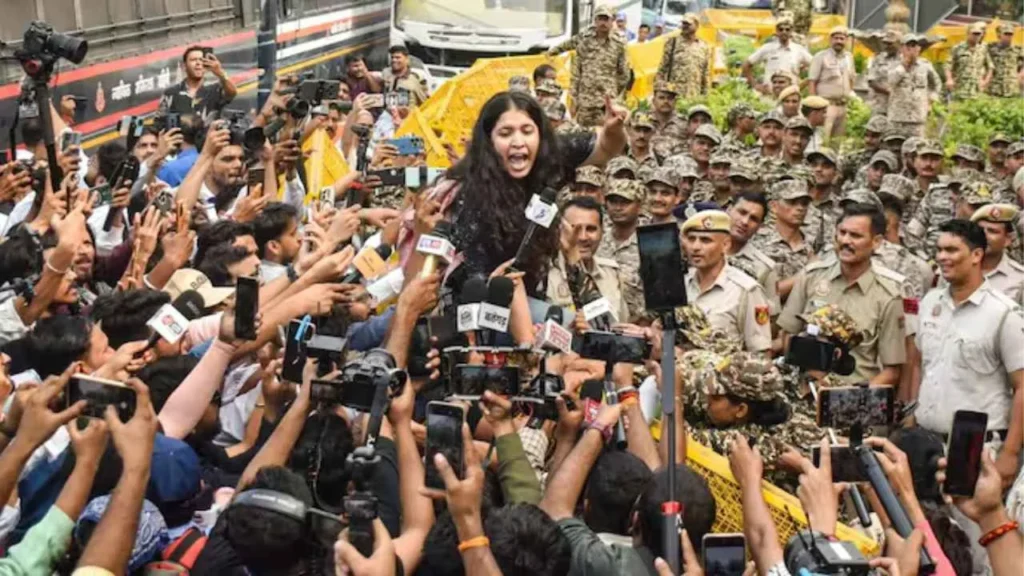
NEW DELHI — Delhi Police on Tuesday, October 13, 2026, detained Cockroach Janata Party (CJP) leaders Ashutosh Ranka, Saurav Das, and Ajinkya Shinde after they scaled barricades to enter Jantar Mantar and hoist the Indian national flag. The incident unfolded hours after authorities denotified the historic landmark as a designated protest site, triggering sharp condemnation from CJP founder Abhijeet Dipke, who labeled the police action a display of “dictatorial mentality.”
“Our team went to Jantar Mantar this morning and hoisted the tricolor. When did hoisting the tricolor become a violation? Whoever thinks that hoisting the tricolor at Jantar Mantar is a violation is a traitor,” stated CJP founder Abhijeet Dipke while addressing reporters following the detentions.
Escalation at Jantar Mantar: Barricades Breached and Detentions
Early on Tuesday morning, CJP activists arrived at the restricted Jantar Mantar premises carrying the national flag. Video footage posted on social platform X by party leaders showed protesters climbing over iron gates and police barricades to enter the area.
Security forces stationed nearby intervened shortly after the group raised the flag, taking Ranka, Das, Shinde, and several other supporters into custody.
Following their arrest, leaders went live on social media from inside a police transport bus, holding up copies of the Constitution of India and demanding immediate access to legal assistance.
“We hope that the Delhi Police will let them talk to their lawyers. It shouldn’t happen that, as it happened to me, they are kept for 24 hours without being allowed to speak to a lawyer,” Dipke added, calling on law enforcement to strictly adhere to established legal safeguards.
Policy Shift: Delhi Police Denotifies Historic Protest Hub
The high-voltage confrontation directly follows a structural change in how public demonstrations are managed in the national capital. On Monday, October 12, 2026, Delhi Police Commissioner Anurag Kumar issued an order removing Jantar Mantar from the official list of authorized demonstration sites.
The decision came on the recommendation of a specialized committee constituted by the Union Ministry of Home Affairs (MHA) to evaluate alternative locations for public gatherings. The formal order partially modifies Standing Order No. L&O/48/22 (dated April 28, 2022).
| Venue Name | Location | Purpose / Type |
|---|---|---|
| 1. RAMLILA GROUND | Central Delhi | Large-scale rallies & marches |
| 2. BURARI GROUND | North Delhi | Mass assemblies & conventions |
| 3. CBD GROUND | East Delhi | Regional demonstrations |
Delhi Police stated that a revised Standard Operating Procedure (SOP) governing assemblies across these three newly assigned locations will be published separately.
Core Political Driver: The Controversial SIR Exercise
The standoff at Jantar Mantar is part of an escalating national political campaign centered on electoral integrity. The CJP, supported by broader opposition coalitions including the INDIA bloc, has been demanding the immediate resignation of Chief Election Commissioner (CEC) Gyanesh Kumar.
The agitation stems from alleged widespread irregularities during the Election Commission of India’s (ECI) Special Intensive Revision (SIR) of electoral rolls. Critics allege that procedural changes introduced in Form 6 and Form 7 during the drive led to arbitrary voter deletions and created unnecessary hurdles for first-time voters.
Legal and Civil Rights Analysis: Public Space vs. Public Order
The denotification of Jantar Mantar highlights a growing tension between state security protocols and fundamental constitutional rights under Article 19(1)(a) and Article 19(1)(b), which guarantee freedom of speech and peaceful assembly.
While administrative authorities cite municipal management, traffic control, and public order concerns in Central Delhi, civil society organizations argue that relocating protests to outlying grounds like Burari diminishes the visibility and effectiveness of citizen-led grievances.
“The dictatorship doesn’t want anyone to go to Jantar Mantar and hoist the tricolor. They think the whole country is their personal property. Jantar Mantar belongs to the people of this country, the 140 crore Indians,” argued Dipke, asserting that the movement will persist regardless of spatial bans.
Frequently Asked Questions (FAQs)
Why were Cockroach Janata Party (CJP) leaders detained at Jantar Mantar?
Ashutosh Ranka, Saurav Das, and Ajinkya Shinde were detained by Delhi Police after climbing over security barricades to enter Jantar Mantar and hoist the national flag at a site recently denotified for protests.
Why was Jantar Mantar removed as a designated protest site?
Delhi Police Commissioner Anurag Kumar issued an order based on Union Home Ministry committee recommendations to shift public demonstrations to alternative locations across the capital.
What are the new designated protest sites in Delhi?
The three officially recognized locations for public demonstrations and protests in Delhi are now Ramlila Ground (Central Delhi), Burari Ground (North Delhi), and CBD Ground (East Delhi).
What are the primary political demands behind the CJP protest?
The CJP and allied opposition groups are demanding the resignation of Chief Election Commissioner Gyanesh Kumar over alleged voter list deletions during the ECI’s Special Intensive Revision (SIR) exercise.
Did CJP leaders receive access to legal counsel after detention?
Party leaders publicly urged Delhi Police to grant detained members immediate access to their legal counsel, alleging that previous detentions involved hold times without legal access.
Analytical Summary & Future Outlook
The clash over Jantar Mantar marks a crucial turning point in institutional protest management in New Delhi. By officially denotifying the site, the government aims to centralize control over public gatherings. However, the willingness of groups like the CJP to breach barricades and raise symbolic emblems signals that spatial bans may escalate political friction rather than suppress it.
Moving forward, legal challenges are expected regarding the constitutional validity of restricting assemblies to designated peripheral zones. With the CJP promising continued demonstrations until their electoral demands are met, the conflict between law enforcement orders and public demonstrations remains far from resolved.


Manish Kumar began his professional journey in digital marketing and performance marketing, and currently works as a Digital Marketing Excutive and SEO expert. With over 3 years of professional experience, he handles both strategy and execution. Currently, he manages digital marketing and performance marketing at ‘Shabd Sanchi’ (shabdsanchi.com).