




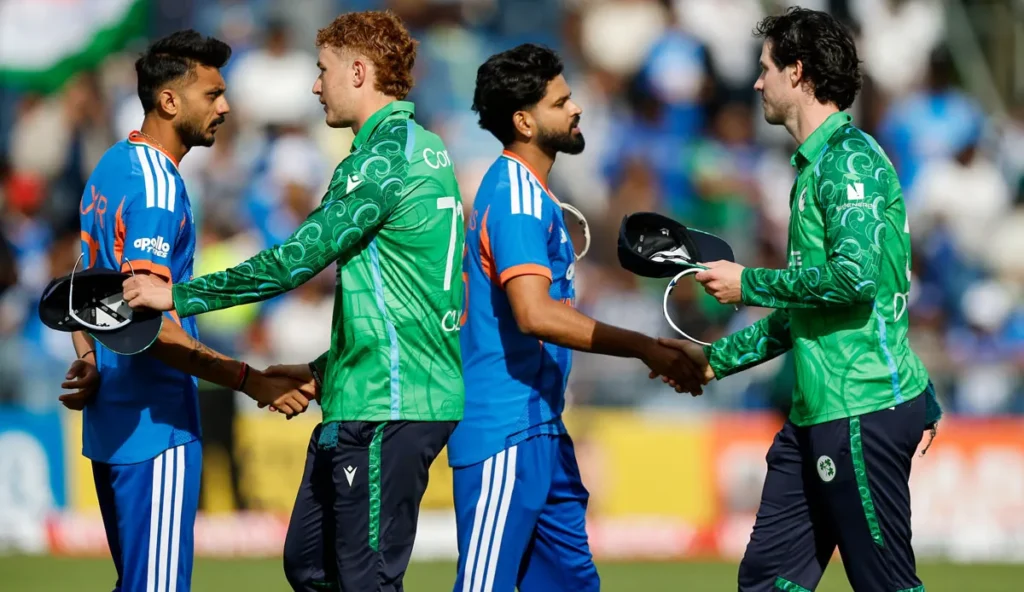
Ireland T20 Whitewash: In the history of Indian cricket, some defeats do more than just enter the record books—they expose systemic flaws and challenge the team’s core approach. The shocking 2-0 T20I series whitewash against Ireland in Belfast is exactly one such moment. India, a two-time T20 World Champion, was humbled twice in three days by a resilient Irish side.
The defeat has left Indian cricket fans in absolute disbelief. Assistant coach Ryan ten Doeschate pulled no punches either, admitting that the Indian players completely failed to adjust to the local playing conditions. Let’s dive into a practical, logical analysis of where exactly Team India faltered.
The Belfast Shock: A Stunning Defeat for the Two-Time World Champions
Before the series commenced, hardly any cricket pundit or fan gave Ireland a realistic chance. Yet, Lorcan Tucker’s inspired Irish team thoroughly outclassed a formidable-looking Indian lineup in every department of the game.
Ireland did not just stumble into these victories; they tactically exposed the vulnerabilities that often stay hidden when India plays on flat, batting-friendly home decks. This capitulation serves as a reminder that international cricket is never won on paper or reputation—it is decided by on-day planning and execution.
A Grim Start for Shreyas Iyer’s Captaincy
This series was supposed to be a golden opportunity for Shreyas Iyer, marking his debut as India’s 20-overs captain. Instead, it turned into an unforgettable nightmare that he will want to erase from his memory as quickly as possible.
As a leader, Iyer looked devoid of aggressive tactical answers on the field, and as a batsman, he failed to anchor the innings when the team was in freefall. When the batting order collapsed, there was a noticeable absence of a ‘Plan B’ to counter the hostile conditions. For a new captain, this series is a harsh lesson in the sheer mental resilience required to lead at the international level.
Ryan ten Doeschate’s Hard Truth: Indian Batsmen Failed to Adapt
Post-match, assistant coach Ryan ten Doeschate bypassed standard diplomatic platitudes to pinpoint the exact reason for the debacle. He pointed the finger squarely at the batsmen’s lack of adaptability.
“Our biggest failure was our inability to read the pitches and the ground dimensions in Belfast. If you don’t adapt to local conditions quickly at the international level, this is exactly the result you get.” — Ryan ten Doeschate
Spicy Pitches and Large Boundaries: The Achilles’ Heel of Indian Batting
The pitches in Belfast were undeniably “spicy,” offering extra seam movement, swing, and unpredictable bounce for the fast bowlers. Indian batsmen, heavily accustomed to planting their front foot and hitting through the line on predictable tracks, looked completely at sea against the moving ball.
Furthermore, Belfast features significantly larger boundary dimensions. Instead of rotating the strike and finding gaps—which is crucial on big grounds—Indian batsmen repeatedly threw their wickets away attempting to clear the fence without proper timing.
The IPL Mindset vs International Reality
A bitter pill must be swallowed here: the comfort of flat IPL tracks and short boundaries has seemingly compromised the technical footwork of modern Indian batsmen. In the IPL, even a mistimed hit frequently flies over the rope for a six. In Belfast, attempting the same shots without pristine timing meant hitting the ball straight into the hands of the boundary fielders. The batsmen failed to bridge the gap between franchise comfort and international reality until it was too late.
A Wake-Up Call Ahead of the England Tour: What’s Next?
The psychological impact of this whitewash is severe, particularly given its timing. India is scheduled for a crucial tour of England, where conditions closely mirror those found in Ireland—heavy swing, seam movement, and pace-friendly pitches.
If the Indian think-tank fails to learn from this disaster, the outcome in England could be even more damaging. The team management must look beyond just technical drills and address the players’ mental approach to ensure they do not panic when confronted with challenging, unfamiliar environments.
Read Also: PM Modi Cabinet Reshuffle: Shaktikanta Das Tipped for Finance Minister in Major Modi 3.0 Overhaul
Conclusion
The 2-0 defeat to Ireland is a stark reality check for Team India. It proves that no team can rely solely on past glories or star power to remain invincible. To sustain status as a world-class unit, a team must possess the tactical flexibility to adapt to any country, pitch, or climate. For Shreyas Iyer and the team management, this is the definitive moment to self-reflect, discard outdated approaches, and completely reboot their overseas strategy.
Frequently Asked Questions (FAQs)
Q1. Where was the India vs Ireland T20I series played?
The entire two-match T20I series was played in Belfast, Northern Ireland.
Q2. Who captained the Indian team during the T20 series against Ireland?
Shreyas Iyer made his debut as India’s T20I captain during this series.
Q3. What did assistant coach Ryan ten Doeschate state as the primary reason for the loss?
He attributed the series loss directly to India’s failure to adapt to local playing conditions, specifically the swing-friendly pitch and the larger ground dimensions.
Q4. Why was the Belfast pitch described as ‘spicy’?
In cricket terminology, a ‘spicy pitch’ refers to a surface that offers significant assistance to fast bowlers in the form of extra swing, seam movement, and uneven bounce, making it highly challenging for batsmen.
Q5. How does this defeat impact India’s upcoming cricket schedule?
This whitewash serves as a critical wake-up call right before the England tour. If Indian batsmen do not rapidly improve their technique against the moving ball, they face similar struggles in English conditions.
For more information, follow Shabdsanchi‘s social media pages today and stay updated.
- Facebook: shabdsanchi
- Instagram: shabdsanchiofficial
- YouTube: @shabd_sanchi
- Twitter: shabdsanchi