

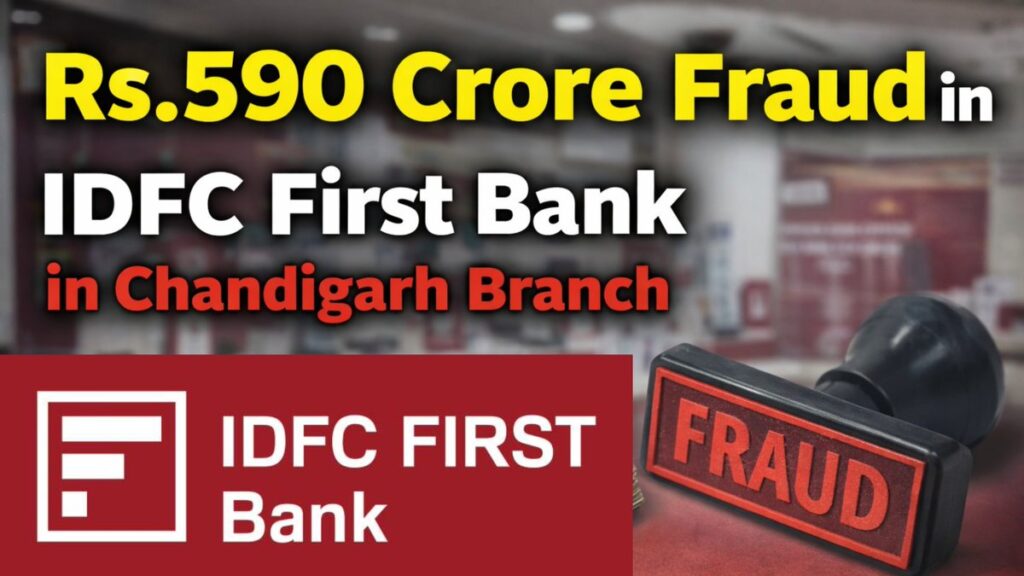
The IDFC First Bank Rs 590 crore fraud case has emerged as one of the most significant operational failures in recent private banking history. Centered around the bank’s Chandigarh branch, the incident involves unauthorized transactions in accounts belonging to various Haryana government departments. This breach has not only wiped out over Rs 14,000 crore in market capitalization but has also raised serious questions about internal oversight and audit mechanisms.
Understanding the IDFC First Bank Rs 590 Crore Fraud Case
The controversy came to light on February 21, 2026, when IDFC First Bank officially informed the stock exchanges about “unauthorized and fraudulent activities” at its Chandigarh branch. The issue was discovered during a routine fund transfer request, revealing a massive gap between the bank’s records and the customer’s actual holdings.
1. The Trigger: A Routine Closure Request
The fraud was unmasked when a specific department of the Haryana Government requested the bank to close its account and transfer the remaining funds to another institution. During the processing of this request, bank officials noticed that the balance mentioned by the department was significantly higher than what was reflected in the bank’s internal systems. This single discrepancy acted as a whistleblow, prompting an immediate internal audit.
2. Scale of the Discrepancy
As the bank began reconciling other government-linked accounts at the same branch, more mismatches surfaced. According to the regulatory filing, the total amount currently under reconciliation is approximately Rs 590 crore. To put this in perspective, the fraud amount is larger than the bank’s entire net profit of Rs 503 crore for the third quarter (Q3 FY26), highlighting the severity of the financial hit.
3. Modus Operandi: Internal Collusion
Preliminary investigations suggest that the fraud was not a technical glitch but a result of internal collusion. V. Vaidyanathan, MD & CEO of IDFC First Bank, stated that some employees at the Chandigarh branch likely connived with external third parties. These individuals reportedly used forged cheques and fraudulent authorization letters to siphon off funds manually, bypassing the bank’s standard digital safeguards.
4. Immediate Suspension of Staff
In an effort to contain the damage and ensure a fair probe, IDFC First Bank has placed four branch officials under immediate suspension. These employees are suspected of being directly involved in the unauthorized movement of government funds. The bank has made it clear that it will pursue strict criminal and civil action against all internal and external perpetrators.
5. Independent Forensic Audit by KPMG
While the bank’s internal team is working on the reconciliation, the board has engaged KPMG to conduct a comprehensive independent forensic investigation. This audit is expected to trace the money trail, identify the end beneficiaries, and uncover how the ‘maker-checker’ protocol—a standard banking safety net—was so effectively compromised over a period of time.


Government Backlash and Market Fallout
6. Haryana Government’s Decisive Action
The fallout has been swift from the client’s side. The Haryana Government has de-empanelled IDFC First Bank (along with AU Small Finance Bank) for all state business with immediate effect. A circular issued by the State Finance Department has directed all departments, boards, and corporations to close their accounts with these private lenders and move their funds to nationalized (public sector) banks.
7. Impact on Investor Wealth
The market’s reaction was nothing short of a bloodbath. On Monday, February 23, 2026, shares of IDFC First Bank crashed by 20%, hitting the lower circuit. This massive sell-off resulted in an erosion of investor wealth exceeding Rs 14,000 crore in a single trading session. Investors are particularly concerned about the governance lapse and the potential for higher provisioning in the upcoming quarter.
8. The “Isolated Incident” Defense
Despite the scale, CEO V. Vaidyanathan has maintained that the IDFC First Bank Rs 590 crore fraud case is an isolated event. He emphasized that the bank has over 1,000 branches and has operated for a decade without such an incident. According to the management, this is a “branch-level compromise” and not a structural or system-wide failure of the bank’s technology.
9. Recovery and Lien-Marking Efforts
The bank is currently in the process of recovering the stolen funds. It has sent “recall requests” to various beneficiary banks where the fraudulent amounts were transferred. By asking these banks to mark a “lien” on the suspicious accounts, IDFC First Bank hopes to freeze the money and eventually reverse the transactions. The final financial impact on the bank’s balance sheet will depend heavily on the success of these recoveries.
10. Brokerage Outlook and Future Scrutiny
Global brokerages like UBS and Morgan Stanley have adjusted their outlook for the stock. While the fraud represents only about 1% of the bank’s net worth, it could impact the FY26 profit before tax by nearly 20%. Analysts warn that the stock may remain under pressure until the forensic audit is completed and the bank provides a clear assurance that no other branches or account types are affected.
To learn more, follow Shabdsanchi’s social media pages today and stay updated.
- Facebook: shabdsanchi
- Instagram: shabdsanchiofficial
- YouTube: @shabd_sanchi
- Twitter: shabdsanchi