


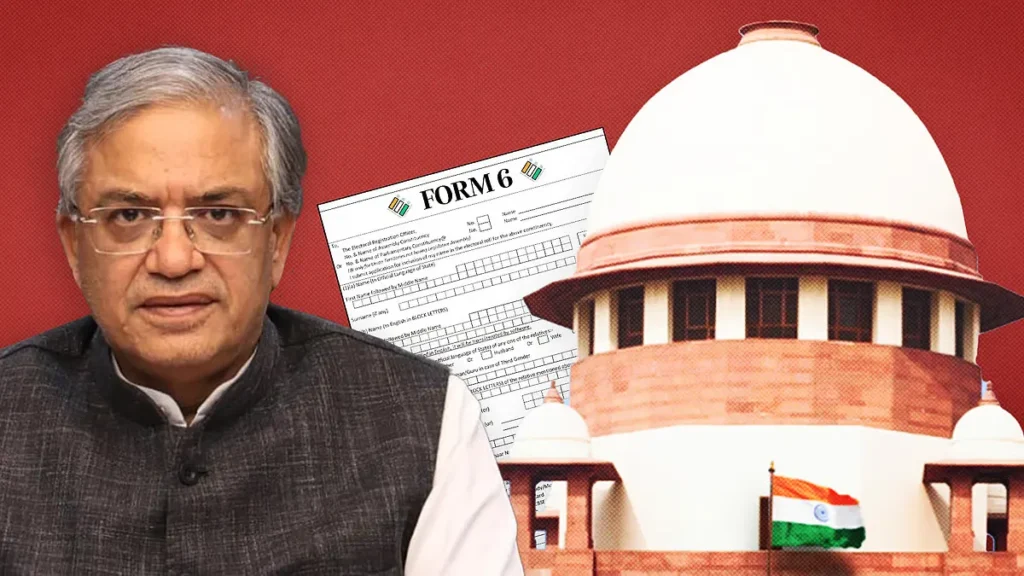
NEW DELHI — Chief Justice of India Surya Kant clarified on October 5, 2026, that the Supreme Court has not approved any modifications to Form 6 used for new voter registrations. Hearing a petition filed by Shailendra Mani Tripathi challenging the Election Commission of India’s (ECI) unilateral procedural additions during the Special Intensive Revision (SIR) 2026, the three-judge bench sought an authenticated record from the poll panel.
The Core Conflict: What Triggered the Judicial Scrutiny?
The political and legal clash centers on the operational rollout of SIR 2026, the first nationwide intensive electoral roll overhaul conducted since the 2002–2004 cycle. Designed to eliminate duplicate entries and ghost voters through Self-Mapping and Progeny Mapping, the ECI attached an extra mandatory Declaration Form to the statutory Form 6 on its digital portal ECInet.
STANDARD FORM 6 (Rules, 1960)
- Name, Age, Address Proof
- Statutory Declaration under Law
- Direct Submission on Portal
SIR 2026 ATTACHED DECLARATION
- Parent/Grandparent Voter Mapping
- Mandatory Ancestral Verification
- Enforced Digital Gatekeeping
The dispute escalated when the ECI issued a press release on September 26, 2026, claiming the Supreme Court’s prior judgment in May 2026 had validated its authority to attach this mandatory declaration. Rejecting this claim directly from the bench, CJI Surya Kant—alongside Justices Joymalya Bagchi and V. Mohana—stated:
“Any modified Form 6 has not been approved by us. Let’s be very clear. When the record is produced, we would like to see who has modified it.”
Legal Ambiguity: Rule-Making Authority vs Residual Powers
The debate exposes a critical constitutional boundary between statutory rules and executive discretion:
- The Statutory Constraint: Under the Registration of Electors Rules, 1960, any structural alteration to statutory forms like Form 6 requires formal legislative amendments or executive notification via government authorization.
- The ECI’s Defense: The poll panel cited its residual powers under Article 324 of the Constitution, arguing that intensive revisions authorize additional verification protocols to preserve electoral purity.
- Internal Dissent: Leaked internal communications revealed that Election Commissioner Sandhu recorded on August 13, 2026, that the additional declaration was “unauthorised and illegal,” ordering its withdrawal after finding it harassed young, eligible voters.
The petition alleges that Chief Election Commissioner Gyanesh Kumar acted unilaterally without the full commission’s consensus, violating statutory procedures under the Election Commission (Conditions of Service of Election Commissioners and Transaction of Business) Act.
Ground Reality: Exclusions and Administrative Friction
While intended to clean voter lists, the mandatory declaration created severe access barriers on the ground, particularly across rural belts and for young first-time voters:
Applicants who could not furnish parent or grandparent electoral details from historical SIR rolls found their applications stalled or rejected online through ECInet. Following mounting public outcry, the ECI silently removed the attached declaration from ECInet on September 30, 2026, in states where the SIR process had concluded, while retaining it in ongoing revision zones.
Political Fall-out and Opposition Mobilization
The CJI’s observations triggered immediate political friction in New Delhi:
- Parliamentary Protests: Opposition leaders, led by Rahul Gandhi, organized marches toward Nirvachan Sadan, accusing the poll panel of disenfranchising lakhs of young citizens without legislative authority.
- Nationwide Demonstrations: Grassroots political groups announced planned marches to Delhi by October 10, 2026, demanding accountability for administrative overreach.
- Demands for Personal Liability: Petitions before the apex court seek to strip immunity from ECI officials, alleging that unauthorized form alterations constitute personal administrative overreach.
Frequently Asked Questions (FAQs)
Did the Supreme Court strike down Form 6 completely?
No, the Supreme Court did not strike down Form 6 itself; it clarified that it had never approved any unauthorized modifications or extra declarations added to Form 6 by the Election Commission.
Why did the Election Commission add a Declaration Form to Form 6 during SIR 2026?
The Election Commission introduced the supplementary declaration to perform self-mapping and progeny mapping to eliminate duplicate and non-citizen entries during the intensive revision.
Is the additional declaration form still required on ECInet?
The ECI removed the additional declaration from ECInet on September 30, 2026, for states where SIR 2026 concluded, though procedural status remains contested in active revision states.
What is the statutory basis for changing voter registration forms in India?
Voter registration forms are governed by the Registration of Electors Rules, 1960, and any formal structural modification requires legislative amendment or statutory notification.
What happens next in the Supreme Court case?
The Supreme Court has ordered the ECI to submit authenticated records detailing who authorized the Form 6 modifications, after which the bench will decide whether to annul the changes.
Long-Term Implications & What Happens Next
The Supreme Court’s intervention marks a pivotal moment for electoral governance in India. By demanding authenticated records of internal ECI decision-making, the apex court has reasserted that administrative expediency under Article 324 cannot bypass statutory frameworks like the Registration of Electors Rules, 1960.
If the court finds that the Form 6 alterations were executed without commission-wide unanimity or statutory backing, it may annul all arbitrary rejections issued during the SIR 2026 drive. Such a ruling would establish a strict legal precedent: ensuring that voter roll cleanup operations prioritize voter inclusion over administrative hurdles, safeguarding the constitutional rights of first-time electors nationwide.


Manish Kumar began his professional journey in digital marketing and performance marketing, and currently works as a Digital Marketing Excutive and SEO expert. With over 3 years of professional experience, he handles both strategy and execution. Currently, he manages digital marketing and performance marketing at ‘Shabd Sanchi’ (shabdsanchi.com).