


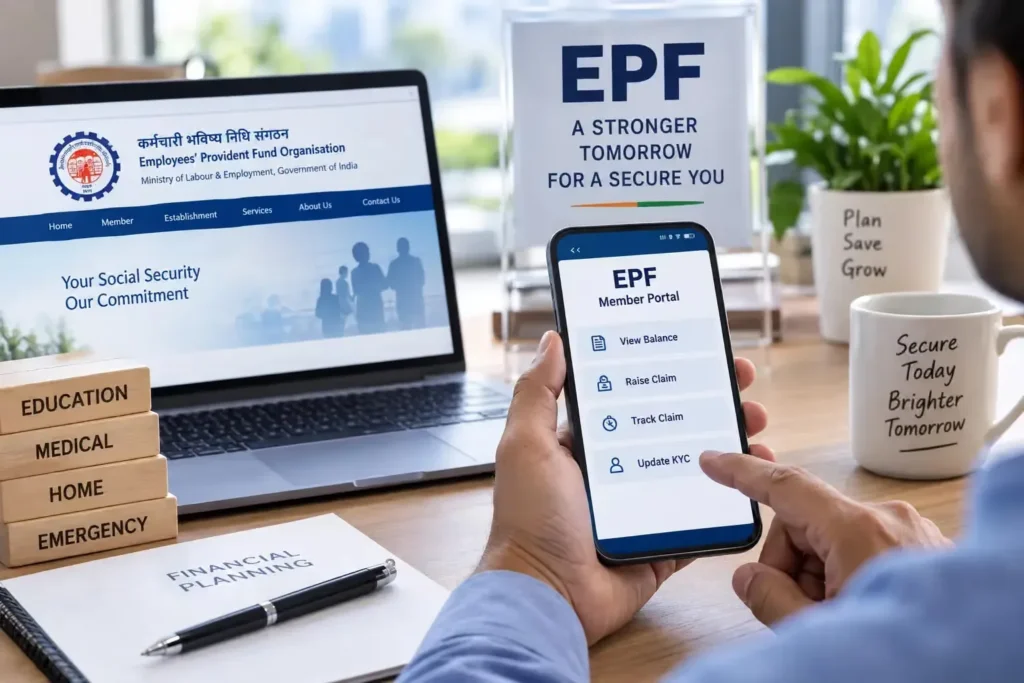
The Employees’ Provident Fund Organisation (EPFO) has streamlined partial withdrawal provisions under the updated Employees’ Provident Funds Scheme framework. Eligible members can now access up to 75% of their eligible Provident Fund (PF) balance for essential life requirements while retaining 25% as an compounding safety net for retirement.
“The 2026 partial withdrawal framework simplifies complex sub-rules into clear categories—Essential, Housing, and Special Needs—while protecting 25% of the member’s eligible balance to ensure long-term wealth compounding.”
What Changed in the EPFO Partial Withdrawal Framework?
Prior to these provisions, subscribers navigated fragmented guidelines, varying service tenure mandates, and complex paperwork for different emergencies. The updated structure consolidates partial advance applications into three core operational categories:
- Essential Needs: Covers medical emergencies, higher education, and marriage.
- Housing Needs: Covers plot purchase, home construction, property renovation, and home loan repayment.
- Special Needs: Covers unemployment, sudden financial difficulties, and non-attributable emergency situations.
Additionally, the minimum service eligibility for most partial advances has been streamlined to 12 months of continuous membership, significantly reducing the wait time compared to older multi-year mandates.
The 75% Cap and 25% Reserve Rule: Practical Calculation
Under the updated guidelines, eligible subscribers are permitted to withdraw a maximum of 75% of their eligible PF balance as a non-refundable advance. The remaining 25% must remain locked in the account to preserve retirement security.
The 25% threshold is calculated on the eligible member balance (accumulated employee and employer contributions plus accrued interest). Retaining this quarter balance ensures members continue earning annual interest—currently 8.25%—allowing their core savings to benefit from long-term compounding.
Category-Wise Withdrawal Limits, Frequency, and Tenure Requirements
While 75% represents the outer boundary for partial advances, actual approved amounts depend on category-specific caps and membership duration:
| Reason for Advance | Minimum Service Required | Permissible Limit | Maximum Allowed Frequency |
|---|---|---|---|
|
Medical Emergency (Self/Dependents) |
12 Months | Up to 100% of eligible balance (or 6 months basic + DA) | 3 times per financial year |
|
Higher Education (Self/Children) |
12 Months | Up to 100% of eligible balance (50% of employee share) | Up to 10 times in total tenure |
|
Marriage (Self/Children/Siblings) |
12 Months | Up to 100% of eligible balance (50% of employee share) | Up to 5 times in total tenure |
|
Housing (Purchase/Construction) |
12 Months | Up to 100% of eligible balance | Up to 5 times in total tenure |
| Unemployment (1 Month) | 1 Month Unemployment | Up to 75% of total balance | 1 time per job loss episode |
Note: Withdrawal counters reset under the updated framework rules, allowing long-standing subscribers clean limits going forward.
Unemployment and Full Settlement Guidelines
For members facing job separation, the updated rules establish a clear two-stage withdrawal mechanism:
- After 1 Month of Unemployment: The subscriber can immediately claim up to 75% of their total accumulated balance to meet liquid expense needs.
- After 12 Months of Continuous Unemployment: The member becomes eligible to submit a Form 19 final settlement to claim the remaining 25% balance and close the account.
However, if an individual transitions to a new job rather than remaining unemployed, mandatory account transfer via Universal Account Number (UAN) remains required rather than full liquidation.
Analytical Value Addition: Compounding Loss vs. Short-Term Liquidity
While easier access to 75% of PF reserves offers immediate financial relief during emergencies, subscribers must weigh the long-term opportunity cost.
An advance of ₹3,00,000 taken early in a career (e.g., at age 30) deprives the subscriber of compound growth over 28 years. At an average annual EPFO interest rate of 8.25%, that single ₹3,00,000 withdrawal reduces the final retirement pool at age 58 by over ₹27,50,000.
Strategic Takeaway: Treat partial advances as an emergency option rather than a routine cash source. Utilize the expanded Essential Needs provision for non-negotiable emergencies (such as medical crises) while preserving housing and special advance limits wherever possible.
How to Apply for EPFO Partial Withdrawal Online
Subscribers with active Universal Account Numbers (UAN) and completed KYC verification (Aadhaar, PAN, and Bank Account linked) can submit claims via the EPFO Unified Member Portal:
- Log in to the EPFO Unified Member Portal using your UAN and password.
- Navigate to ‘Online Services’ and select ‘Claim (Form-31, 19 & 10C)’.
- Authenticate your registered bank account by entering the last 4 digits.
- Select Form 31 (PF Advance) from the dropdown list.
- Choose the purpose under Essential, Housing, or Special Needs, enter the desired amount, and upload Form 15G/15H if service is under 5 years.
- Submit via Aadhaar OTP authentication.
Eligible auto-settlement claims up to ₹5,00,000 are processed via automated IT pipelines, with funds credited to bank accounts within 3 working days.
Frequently Asked Questions (PAA)
Can I withdraw 75% of my PF balance while still working in a job?
Yes, employed members can withdraw up to 75% of their eligible PF balance as a non-refundable advance for approved essential, housing, or medical needs.
Is EPF partial withdrawal subject to TDS tax deduction?
No TDS is deducted on partial PF advances if total service exceeds 5 years or if the withdrawal amount is below ₹50,000.
Why does the EPFO portal limit my withdrawal to less than 75%?
The portal displays a lower available limit if previous advances reduce your balance or if you have not met specific categorical tenure thresholds.
How many times can I take a PF advance for medical emergencies?
Under the updated 2026 rules, members can submit medical emergency partial withdrawal claims up to 3 times per financial year.
What is the minimum service period required for a housing PF advance?
The minimum service requirement for housing-related partial advances is 12 months of continuous EPFO membership.
Conclusion & Long-Term Outlook
The updated EPFO partial withdrawal framework reflects a modern approach to worker social security. By lowering service thresholds to 12 months and implementing automated 3-day settlement pipelines, the Ministry of Labour and Employment has provided vital liquidity to India’s formal workforce.
However, the mandatory 25% retention mandate serves as an essential guardrail against total account depletion. Moving forward, salaried employees should treat the 75% cap as a backstop for genuine crises rather than dynamic savings, balancing short-term cash needs against their long-term wealth targets.


Manish Kumar began his professional journey in digital marketing and performance marketing, and currently works as a Digital Marketing Excutive and SEO expert. With over 3 years of professional experience, he handles both strategy and execution. Currently, he manages digital marketing and performance marketing at ‘Shabd Sanchi’ (shabdsanchi.com).