

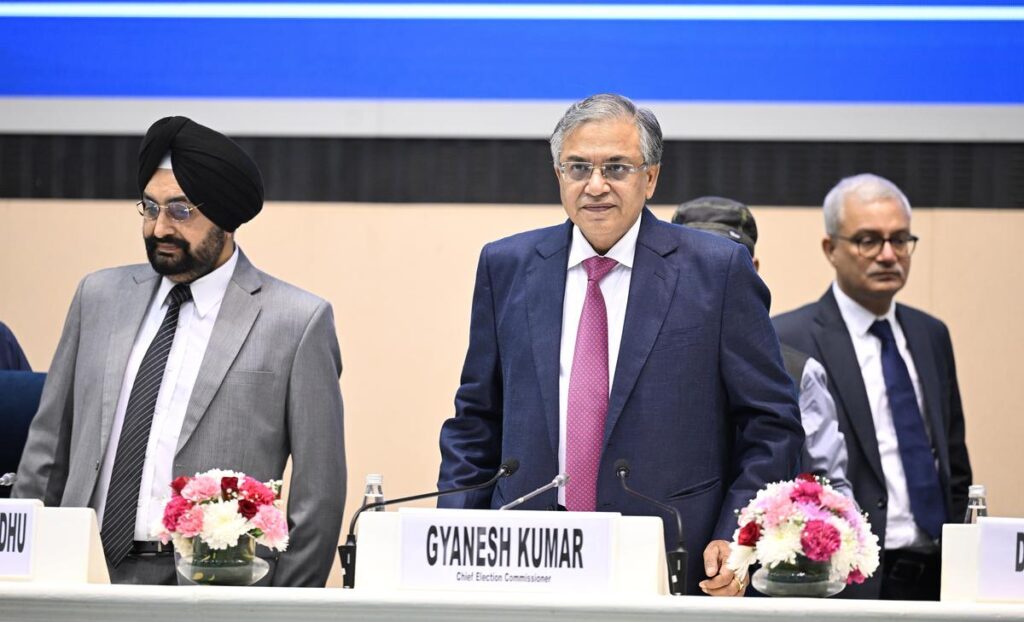
The Election Commission of India (ECI) has submitted a nearly 250-page joint counter-affidavit before the Supreme Court, asserting that Chief Election Commissioner (CEC) Gyanesh Kumar cannot be restrained from functioning or ousted from office except through the formal procedure applied to a Supreme Court judge.The joint filing—approved by CEC Gyanesh Kumar and Election Commissioners Sukhbir Singh Sandhu and Vivek Joshi—flatly rejected allegations of unilateral decision-making and procedural violations during the ongoing Special Intensive Revision (SIR) of electoral rolls.
ECI Rejects Unilateral Action Charges in 250-Page Affidavit
The counter-affidavit came in response to petitions filed by Opposition leaders and public interest litigants challenging the administrative functioning of the poll panel. The petitioners had urged the top court to suspend the CEC and declare decisions regarding the SIR exercise invalid, alleging that critical administrative directives were issued unilaterally without the consensus of the full Commission.
Refuting these charges, the ECI stressed that decisions within the multi-member constitutional body adhere strictly to collegial protocols.
“Decisions are first sent to one Election Commissioner and then to the other Election Commissioner and then finally to the CEC. Such approved decisions of the EC are duly noted in the files concerned… and bear the signature of the Election Commissioners and the CEC,” the affidavit submitted.
The Commission further highlighted that internal file notes, queries, or suggestions expressed by individual Commissioners during deliberations do not constitute final orders. Under Section 18 of the Chief Election Commissioner and Other Election Commissioners (Appointment, Conditions of Service and Term of Office) Act, 2023, decisions are arrived at unanimously or through majority voting.
ECI Clarifies Form 6 Status and West Bengal Appeals
Addressing specific points raised in the petitions, the ECI clarified key operational matters regarding voter registration and ongoing revision exercises:
- No Amendment to Form 6: The poll panel denied modifying statutory Form 6 during the SIR directives of June 24, 2025, October 27, 2025, and May 14, 2026. It explained that the additional mapping declaration format is a supporting document to assist applicants and that only the Central Government holds the legal authority to amend statutory forms.
- 16.10 Lakh Appeals in West Bengal: Responding to queries over 16.10 lakh appeals filed against voter inclusions in West Bengal, the ECI stated these appeals were filed directly by officers under the State Chief Electoral Officer (CEO) acting as statutory authorities under judicial orders.
- July 28 Work Allocation Order: The affidavit addressed an internal July 28 work allocation order issued by an officer on deputation, confirming it was never implemented following prompt joint instructions by the Commissioners on July 30.
Constitutional Safeguards and Removal Procedure
The core of the ECI’s legal defense relies on constitutional protections guaranteed under Article 324(5). The affidavit argued that attempting to suspend or restrain the CEC through judicial interim orders would bypass explicit constitutional safeguards designed to preserve the independence of the election machinery.
Under the statutory framework, a Chief Election Commissioner enjoys security of tenure comparable to a Supreme Court judge and can only be removed by the President of India following an address passed by both Houses of Parliament with a special majority on grounds of proven misbehaviour or incapacity.
The ECI maintained that petitions relying primarily on unverified media reports regarding internal friction fail to meet legal thresholds for maintainability in the top court.
Analytical Summary & Next Steps
The filing of this unified affidavit marks a significant turn in the legal battle surrounding electoral roll management and institutional governance. By presenting a joint front signed by the CEC and both Election Commissioners, the ECI seeks to negate arguments that internal dissent compromised the legitimacy of the SIR exercise.
As the Supreme Court takes up the matter, the primary focus will rest on whether judicial intervention is warranted over internal administrative procedures, or if constitutional immunity insulates the Commission’s decision-making hierarchy from interim restraint.


Manish Kumar began his professional journey in digital marketing and performance marketing, and currently works as a Digital Marketing Excutive and SEO expert. With over 3 years of professional experience, he handles both strategy and execution. Currently, he manages digital marketing and performance marketing at ‘Shabd Sanchi’ (shabdsanchi.com).
Frequently Asked Questions (FAQs)
How can the Chief Election Commissioner (CEC) of India be removed from office?
Under Article 324(5) of the Constitution, the CEC can only be removed from office in the same manner and on the same grounds as a Supreme Court judge, which requires a parliamentary motion passed by a special majority in both Houses.
Was Form 6 amended during the Special Intensive Revision (SIR)?
No, the ECI stated in its Supreme Court affidavit that statutory Form 6 was never amended, as only the Central Government has the authority to alter statutory electoral forms.
What did the ECI say regarding the 16.10 lakh voter appeals in West Bengal?
The ECI clarified that the 16.10 lakh appeals against voter inclusions were filed by officers of the West Bengal Chief Electoral Officer (CEO) in their capacity as statutory authorities under Representation of the People Act provisions and court directions.
For a detailed analysis on how constitutional provisions safeguard the election machinery, watch this coverage on S.I.R Row: Election Commission’s Joint Affidavit to Supreme Court. This video provides helpful visual context on the Election Commission’s submission and the procedural framework governing the Chief Election Commissioner’s tenure.