




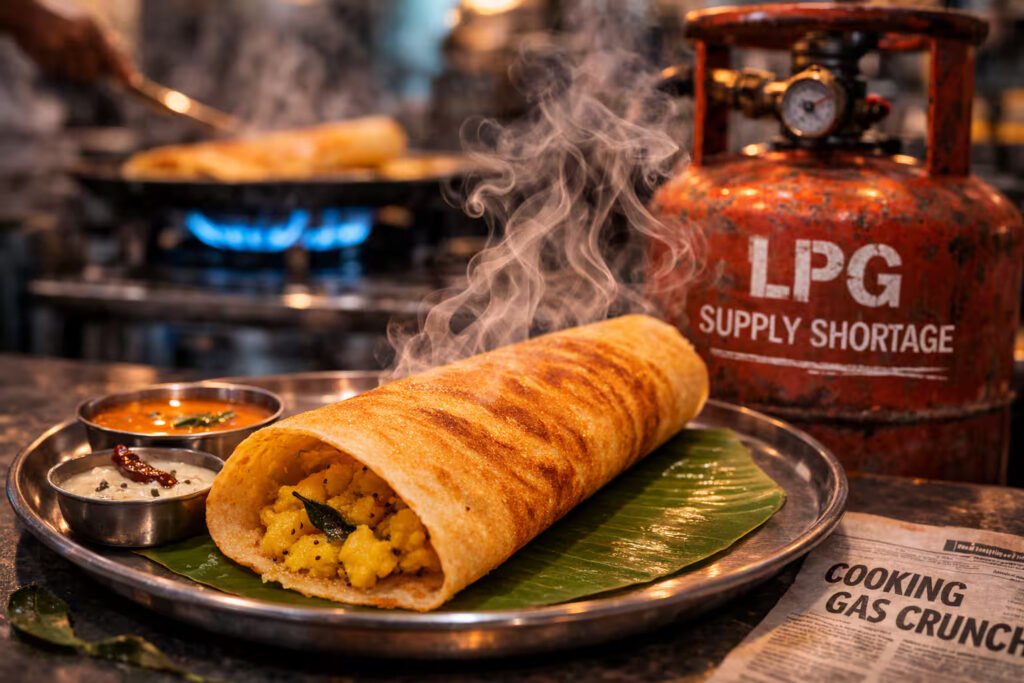
A severe commercial LPG shortage is pushing India’s vibrant restaurant industry into an unprecedented crisis. Driven by escalating geopolitical tensions in the Middle East, this critical fuel deficit has forced many beloved eateries to slash their menus, suspend operations, or revert to traditional wood and coal fires just to keep their kitchens running.
The disruption is not merely a logistical hiccup; it is a profound shock to the hospitality sector’s supply chain. With commercial kitchens across major metros like Chennai, Bengaluru, Kolkata, and Mumbai scrambling for fuel, the crisis highlights the fragile link between global energy security and local businesses.
The Geopolitical Root of the Crisis
The current fuel crunch stems directly from the ongoing US-Israel-Iran conflict, which has severely impacted maritime trade routes. The focal point of this disruption is the Strait of Hormuz. As a narrow passage over which Tehran exerts geographical control, the strait is the primary artery for Middle Eastern energy exports.
India’s reliance on this route is massive. The country imports roughly 62 percent of its total LPG requirements. With domestic consumption showing a steady upward trajectory—peaking at over 31 million tonnes recently—any bottleneck in the Hormuz Strait immediately triggers a domestic supply shock. Approximately 90 percent of India’s imported LPG originates from suppliers like Qatar, the UAE, Saudi Arabia, and Kuwait. With access to these traditional routes now severely compromised, the upstream supply has dwindled rapidly.
Government Strategy: Prioritizing the Domestic Consumer
Faced with a shrinking import pool, the federal government has had to make difficult triage decisions. The Ministry of Petroleum and Natural Gas has explicitly prioritized domestic households over commercial enterprises.
According to recent directives issued to oil refineries, extra production is being strictly diverted for domestic LPG use. To prevent panic buying and black marketing at the household level, the government has increased the waiting period between cylinder bookings from 21 days to 25 days.
For the non-domestic sector, the available imported LPG is being strictly rationed. Essential non-domestic sectors, such as hospitals and educational institutions, have been placed at the top of the priority list. This leaves the hospitality sector—restaurants, hotels, and street food vendors—at the very bottom of the supply chain hierarchy. The Ministry has constituted a committee comprising three Executive Directors of Oil Marketing Companies (OMCs) to review representations for LPG supply to restaurants and other industries, but immediate relief remains elusive.
Eateries Forced into Retro Mode
The reality on the ground is grim. Without access to steady commercial fuel, modern kitchens are stepping back in time. In major metropolitan areas, the shift is already visible. Several commercial kitchens in Chennai and Bengaluru are now burning scrap lumber to maintain basic operations. The situation has forced a drastic re-engineering of restaurant menus. Items that require prolonged cooking times or high-intensity gas flames are being quietly removed.
In Karnataka, the popular Bangalore Thindies—usually bustling with orders for dosa, idli, and complex rice dishes—has reduced its 11-item menu to serving only coffee and tea. In Mumbai, an estimated 20 percent of eateries have temporarily suspended operations entirely due to the unpredictable supply.
The heritage Mughlai restaurant Aminia in Kolkata represents the broader struggle of the sector. Operating with only a few days of cylinder stock left, management has begun utilizing coal and is actively considering a complete switch to traditional solid fuels to avoid shutting down.
The Industry’s Appeal for Intervention
The hospitality industry is fighting back against its classification as a non-essential sector. Earlier this week, the Chennai Hotels Association submitted an urgent plea to the Prime Minister’s Office and the Ministry of Petroleum.
The association argues that the food industry functions as a critical 24×7 support system. Commercial kitchens are responsible for supplying food to hospitals, IT parks, college hostels, and transit hubs. They contend that cutting off their fuel supply indirectly cripples these broader networks, hindering the daily lives of the general public.
The Economic Toll and the Black Market
Where there is scarcity, parallel economies thrive. The commercial LPG shortage has birthed a lucrative black market, further squeezing the already thin profit margins of restaurant owners.
While official prices for a 19-kg commercial cylinder hover around Rs 1,883 in Delhi and up to Rs 2,043 in Chennai, desperate hoteliers in cities like Surat are reportedly paying upwards of Rs 2,200 on the black market to keep their stoves burning. This aggressive spike in operational overheads leaves restaurant owners with a difficult choice: absorb the massive losses, pass the cost onto the consumer through immediate menu price hikes, or shut their doors until the geopolitical storm passes.
As per official statements, the government maintains it is actively monitoring the geopolitical situation and exploring alternative supply mechanisms to stabilize the energy market.
To learn more, follow Shabdsanchi’s social media pages today and stay updated.
- Facebook: shabdsanchi
- Instagram: shabdsanchiofficial
- YouTube: @shabd_sanchi
- Twitter: shabdsanchi