India’s largest private thermal power producer has secured a significant long-term energy contract in Maharashtra. The newly announced Adani Power MSEDCL deal involves supplying 1,600 MW of electricity over a span of 25 years. This strategic agreement strengthens the company’s long-term revenue visibility while actively supporting the growing base-load electricity demands across the state.
Key Details of the Adani Power MSEDCL Deal
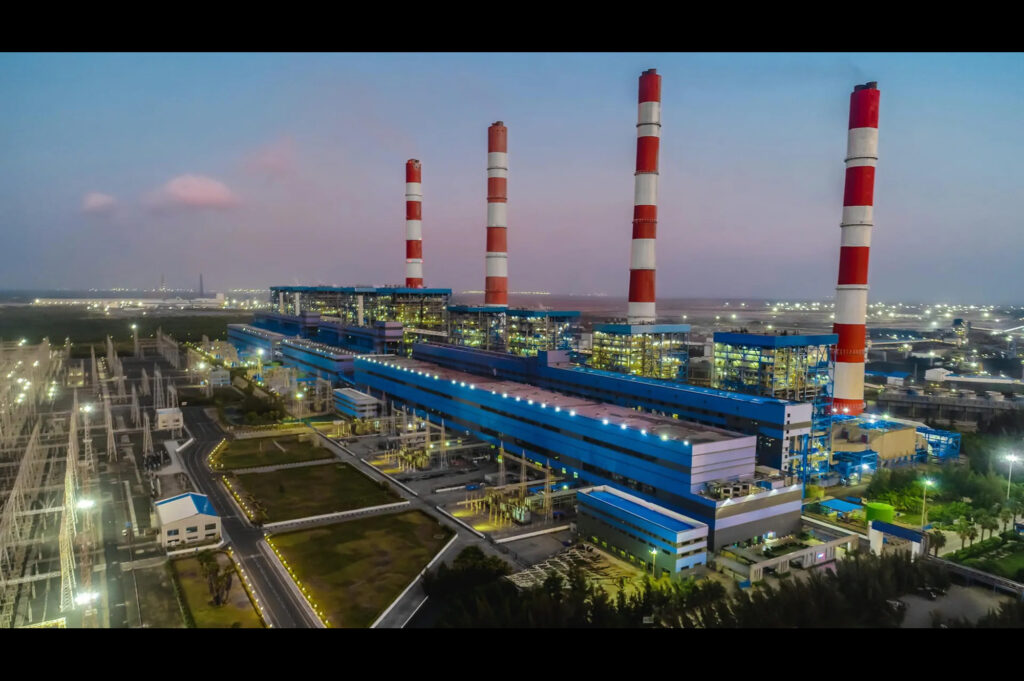
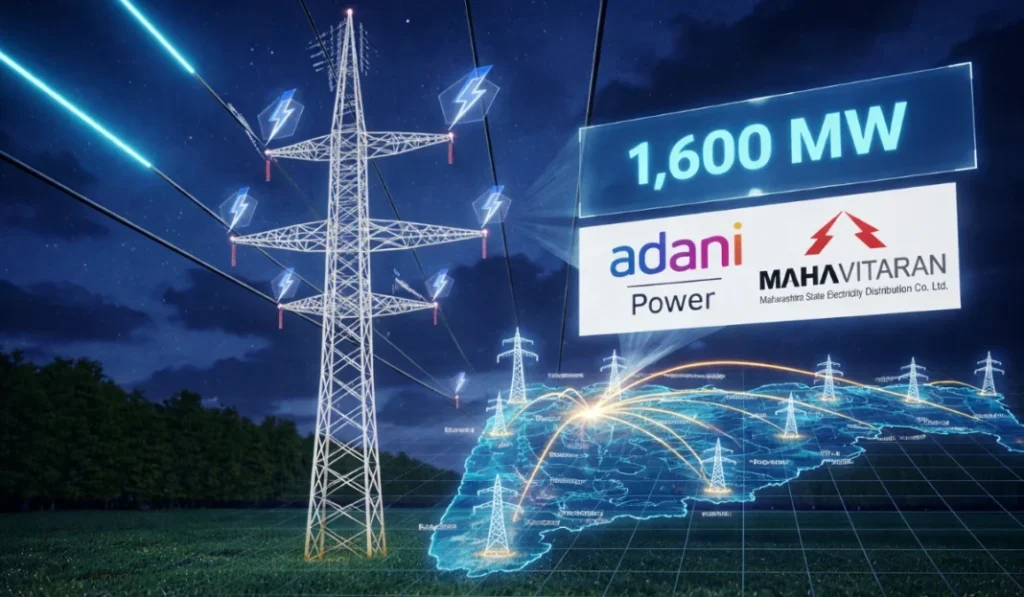
Adani Power Limited (APL) confirmed the receipt of a Letter of Award from the Maharashtra State Electricity Distribution Company Ltd. The state distributor issued this LoA to procure 1,600 MW of consistent power supply. The electricity will be generated from one of Adani Power’s upcoming ultra-supercritical thermal power projects.
This contract will be executed under a formal 25-year Power Supply Agreement (PSA). According to the current timeline, the actual supply of electricity to Maharashtra is scheduled to commence from the financial year 2030-31. Long-term agreements like this provide a stable and predictable revenue stream for power generation companies over multiple decades.
The company secured this massive contract through a highly competitive bidding process. Adani Power emerged as the lowest-tariff bidder among the participants. The winning bid offered electricity at a highly competitive combined tariff of Rs 5.30 per kilowatt-hour (kWh).
Technology and Fuel Security Assurances
A major highlight of this project is the planned use of ultra-supercritical thermal power technology. These advanced plants operate at higher temperatures and pressures compared to traditional subcritical plants. As a result, they consume significantly less coal per megawatt-hour produced, leading to higher efficiency and relatively lower carbon emissions.
Fuel security remains a critical factor for any long-term thermal power commitment. To address this, the MSEDCL bid specifically incorporates a pre-determined coal linkage. This structural guarantee ensures that the generation facility will have uninterrupted access to domestic coal supplies. Consequently, it protects the project from global fuel price volatility and guarantees reliable, cost-effective power generation for Maharashtra consumers.
A Year of Massive Order Wins for APL
The recent Maharashtra contract is not an isolated victory for the power giant. The company is currently experiencing a massive surge in long-term capacity tie-ups. During the current financial year (FY25-26) alone, Adani Power has successfully won five different long-term PSA bids.
When combined, these five recent contracts account for a staggering 10,400 MW of power supply commitments. This winning streak highlights the renewed investment cycle currently underway in India’s thermal power sector. It also underscores the company’s competitive cost structure and its ability to execute large-scale baseload power projects efficiently.
S.B. Khyalia, CEO of Adani Power Ltd, emphasized the importance of these long-term partnerships. He noted that steady capacity addition is absolutely critical to ensuring national energy security. The CEO reiterated the company’s commitment to delivering dependable baseload power to support India’s rapidly growing electricity needs.
Tracking the Two Lakh Crore Expansion Plan
Adani Power is currently executing the largest private-sector thermal power capital expenditure program in India’s history. The company aims to aggressively expand its total generation capacity. The current operational capacity stands at 18.15 GW, but the company plans to scale this up to an impressive 41.87 GW by the financial year 2031-32.
This massive expansion strategy involves estimated investments of approximately Rs 2 lakh crore over the coming years. The company currently has a robust under-implementation pipeline of 23.8 GW. Out of this future pipeline, APL has already tied up 13.3 GW under long-term supply agreements.
Securing off-take agreements before a plant becomes operational drastically reduces the financial risk of new projects. Currently, more than 95 percent of Adani Power’s operational capacity is tied up under medium-to-long-term agreements. Furthermore, over 55 percent of its upcoming capacity is already secured under 25-year contracts.
Economic Impact and Employment Generation
India’s electricity demand continues to rise at a rapid pace. This growth is primarily driven by broader economic expansion, rapid urbanization, industrial growth, and increasing household electrification targets. Reliable baseload power remains the backbone of this economic engine, complementing the intermittent nature of renewable energy sources.
The massive capital expenditure planned by Adani Power is expected to create significant ripple effects across the domestic economy. During the multi-year construction and project execution phase, these upcoming power plants will require vast amounts of raw materials, engineering services, and heavy machinery.
Additionally, these mega-projects are projected to generate employment for tens of thousands of people. The economic stimulus will extend across multiple ancillary sectors, supporting local manufacturing and regional infrastructure development near the plant locations.
To learn more, follow Shabdsanchi’s social media pages today and stay updated.
- Facebook: shabdsanchi
- Instagram: shabdsanchiofficial
- YouTube: @shabd_sanchi
- Twitter: shabdsanchi